
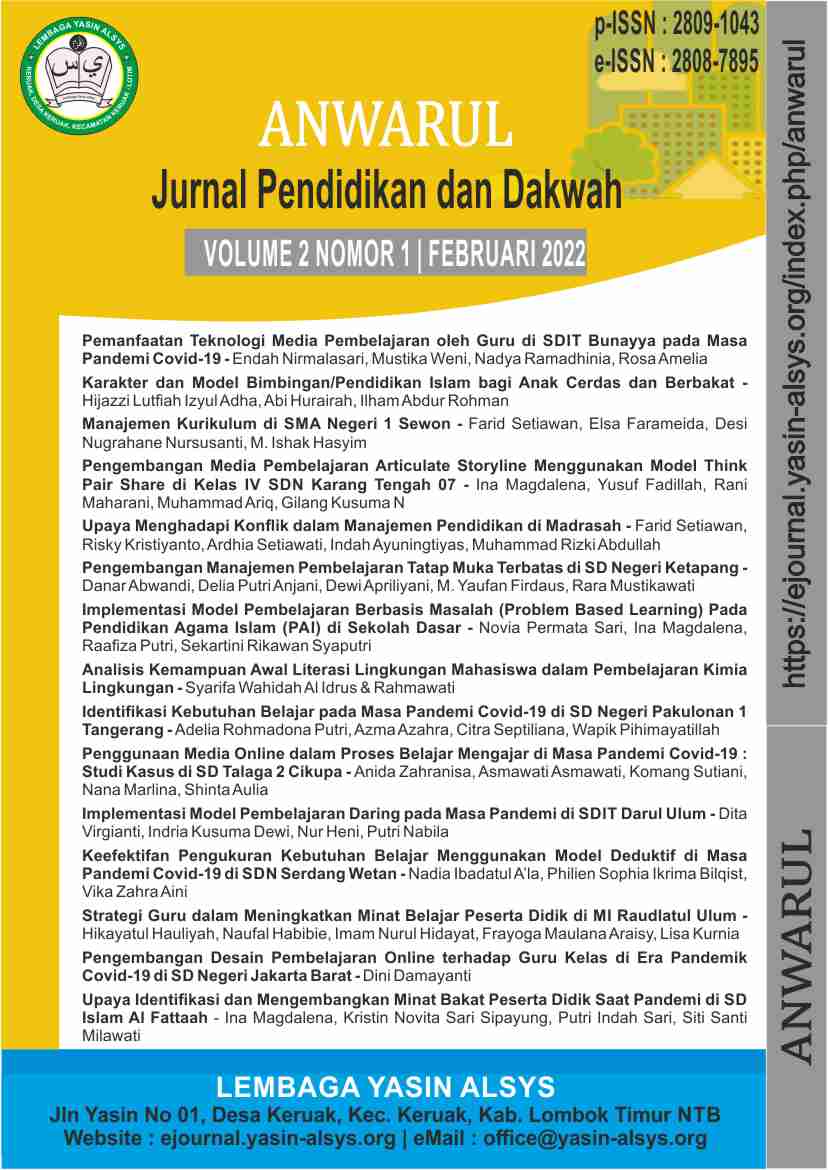
Implementasi Model Pembelajaran Berbasis Masalah (Problem Based Learning) Pada Pendidikan Agama Islam (PAI) di Sekolah Dasar

Article Sidebar
 Page Numbers:
77-98
Page Numbers:
77-98
 Digital Object Identifier:


 Viewed: 1.991 times
 Downloaded: 879 times












LYAS Publisher cordially invites qualified professionals to serve as Editors or Reviewers. Your expertise will make an important contribution to maintaining and strengthening the academic quality of our publications. Interested applicants are kindly requested to complete the application form at the following link: Editors & Reviewers


Please feel free to contact us if you need any further information about the submission process or if you have any additional questions.

 Authors:
Novia Permata Sari1, Ina Magdalena2, Raafiza Putri3, Sekartini Rikawan Syaputri4
 Copyright :
Authors retain copyright and grant the journal right of first publication.
Main Article Content
Abstract
So far, the learning system that occurs in elementary schools is still filled with a world view which states that information is a set of realities that must be remembered. In addition, most of the learning space situation is still centered on the instructor (focused on educators or teachers) as a source of basic information, and the use of speaking techniques as the main decision of the teaching and learning system. Such a learning situation does not include students in making questions. To foster a teaching and learning environment that can foster courage, mentality, and inventive and innovative behavior, it is very important to have a relationship between the parts of the training, such as instructors, students, educational plans, apparatus (learning media) and learning assets, materials, techniques , and assessment tools work together to create useful learning measures, the Problem Based Learning model is the best decision in today's learning. The problem is how to apply the issue-based learning model in PAI learning in elementary schools?




Citation Metrics:




Downloads
Citation Metrics & Similar Scopus Articles
-
Irawati R. (2027)Enhancing accounting students’ writing performance through problem-based learning: Evidence from a vocational higher education contextMultidisciplinary Science Journal, 9(1)
-
Kusuma N.A. (2027)Exploring the acceptance of science teachers toward simulator-based technologyMultidisciplinary Science Journal, 9(1)
-
Azhand A. (2027)Teaching Persian derivational affixes to non-Persian speakers from a Cognitive Morphology Approach: A case study of nominal suffixes (kar, gar, ban, baz, -ande)Language Related Research, 17(4), 469-497
Article Details

Authors retain copyright and grant the journal right of first publication with the work simultaneously licensed under a Creative Commons Attribution-NonCommercial-ShareAlike 4.0 International License that allows others to share the work with an acknowledgement of the work's authorship and initial publication in this journal.