
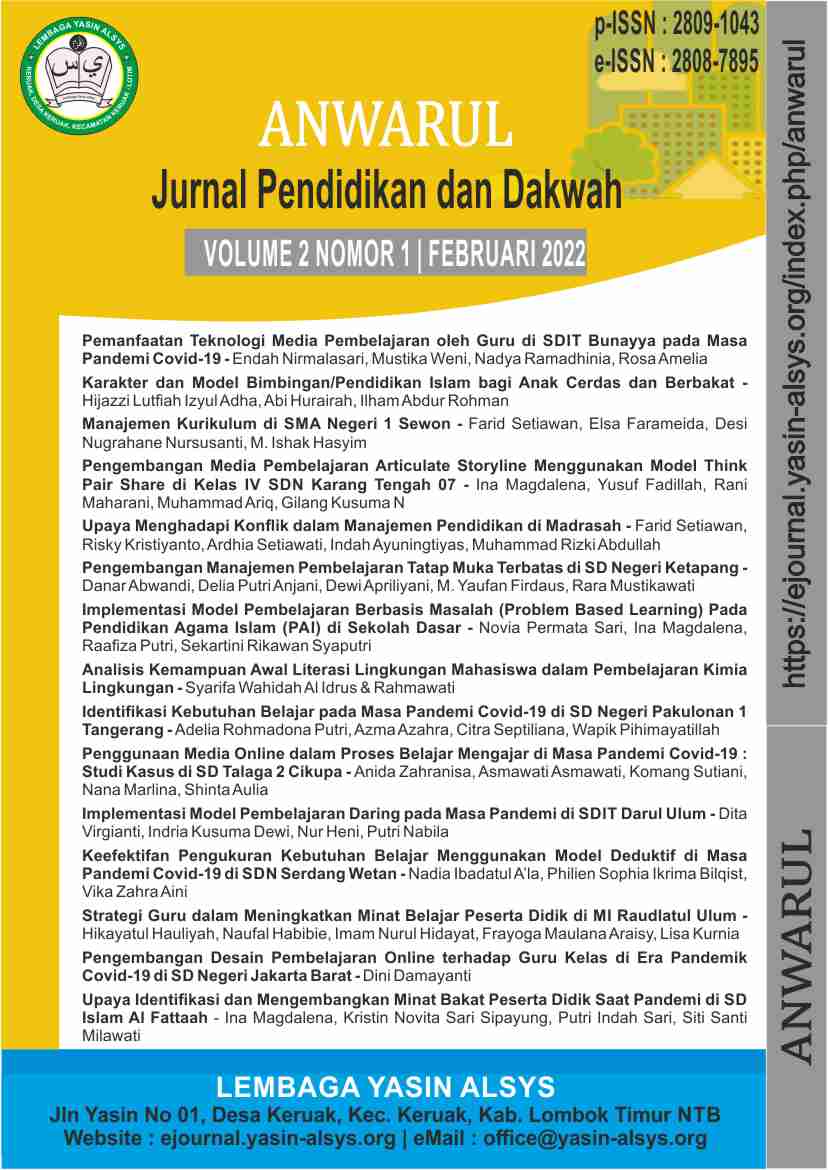
Upaya Menghadapi Konflik dalam Manajemen Pendidikan di Madrasah
Main Article Content
Abstract
The purpose of this study was to find out how to resolve conflicts in the administration of education in Madrasahs and the challenges faced in education management in Madrasas or schools. This is so that the author as a vocational teacher can find a solution to the conflict in education management in the madrasa that he must find when he becomes a teacher candidate. In this paper, the author uses a qualitative descriptive research method to obtain information. Because the information in this document describes efforts to manage conflict in the provision of education in madrasas or schools. Poor management will affect the development of schools, especially at this time the quality of education is still declining. The factors that influence the government are the obsolescence of science and technology due to globalization so that it gives birth to quality, directed, well-planned and well-organized schools. As is happening in Indonesia today, education is still developing unevenly, coupled with the impact of the 19th earthquake, making education management even more chaotic. Therefore, in the arrangement and management of teachers, teachers must carry out their responsibilities and obligations properly in school management in accordance with educational orientation.




Citation Metrics:




Downloads
Citation Metrics & Similar Scopus Articles
-
Unyaphatariyakool S. (2027)Science Teachers’ Learning Management Competency through Professional Learning Communities to Promote Scientific Creativity and Sustainable Development Goals (SDGs)Asean Journal of Educational Research and Technology, 6(2), 241-252
-
Sheng T. (2027)Photothermal Superhydrophobic Textiles: An Emerging Paradigm from Passive Water Repellency to Active Thermal ManagementNano Micro Letters, 19(1)
-
Vincy M.V. (2027)Short-term variability in sediment carbon sequestration in tropical Indian Wetlands: Physicochemical controls and policy relevanceEnvironmental Pollution and Management, 4, 14-26
Article Details

Authors retain copyright and grant the journal right of first publication with the work simultaneously licensed under a Creative Commons Attribution-NonCommercial-ShareAlike 4.0 International License that allows others to share the work with an acknowledgement of the work's authorship and initial publication in this journal.
Article Sidebar
 Page Numbers:
54-65
Page Numbers:
54-65
 Digital Object ID:













 Viewed: 870 times
 Downloaded: 564 times

LYAS Publisher cordially invites qualified professionals to serve as Editors or Reviewers. Your expertise will make an important contribution to maintaining and strengthening the academic quality of our publications. Interested applicants are kindly requested to complete the application form at the following link: Editors & Reviewers


Please feel free to contact us if you need any further information about the submission process or if you have any additional questions.

 Authors:
 Copyright :
Authors retain copyright and grant the journal right of first publication.
Explore Our Journals
Find the journal that best fits your research. If this journal does not match your manuscript’s scope, explore our portfolio below to select a more suitable publication venue.