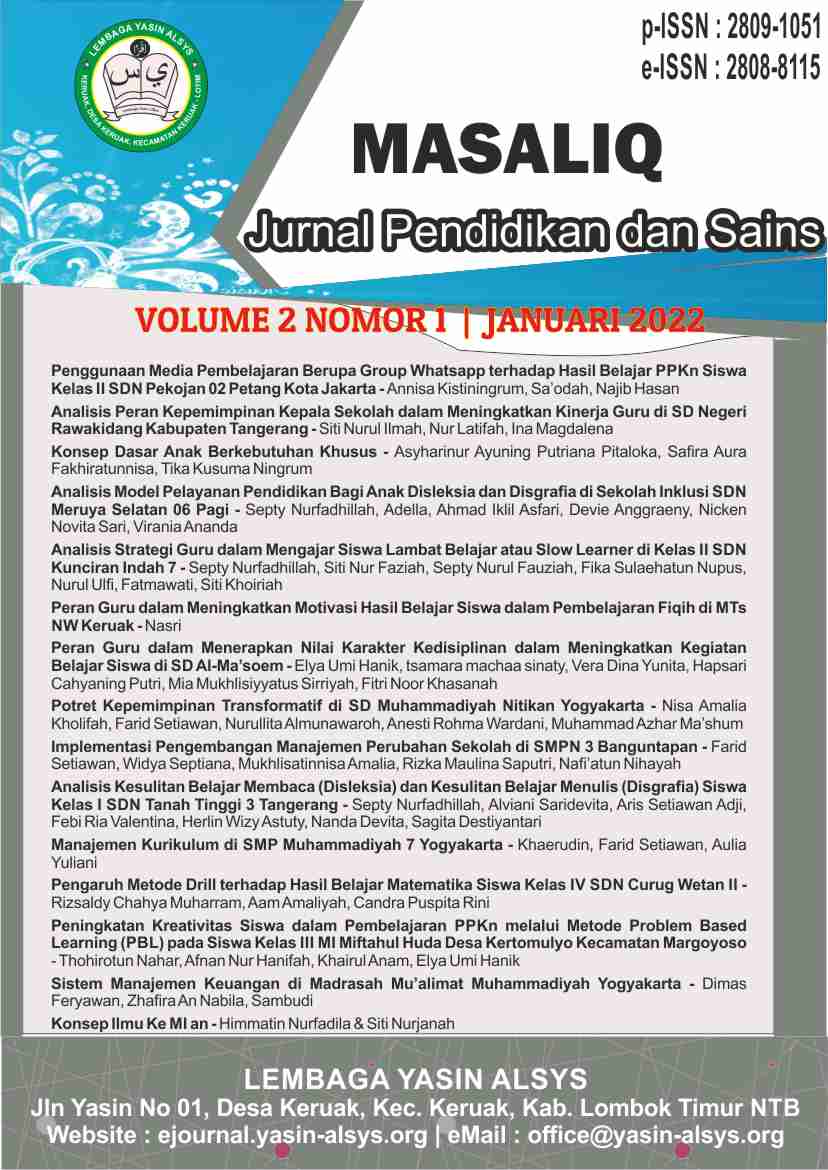
Manajemen Kurikulum di SMP Muhammadiyah 7 Yogyakarta
Main Article Content
Abstract
The existence of educational curriculum management is a form of collaborative effort or effort to encourage the achievement of learning objectives, especially to improve the quality of teaching and learning interactions. This requires a series of evaluation, planning and implementation that cannot be separated from the unit. On the other hand, learning management is a part of a system with interrelated components. The learning components in an educational structure include students (students), teachers (educators), materials, curriculum, school infrastructure, and learning method strategies. In curriculum management and learning thus interrelated in education to achieve the desired goals. Curriculum management is an important part that influences the success of education in national education. In addition, because the curriculum is a support system to achieve institutional goals in an educational institution, the curriculum has an important role in realizing and creating quality schools. To support the success of the curriculum, the government sector or must be empowered to lead the curriculum. Curriculum management at the institution or school level must be coordinated by management (administrators) and assistant supervisors (administrators) which are developed as a whole in the context of the SBM and unit level curriculum. (KTSP) and the vision and mission of the educational institution. In this study, the method we use is direct observation at the school by interviewing the school and the supporters in making this journal are using library research or literature study which includes theories relevant to the problem in research. The library study itself is a series of activities related to collecting library data, reading, recording and processing data from a research.




Citation Metrics:




Downloads
Citation Metrics & Similar Scopus Articles
-
Triharyuni S. (2027)Bridging single-species models to ecosystem-based maximum sustainable yield for environmental sustainability in marine fisheriesGlobal Journal of Environmental Science and Management, 13(1), 553-574
-
Hosang M.L.A. (2027)Environmental risks of pest management practices in smallholder coconut plantationsGlobal Journal of Environmental Science and Management, 13(1), 501-522
-
Fitria D. (2027)Consumer awareness, participation, and accessibility in sustainable electronic waste managementGlobal Journal of Environmental Science and Management, 13(1), 413-432
Article Details

Authors retain copyright and grant the journal right of first publication with the work simultaneously licensed under a Creative Commons Attribution-NonCommercial-ShareAlike 4.0 International License that allows others to share the work with an acknowledgement of the work's authorship and initial publication in this journal.
Article Sidebar
 Page Numbers:
123-135
 Digital Object ID:













 Viewed: 1.121 times
 Downloaded: 1.028 times

LYAS Publisher cordially invites qualified professionals to serve as Editors or Reviewers. Your expertise will make an important contribution to maintaining and strengthening the academic quality of our publications. Interested applicants are kindly requested to complete the application form at the following link: Editors & Reviewers


Please feel free to contact us if you need any further information about the submission process or if you have any additional questions.

 Authors:
 Copyright :
Authors retain copyright and grant the journal right of first publication.
Explore Our Journals
Find the journal that best fits your research. If this journal does not match your manuscript’s scope, explore our portfolio below to select a more suitable publication venue.