
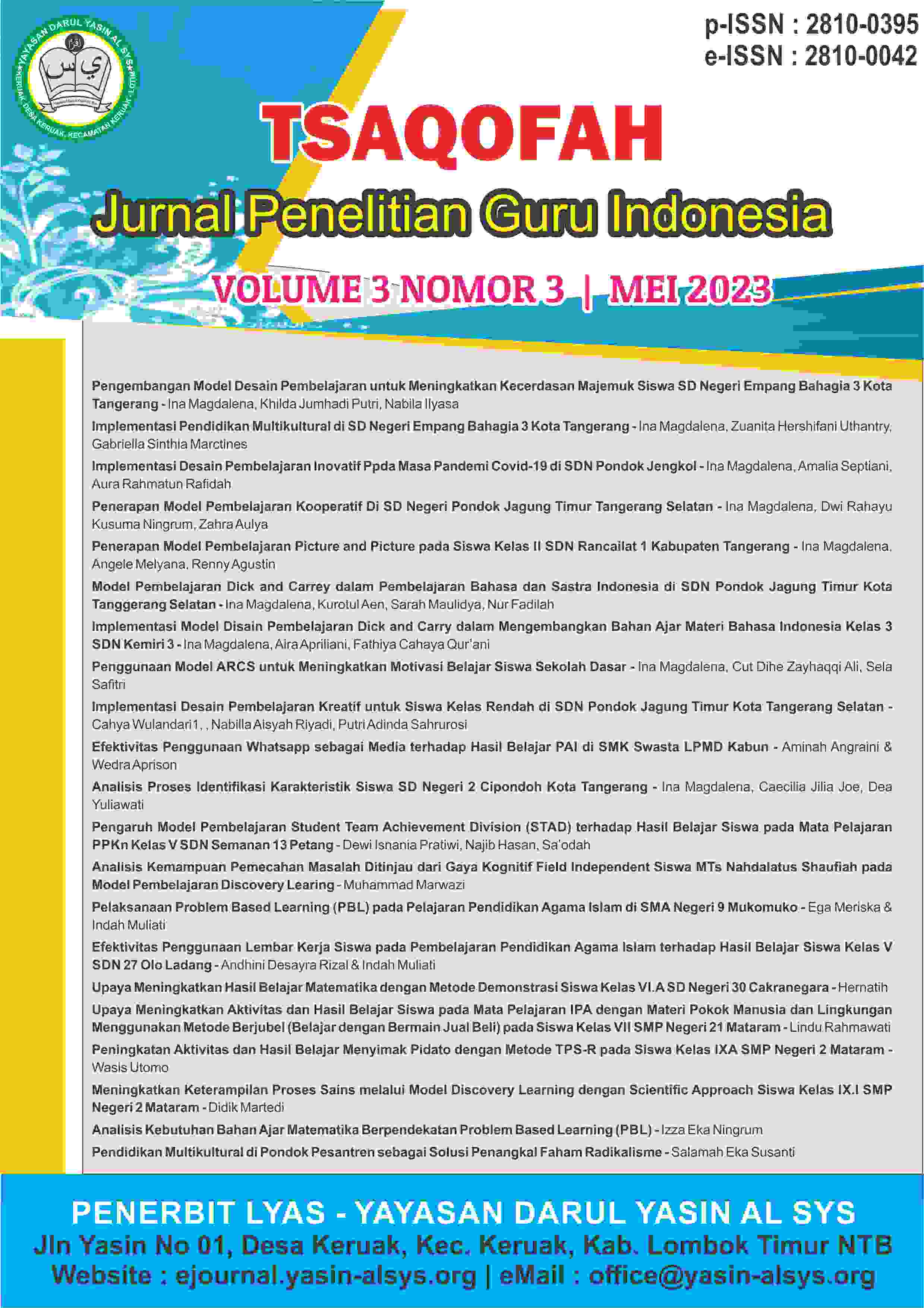
Pengembangan Model Desain Pembelajaran untuk Meningkatkan Kecerdasan Majemuk Siswa SD Negeri Empang Bahagia 3 Kota Tangerang

Article Sidebar
 Page Numbers:
324-329
Page Numbers:
324-329
 Digital Object Identifier:
10.58578/tsaqofah.v3i3.955
Digital Object Identifier:
10.58578/tsaqofah.v3i3.955


 Viewed: 764 times
 Downloaded: 350 times












LYAS Publisher cordially invites qualified professionals to serve as Editors or Reviewers. Your expertise will make an important contribution to maintaining and strengthening the academic quality of our publications. Interested applicants are kindly requested to complete the application form at the following link: Editors & Reviewers


Please feel free to contact us if you need any further information about the submission process or if you have any additional questions.

 Authors:
Ina Magdalena1, Khilda Jumhadi Putri2, Nabila Ilyasa3
 Copyright :
Authors retain copyright and grant the journal right of first publication.
Main Article Content
Abstract
Several studies show that students have interests, skills, and intelligence that definitely contribute to their perspective, participation, and performance in academic matters. Students, although different from one another, certainly look for interesting activities and assignments where they can learn lessons and where they can apply their intelligence. Allowing students to choose and work on tasks that interest them and at the same time they can mobilize their intelligence can definitely increase their participation and performance especially for low performing literary genres. Therefore, this research focuses on developing learning designs to improve multiple intelligences. This research uses descriptive research and development methods. The results of the study show that the application of teaching with multiple intelligences allows students at SD Negeri Empang Bahagia 3 Tangerang City to think more critically and have other talents.




Citation Metrics:




Downloads
Citation Metrics & Similar Scopus Articles
-
Irawati R. (2027)Enhancing accounting students’ writing performance through problem-based learning: Evidence from a vocational higher education contextMultidisciplinary Science Journal, 9(1)
-
Azhand A. (2027)Teaching Persian derivational affixes to non-Persian speakers from a Cognitive Morphology Approach: A case study of nominal suffixes (kar, gar, ban, baz, -ande)Language Related Research, 17(4), 469-497
-
Kenzhaliyev B.K. (2027)Predicting Copper Production Cycles in Hydrometallurgy with Interpretable Machine LearningKompleksnoe Ispolzovanie Mineralnogo Syra, 341(2), 5-15
Article Details

Authors retain copyright and grant the journal right of first publication with the work simultaneously licensed under a Creative Commons Attribution-NonCommercial-ShareAlike 4.0 International License that allows others to share the work with an acknowledgement of the work's authorship and initial publication in this journal.