LYAS Publisher is an academic publishing house that manages 27 scholarly journals with National, Asian, African, and International scopes. All journals have been assigned International Standard Serial Numbers (ISSNs) and can be verified through the ISSN Portal. The journals are indexed in several reputable National and International databases. Some of our journals have received accreditation under the Ministry of Higher Education, Science, and Technology (Kemdiktisaintek) Decree No. 177/E/KPT/2024, while others are currently undergoing the accreditation assessment process.
At present, LYAS Publisher manages 8 National Journals, 5 Asian Journals, 5 African Journals, and 9 International Journals, with contributions from scholars in 47 countries, including Indonesia, Nigeria, Ghana, India, Tanzania, Pakistan, Nepal, Vietnam, Laos, the Philippines, Cambodia, Cameroon, Malaysia, Saudi Arabia, the United States, Georgia, the United Kingdom, Russia, Ethiopia, Germany, Zambia, Morocco, Turkey, Bangladesh, France, Iraq, Yemen, South Africa, Tunisia, Mexico, El Salvador, Japan, Somalia, Guatemala, Qatar, and Congo. In addition, all journals under LYAS Publisher offer APC-free publication for international authors, in accordance with each journal’s editorial and publication policies.
LYAS Publisher cordially
invites qualified professionals to serve as
Editors or
Reviewers. Your expertise will make an important contribution to maintaining and strengthening the academic quality of our publications. Interested applicants are kindly requested to complete the application form at the following link:
https://yasin-alsys.org/LYAS_PublisherApplicants will be officially registered as editors or reviewers after completing the application form and creating an account in the target journal that matches their area of expertise and the journal’s scope. Certificates will be made available through the OJS system only after the editorial process has been completed and may be downloaded or printed after logging in.
The review and publication process generally takes 45–120 days, depending on reviewer availability, editorial assessment, and the extent of revisions required.






























Last Seen
International Schedule
01Monthly Publication Schedule
Selected indexing and discovery services: Index Copernicus, EuroPub, Dimensions, Scilit, Semantic Scholar, Lens, ResearchGate, Google Scholar, and selected university library discovery systems.
02Journal Details
International Scope
The journals have an international scope and welcome scholarly submissions from academics, researchers, graduate students, and policymakers worldwide. Accepted manuscript types include original research articles, theoretical studies, and critical reviews. Manuscripts must be written in English or Arabic.
SINTA Schedule
01Jadwal Publikasi Bulanan
Pengindeksan minimum: Index Copernicus, SINTA 5, Dimensions, ResearchGate, Scilit, Garuda, Google Scholar, BASE, dan layanan pengindeksan lainnya.
02Daftar Jurnal LYAS Publisher
Journals

International Journal of Humanities, Education, and Social Sciences (IJHESS)
Latest Issue: Vol. 4 No. 1 (March 2026). This issue features peer-reviewed contributions that advance multidisciplinary scholarship in humanities, education, and social sciences, and provide evidence-informed responses to contemporary cultural, pedagogical, and societal challenges.
Open Access Peer Reviewed Humanities–Education–Social Sciences
Indexed
To date, IJHESS has published articles by authors affiliated with institutions in fourteen (14) countries: Indonesia, Nigeria, Nepal, Cameroon, Vietnam, Saudi Arabia, Ethiopia, Pakistan, Malaysia, Zambia, Morocco, Bangladesh, India, and South Africa.
IJHESS (International Journal of Humanities, Education, and Social Sciences) is an open-access, double-blind peer-reviewed journal that disseminates research and critical scholarship advancing Humanities, Education, and Social Sciences, including interdisciplinary work connecting these fields. The journal publishes original research, theoretical analyses, and critical reviews, and welcomes contributions from academics, researchers, graduate students, and policymakers in international contexts.
Aims
International Journal of Humanities, Education, and Social Sciences (IJHESS) aims to publish rigorous, peer-reviewed scholarship that advances theory, research, and evidence-informed practice across the humanities, education, and social sciences. The journal welcomes work that is methodologically transparent, analytically defensible, and socially relevant, particularly research addressing contemporary challenges in diverse international contexts.
• Humanities Scholarship: advance interpretive, historical, linguistic, cultural, and philosophical inquiry with clear scholarly contribution.
• Education Research: strengthen research on teaching, learning, assessment, curriculum, leadership, and educational policy with defensible evidence.
• Social Science Inquiry: promote analysis of institutions, communities, behavior, communication, and governance with clear societal implications.
• Interdisciplinary Integration: encourage coherent links across humanities, education, and social sciences in concepts, methods, and interpretations.
• Ethical and Transparent Scholarship: support responsible research practices, clear sourcing, and appropriately bounded conclusions.
Manuscripts should clearly indicate their disciplinary location, justify the analytic framework and method, and explain how the findings inform scholarship and practice in humanities, education, or the social sciences.
Scope
IJHESS considers manuscripts spanning the humanities, education, and social sciences, including studies that integrate two or more of these domains. Submissions may be empirical, conceptual, interpretive, historical, or review-based, provided they offer clear scholarly contribution and rigorous reasoning or evidence.
• Humanities: language and literature, history, philosophy, religious and cultural studies, arts and heritage, and interpretive approaches to human experience.
• Education: pedagogy, curriculum and instruction, assessment and evaluation, educational leadership and management, teacher education, and learning technologies.
• Social Sciences: sociology, psychology, communication and media, anthropology, political science, public policy, economics, and community development.
• Interdisciplinary Studies: cross-cutting research on identity, inequality, governance, education policy, cultural change, and digital society, with explicit integrative logic.
• Reviews and Critical Analyses: systematic, scoping, or critical reviews and theoretical syntheses that provide clear contribution and methodological transparency.
Authors are encouraged to clarify the study context and stakeholders, specify data sources and analytic procedures, and articulate the broader significance of the work for humanities interpretation, educational improvement, and social policy and practice.

Asian Journal of Science, Technology, Engineering, and Art (AJSTEA)
Latest Issue: Vol. 4 No. 2 (April 2026). This issue features peer-reviewed contributions that advance multidisciplinary scholarship across science, technology, engineering, and art, and provide evidence-informed responses to contemporary scientific, technological, and societal challenges.
Open Access Peer Reviewed Science, Technology, Engineering, and Art
Indexed
To date, AJSTEA has published articles by authors affiliated with institutions in fourteen (14) countries: Indonesia, Nigeria, Pakistan, Nepal, India, Laos, the Philippines, Vietnam, Cameroon, the United States, Iraq, El Salvador, Mexico, and Guatemala.
AJSTEA (Asian Journal of Science, Technology, Engineering, and Art) is an open-access, double-blind peer-reviewed journal that disseminates research and critical scholarship advancing Science, Technology, Engineering, and Art, including integrative studies connecting two or more of these domains. The journal publishes original research, theoretical analyses, and critical reviews, welcoming contributions from academics, researchers, graduate students, and policymakers in international contexts.
Aims
Asian Journal of Science, Technology, Engineering, and Art (AJSTEA) aims to publish high-quality, peer-reviewed scholarship that advances scientific understanding, technological innovation, engineering design, and artistic inquiry and practice. The journal prioritizes methodological transparency, defensible claims, and contributions that strengthen knowledge production and problem-solving in Asian and global contexts.
• Rigorous Scientific Research: advance scientific inquiry through transparent methods, appropriate analysis, and reproducible reporting where applicable.
• Technology Development and Evaluation: promote implementation, performance assessment, and responsible innovation.
• Engineering Design and Systems Thinking: strengthen validated models, prototyping, optimization, and responses to real-world constraints.
• Art-Based Scholarship: support analytically defensible creative practice, design research, and critique linked to broader knowledge claims.
• Interdisciplinary STEA Integration: encourage art-technology, science-engineering, design-computing, and related integrations with explicit logic.
Manuscripts should clearly identify the primary domain or domains, present verifiable methods or analytic procedures, and articulate contributions and implications for research, practice, industry, or policy.
Scope
AJSTEA considers manuscripts spanning Science, Technology, Engineering, and Art, including single-domain studies with broader relevance and integrative work bridging two or more domains. Submissions may address local-to-global challenges and should present clear methods, evidence, and disciplinary contributions.
• Science: natural and applied sciences, environmental studies, life and physical sciences, and data-driven scientific inquiry.
• Technology: computing, information systems, AI applications, digital transformation, and technology-enabled solutions with evaluation evidence.
• Engineering: systems, design and prototyping, optimization, instrumentation, manufacturing, and implementation studies in real contexts.
• Art and Design: visual and performing arts, creative industries, design research, practice-based inquiry, and critical or theoretical perspectives.
• STEA Intersections: human-centered computing, creative technologies, digital arts, design engineering, and science-to-art translation with explicit integration.
Authors are encouraged to state the domain contributions, clarify interdisciplinary integration where applicable, and provide sufficient detail for verification, replication, or responsible reuse of methods, data, software, models, or creative outputs.

Journal of Multidisciplinary Science: MIKAILALSYS
Latest Issue: Vol. 4 No. 2 (August 2026). This issue features peer-reviewed contributions that advance multidisciplinary scholarship and evidence-informed responses to contemporary scientific and societal challenges.
Open Access Peer Reviewed Multidisciplinary Science
Indexed
To date, MIKAILALSYS has published articles by authors affiliated with institutions in twelve (12) countries: Indonesia, Nigeria, Nepal, India, Vietnam, Cambodia, Cameroon, the United States, the United Kingdom, Russia, Germany, and Morocco.
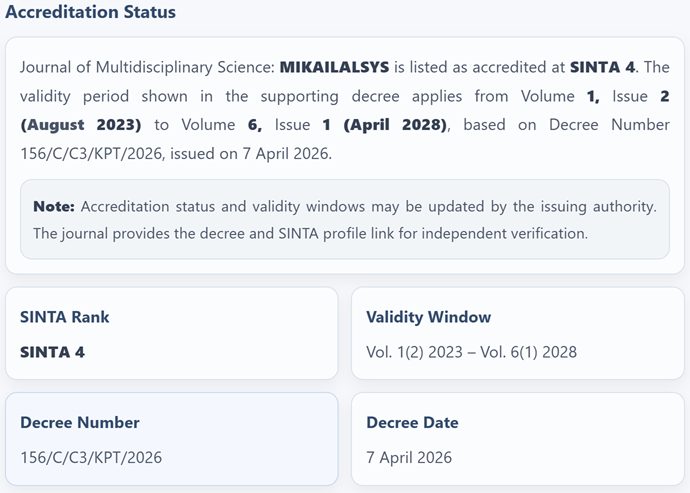
MIKAILALSYS is published by LYAS Publisher and is issued three times per year (April, August, and December), unless published as a co-publication with conference organizers. The journal provides an international forum for disseminating robust multidisciplinary scholarship and encourages submissions that explicitly articulate integrative logic across disciplines, methodological transparency, and defensible evidence.
Aims
Journal of Multidisciplinary Science: MIKAILALSYS aims to publish rigorous, peer-reviewed research and scholarly analyses that advance multidisciplinary science and strengthen evidence-informed responses to contemporary challenges. The journal welcomes contributions that integrate theories, methods, or perspectives across disciplines, with academically grounded argumentation and transparent reporting.
• Multidisciplinary Synthesis: connect insights across fields to address complex real-world problems.
• Methodological Quality: strengthen reproducible methods, defensible analysis, and appropriately bounded claims.
• Applied Innovation: encourage interventions, implementations, prototypes, and evaluations with clear outcomes and limitations.
• Policy and Practice Relevance: support work that connects evidence to decision-making, implementation, and stakeholder implications.
• Integrative Epistemologies: welcome value-informed perspectives when they are analytically defensible and academically grounded.
Submissions should clearly state a research problem or scholarly question, report methods transparently and reproducibly where applicable, present defensible analysis and evidence, and articulate a clear multidisciplinary contribution and implications for research and practice.
Scope
MIKAILALSYS considers manuscripts spanning multiple disciplinary clusters, including single-discipline studies with explicit multidisciplinary relevance and integrative studies bridging two or more domains. Submissions may address local to global contexts and should make the interdisciplinary logic, methods, and implications explicit.
• Science and Technology: natural and applied sciences, data and computing, environmental science, and technology-enabled solutions.
• Engineering and Innovation: design, systems, prototypes, optimization, implementation studies, and evaluation of interventions or technologies.
• Health and Life Sciences: public and community health, well-being, behavioral health, and life-science research with clear methods and ethical safeguards.
• Education, Social Sciences, and Humanities: learning and pedagogy, social issues and development, communication, culture, and human-centered analysis informing policy and practice.
• Economics and Applied Policy: governance, institutional analysis, program evaluation, and evidence-to-policy studies with clearly defined stakeholders and measurable implications.
Authors are encouraged to state the disciplinary contributions, clarify integration across fields, and provide sufficient detail for verification, replication, or responsible reuse of the study’s methods and outputs.
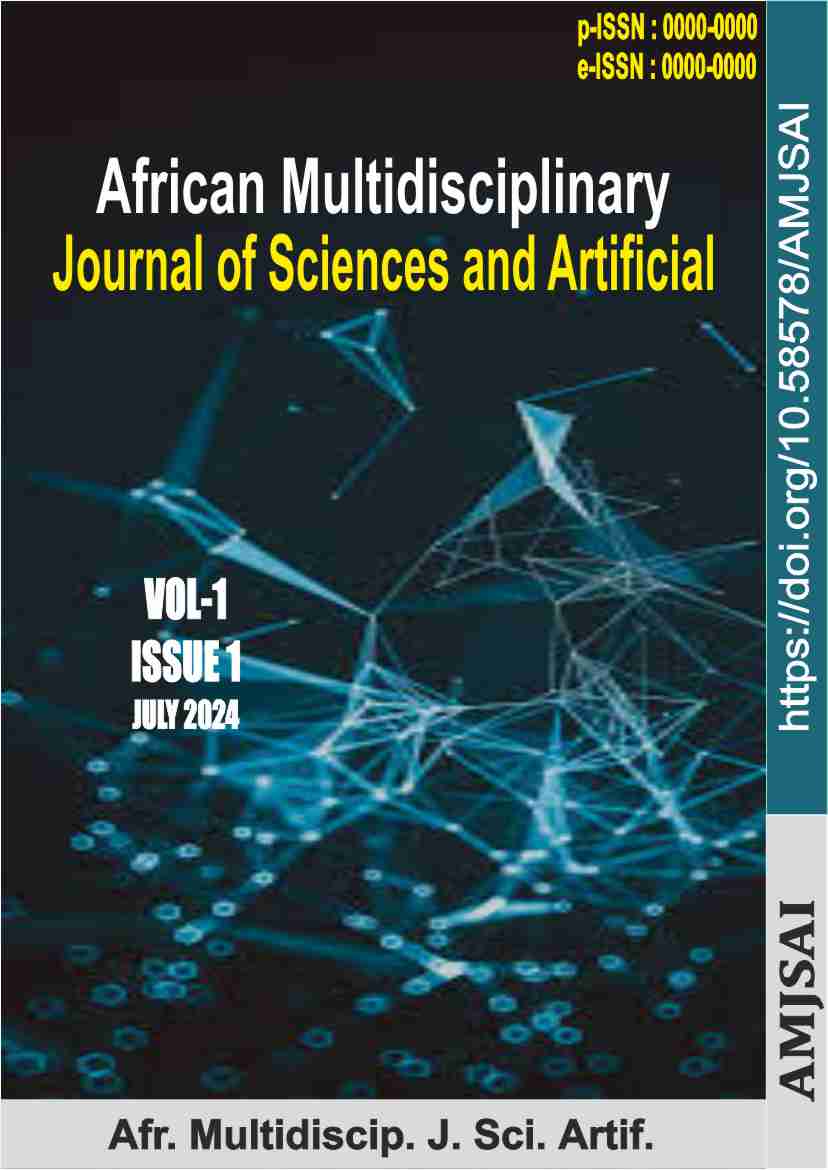
African Multidisciplinary Journal of Sciences and Artificial Intelligence
Initials: AMJSAI
• ISSN: 1595-7969 • Frequency: 3 issues per year (March, July, and November)
DOI Prefix: 10.58578/AMJSAI. The journal is an international, rigorously peer-reviewed forum for the dissemination of scientific and multidisciplinary research, including work connected to artificial intelligence and its responsible application across scientific fields.
Peer Reviewed Science & Artificial Intelligence Multidisciplinary
Citation Analysis and Visibility
African Multidisciplinary Journal of Sciences and Artificial Intelligence (AMJSAI) is an international peer-reviewed journal devoted to the advancement of scientific knowledge and multidisciplinary inquiry across the sciences, engineering, health, agriculture, environmental studies, and artificial intelligence. The journal welcomes original research that demonstrates methodological rigor, conceptual clarity, and meaningful scholarly or practical contribution.
Aims
African Multidisciplinary Journal of Sciences and Artificial Intelligence aims to publish high-quality, peer-reviewed scholarship that advances scientific knowledge and fosters multidisciplinary integration across the sciences, engineering, health, agriculture, environmental studies, and artificial intelligence.
• Scientific Advancement: disseminate rigorous empirical, experimental, analytical, and computational studies across core and applied scientific fields.
• Artificial Intelligence Integration: encourage responsible and evidence-based use of AI in scientific discovery, modeling, prediction, diagnosis, and optimization.
• Multidisciplinary Convergence: promote studies that connect multiple scientific domains to address complex technical, environmental, biological, and societal challenges.
• Innovation and Application: support research that translates scientific and technological knowledge into usable solutions, systems, products, or interventions.
Submissions should clearly formulate the research problem, report methods transparently, present defensible evidence, and articulate a well-defined contribution to scientific knowledge and/or multidisciplinary application.
Scope
AMJSAI welcomes original research articles and related scholarly contributions across scientific and technology-oriented fields, especially those demonstrating multidisciplinary relevance or integration with artificial intelligence.
• Life and Health Sciences: toxicology, physiology, microbiology, parasitology, molecular biology, phytomedicine, health science, and related biomedical fields.
• Environmental and Agricultural Sciences: environmental studies, agriculture, ecological analysis, sustainability research, and biotechnology related to natural and managed systems.
• Physical and Applied Sciences: physics, chemistry, biophysics, and other analytical or experimental sciences.
• Computational and Intelligence-Based Studies: bioinformatics, scientific computing, simulation, machine learning, and AI applications in science and engineering.
• Engineering and Technological Innovation: engineering solutions, intelligent systems, applied technologies, and multidisciplinary technical studies with scientific grounding.
Priority is given to original research articles and multidisciplinary studies that demonstrate scientific rigor, methodological transparency, and clearly articulated implications for scholarship, innovation, and/or societal benefit.
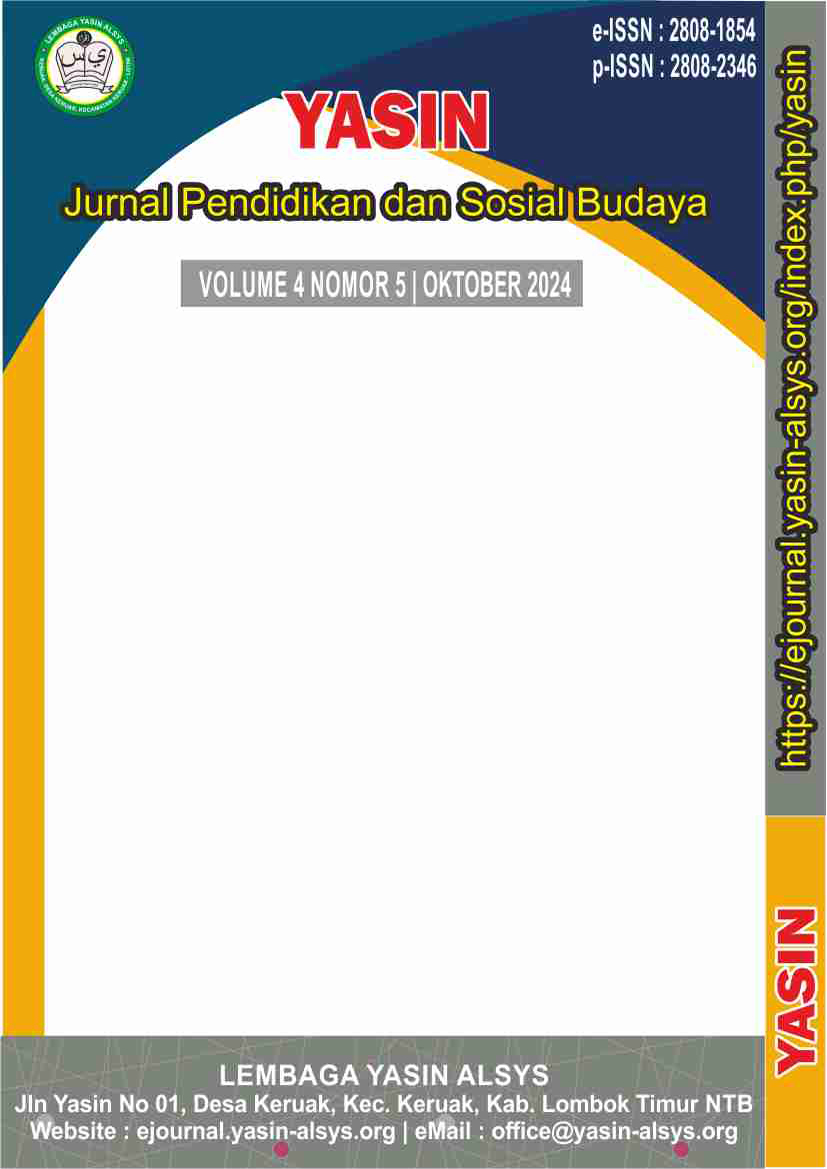
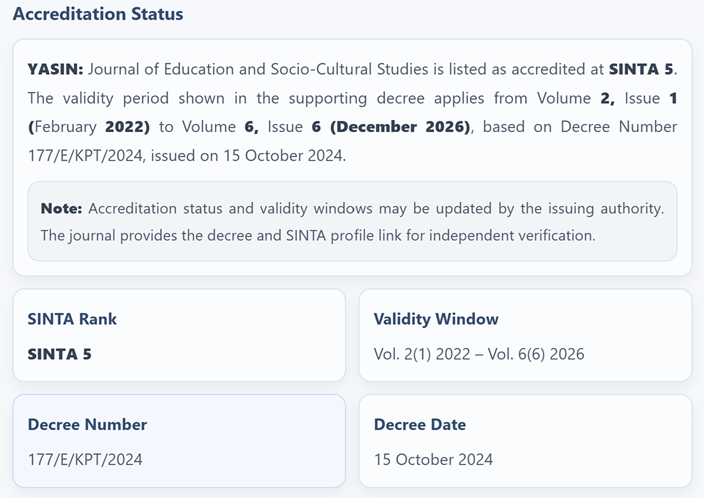
YASIN: Jurnal Pendidikan dan Sosial Budaya
Latest Issue: Vol. 6 No. 5 (October2026). This issue features peer-reviewed articles that advance research and practice in education and sociocultural studies.
Open Access Peer Reviewed Education, Social, and Cultural
Indexed
To date, YASIN has published articles by authors affiliated with institutions in five (5) countries: Indonesia, Nepal, Yemen, Nigeria, and Thailand.
YASIN: Jurnal Pendidikan dan Sosial Budaya is published by Lembaga Yasin Al Sys and is issued six times per year (February, April, June, August, October, and December). All submissions undergo an initial editorial assessment followed by peer review to ensure originality, methodological rigor, ethical compliance, and clarity of scholarly contribution.
Aims
YASIN: Jurnal Pendidikan dan Sosial Budaya aims to disseminate peer-reviewed scholarship across three complementary domains—education, social sciences, and cultural studies—while also welcoming interdisciplinary work that connects these fields. The journal prioritizes manuscripts that offer clear conceptual contribution, empirical rigor, and relevance to contemporary challenges.
• Education: strengthen scholarship on learning, teaching, curriculum, assessment, educational psychology, and school or higher-education practice.
• Social Sciences: advance analyses of society, policy, equity, community development, governance, and social issues affecting human well-being.
• Cultural Studies: enrich research on values, identity, language, arts, heritage, local wisdom, and cultural expression in diverse settings.
• Interdisciplinary Bridges: encourage educational, social, and cultural perspectives to jointly inform theory, evidence, and practice.
• Methodological Openness: welcome quantitative, qualitative, mixed-methods, theoretical, and review-based scholarship with transparent reporting.
Manuscripts should state a clear problem, present sound methods or argumentation, and demonstrate contribution to education, social sciences, cultural studies, or their intersections.
Scope
The journal welcomes submissions in three primary streams—education, social sciences, and cultural studies—along with integrative studies spanning two or more streams. Submissions may address local, national, regional, or global contexts and should provide analytically grounded implications.
• Education: curriculum and instruction, pedagogy, assessment, educational technology, teacher education, learning outcomes, and educational management.
• Social Sciences: social policy, equity and inclusion, community and family studies, social problems, development, governance, and public-sector innovation.
• Cultural Studies: cultural heritage, identity, language and literacy as cultural practice, media and communication, arts, traditions, and sociocultural change.
• Intersections: education-in-society, culture in schooling, social and cultural determinants of learning, policy and identity, and community-based education.
• Article Formats: empirical studies, conceptual papers, systematic or scoping reviews, and critical perspectives with clear method and argumentation.
Submissions are expected to provide adequate context, clear analytical framing, and implications that are logically derived from the evidence or argument.

International Journal of Education, Management, and Technology (IJEMT)
Latest Issue: Vol. 4 No. 1 (April 2026). This issue features peer-reviewed contributions that advance multidisciplinary scholarship in education, management, and technology, and provide evidence-informed responses to contemporary organizational, digital, and societal challenges.
Open Access Peer Reviewed Education–Management–Technology
Indexed
To date, IJEMT has published articles by authors affiliated with institutions in nine (9) countries: Indonesia, Nepal, Nigeria, Georgia, Pakistan, India, the United States, Ethiopia, and Morocco.
IJEMT (International Journal of Education, Management, and Technology) is an open-access, double-blind peer-reviewed journal that disseminates research and critical scholarship advancing Education, Management, and Technology, including interdisciplinary studies connecting these domains. The journal publishes original research, theoretical analyses, and critical reviews, and welcomes contributions from academics, researchers, graduate students, and policymakers in international contexts.
Aims
International Journal of Education, Management, and Technology (IJEMT) aims to publish rigorous, peer-reviewed scholarship that advances knowledge and evidence-informed practice at the intersections of education, management, and technology. The journal prioritizes methodological transparency, defensible analysis, and contributions that improve educational systems, organizational performance, and technology-enabled innovation in diverse international contexts.
• Education Research: advance teaching, learning, assessment, and policy research with clear implications for educational improvement.
• Management and Organizational Scholarship: strengthen leadership, governance, strategy, and quality assurance relevant to educational and other institutions.
• Technology-Enabled Innovation: promote digital transformation, systems design, and evaluation of interventions in education and organizations.
• Interdisciplinary Integration: encourage coherent links among educational objectives, management processes, and technology affordances.
• Policy and Practice Relevance: support translation of evidence into actionable recommendations for leaders, educators, managers, and policymakers.
Manuscripts should specify the focal context, describe the technology where applicable, and explain the mechanisms linking management processes and technology design to outcomes.
Scope
IJEMT considers manuscripts spanning education, management, and technology, including cross-domain studies such as education leadership and governance, educational technology and learning systems, and management of digital transformation. Submissions may be empirical, conceptual, or review-based, provided they offer clear contribution and rigorous evidence or reasoning.
• Education: pedagogy, curriculum and instruction, assessment and evaluation, educational policy, teacher development, and learning improvement initiatives.
• Management: leadership, governance, strategic management, organizational behavior, quality management, and program or project management.
• Technology: information systems, digital transformation, data and analytics, AI applications, and technology governance with evaluation and accountability.
• EdTech and Learning Systems: educational technology, LMS and online learning, learning analytics, digital assessment, and technology-supported instructional design.
• Policy, Ethics, and Impact: governance and regulation, equity and access, privacy and security, responsible AI, and evidence-to-policy translation.
Authors are encouraged to clarify stakeholder relevance, specify implementation constraints, and report outcomes and limitations with sufficient detail to support replication and responsible adaptation across contexts.

Mikailalsys Journal of Advanced Engineering International (MJAEI)
Latest Issue: Vol. 3 No. 1 (March 2026). This issue features peer-reviewed contributions that advance advanced engineering scholarship and provide evidence-informed responses to contemporary technological, industrial, and sustainability challenges.
Open Access Peer Reviewed Advanced Engineering
Indexed:
To date, MJAEI has published articles by authors affiliated with institutions in five (5) countries: Nepal, India, Nigeria, the United States, and Indonesia.
MJAEI (Mikailalsys Journal of Advanced Engineering International) is an open-access, double-blind peer-reviewed journal dedicated to publishing cutting-edge research in engineering and technology across disciplines. The journal serves as a platform for researchers, scientists, and practitioners to share innovative ideas, foster cross-disciplinary collaboration, and contribute to technological and scientific advancements in international contexts.
Aims
Mikailalsys Journal of Advanced Engineering International (MJAEI) aims to publish high-quality, peer-reviewed research that advances engineering and technology through innovative methods, systems, models, and implementations. The journal welcomes interdisciplinary contributions that connect engineering fundamentals with technological progress, with emphasis on methodological rigor, transparent validation, and relevance to international engineering and industrial challenges.
•
Promote advanced engineering solutions grounded in sound theory, explicit assumptions, and reproducible methods.
•
Strengthen validation quality through experiments, simulations, benchmarks, prototypes, and/or field implementation with transparent reporting.
•
Encourage cross-disciplinary integration among engineering, computing, materials, energy, and applied technological systems.
•
Support practical and scalable innovation by highlighting implementation value, operational feasibility, safety, and limitations.
•
Promote sustainability-oriented engineering that responds to environmental, industrial, and infrastructure-related challenges.
•
Welcome international perspectives on engineering standards, technologies, and implementation contexts across sectors and regions.
Manuscripts should define domain context clearly, describe designs, algorithms, or systems precisely, report evaluation protocols and metrics transparently, and provide reproducible supplements where feasible.
Scope
MJAEI considers manuscripts across engineering and technology domains, including theoretical, experimental, computational, and applied studies. The journal welcomes interdisciplinary research bridging engineering design, intelligent systems, manufacturing, energy, infrastructure, and sustainability, provided that the engineering contribution remains central, explicit, and well validated.
•
Electrical, Electronics & Computer Engineering: electronics, embedded systems, control, communications, signal processing, IoT, and hardware/software integration.
•
Mechanical, Manufacturing & Materials Engineering: design, automation, robotics, production systems, industrial materials, and performance optimization.
•
Civil, Environmental & Infrastructure Engineering: structures, transportation, construction systems, water resources, urban infrastructure, and sustainable built environments.
•
Chemical, Process & Energy Engineering: process design, catalysis, reaction systems, separation processes, renewable energy, and energy-efficiency technologies.
•
Biomedical, Health & Applied Engineering: biomedical devices, biosignals, imaging, health technology, and clinically relevant engineering applications.
•
Computer Science, AI & Systems Engineering: artificial intelligence, data engineering, software systems, cybersecurity, information systems, and complex systems design.
Authors are encouraged to report standards compliance where relevant, describe datasets, materials, and experimental setups precisely, and provide evidence of reliability, safety, and sustainability for applied systems.

ALSYSTECH: Journal of Education Technology
Latest Issue: Vol. 4 No. 2 (May 2026). This issue features peer-reviewed contributions that advance educational technology scholarship and evidence-informed responses to contemporary digital learning, instructional innovation, and technology-enhanced assessment challenges in education.
Open Access Peer Reviewed Educational Technology
Indexed
To date, ALSYSTECH has published articles by authors affiliated with institutions in seven (7) countries: Indonesia, India, Nigeria, Nepal, Pakistan, Ethiopia, and the United States.
ALSYSTECH (Journal of Education Technology) publishes scholarship at the interface of technology and education, with an emphasis on how digital tools, learning systems, and technology-supported pedagogies improve teaching, learning, and assessment across educational settings. The journal targets researchers, practitioners, and policymakers in educational technology and online or distance learning.
Aims
ALSYSTECH: Journal of Education Technology aims to publish rigorous, peer-reviewed research and scholarly analyses that advance educational technology by integrating learning sciences, technology design, and curriculum and instructional practice. The journal welcomes evidence-based studies on technology-supported learning across formal, non-formal, and online or distance education contexts.
• Theory-to-Practice Translation: strengthen technology-enhanced learning through clear pedagogical rationale and contextualized design choices.
• Methodological Quality: promote valid design, implementation, and evaluation of EdTech interventions with bounded claims.
• Curriculum and Instructional Innovation: encourage the use of technology for engagement, equity, assessment, and learning improvement.
• Online and Distance Learning: support scholarship on learning design, learner support, interaction, and scalable delivery models.
• Policy and Institutional Strategy: inform responsible technology adoption, governance, and sustainable implementation.
Manuscripts should specify the learning context, the technology or system and its functional design, the pedagogical and curricular alignment, and the evidence supporting instructional, learning, or organizational outcomes.
Scope
ALSYSTECH considers manuscripts addressing the interface of education and technology, including classroom practices, learning experiments, and system-level innovations. Submissions may employ quantitative, qualitative, mixed-methods, design-based research, or evaluation approaches, provided the educational and technological contributions are explicit and evidence-grounded.
• Technology-Enhanced Teaching and Learning: digital pedagogy, blended or flipped learning, interactive learning environments, and classroom-based technology integration.
• Learning Systems and Platforms: LMS or LCMS, learning analytics dashboards, educational information systems, and platform-supported instructional workflows.
• Curriculum, Content, and Digital Media: technology-supported curriculum design, digital resources, OER, multimedia learning, and instructional content development.
• Online and Distance Learning: course design, learner support, interaction and presence, assessment in online settings, and scalable delivery models.
• Evaluation, Policy, and Ethics: effectiveness studies, implementation and adoption, equity and accessibility, data privacy, AI-in-education governance, and responsible innovation.
Authors are encouraged to clarify the intended users and setting, describe the technology design and implementation constraints, and report evaluation procedures and outcomes with sufficient detail for verification and responsible reuse.
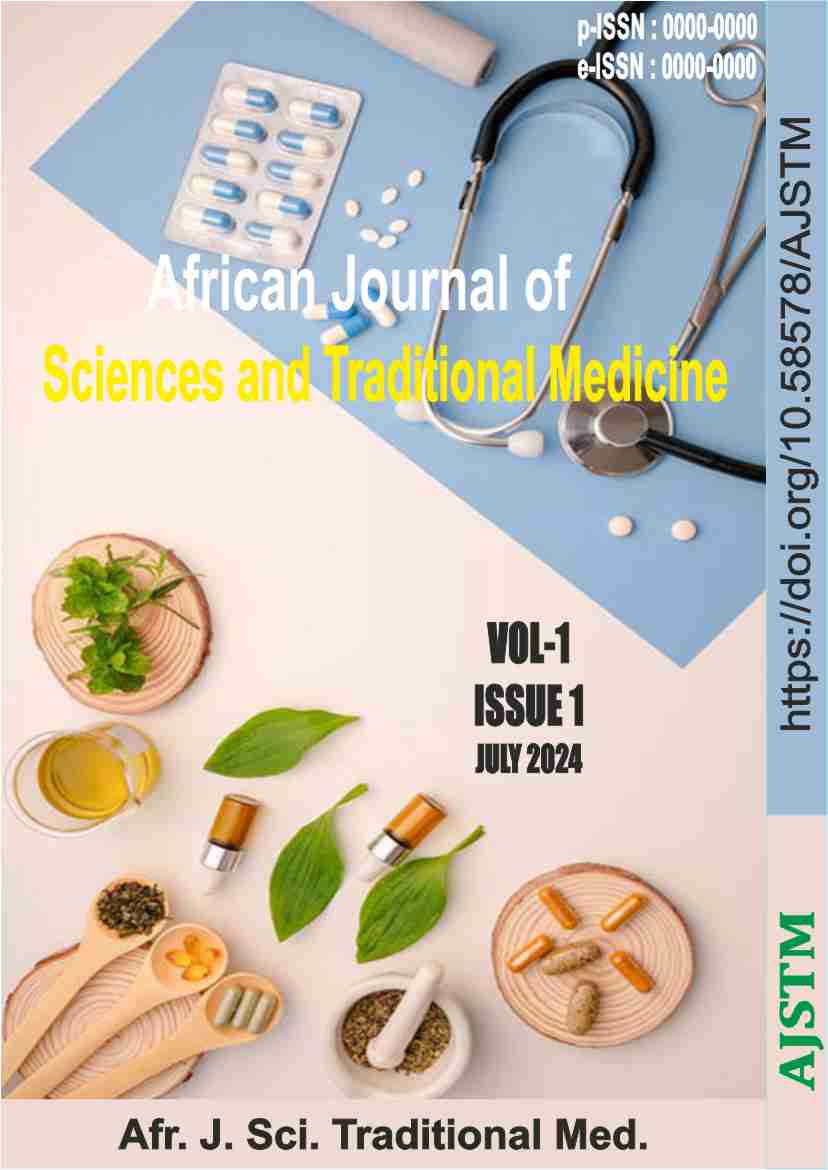
African Journal of Sciences and Traditional Medicine
Initials: AJSTM
• ISSN: 1595-7942 • Frequency: 3 issues per year (March, July, and November)
DOI Prefix: 10.58578/AJSTM. The journal is an international, rigorously peer-reviewed forum for the rapid dissemination of scientific advances in natural and life sciences, with particular attention to traditional medicine and related evidence-based research.
Peer Reviewed Science & Traditional Medicine Natural & Life Sciences
Citation Analysis and Visibility
African Journal of Sciences and Traditional Medicine (AJSTM) is an international peer-reviewed journal devoted to the advancement of natural and life sciences, particularly where scientific inquiry intersects with traditional medicine and biologically relevant applications. The journal provides a scholarly channel for the rapid communication of original research, scientific innovations, and evidence-based studies relevant to health, medicinal resources, and biological systems.
Aims
African Journal of Sciences and Traditional Medicine aims to publish rigorous, peer-reviewed research that advances scientific knowledge in natural and life sciences while promoting analytically grounded and evidence-informed scholarship in traditional medicine and related biological fields.
• Scientific Advancement: disseminate high-quality studies that deepen understanding in biological, biochemical, environmental, and health-related sciences.
• Traditional Medicine Research: encourage scientifically grounded research on plant medicine, phytomedicine, bioactive compounds, and traditional therapeutic knowledge.
• Life-Science Integration: promote interdisciplinary links among biochemistry, molecular biology, microbiology, toxicology, biotechnology, parasitology, and health sciences.
• Application and Relevance: support studies with meaningful implications for public health, medicinal resource development, environmental health, and agricultural or biomedical applications.
• International Scholarly Value: encourage clearly reported studies with reproducible methods and contributions relevant to both regional knowledge and wider scientific discourse.
Submissions should clearly state the research problem, describe methods transparently, present defensible evidence, and articulate a meaningful contribution to science, traditional medicine, or related life-science scholarship.
Scope
AJSTM welcomes original research articles and related scholarly contributions across natural, biological, health, and medicinal sciences, especially studies that engage empirically with traditional medicine and its scientific applications.
• Traditional Medicine and Phytomedicine: medicinal plants, herbal formulations, ethnomedicine, pharmacognosy, phytochemistry, and evaluation of therapeutic bioactive compounds.
• Life and Biomedical Sciences: microbiology, molecular biology, parasitology, physiology, toxicology, biochemistry, and related biological or biomedical investigations.
• Health and Applied Medical Research: public health, laboratory medicine, disease-related studies, therapeutic evaluation, and evidence-based health interventions relevant to natural and traditional medicine contexts.
• Environmental and Agricultural Biosciences: biodiversity, medicinal-resource management, environmental health, biotechnology, and biologically oriented agricultural research.
• Interdisciplinary Scientific Studies: integrative research connecting natural sciences, life sciences, and traditional medicinal knowledge through robust empirical, analytical, or experimental approaches.
Priority is given to original research articles and interdisciplinary studies that demonstrate scientific rigor, methodological transparency, and clearly articulated implications for health, medicinal science, and evidence-based traditional medicine scholarship. Studies with practical, translational, or policy relevance are also strongly encouraged.
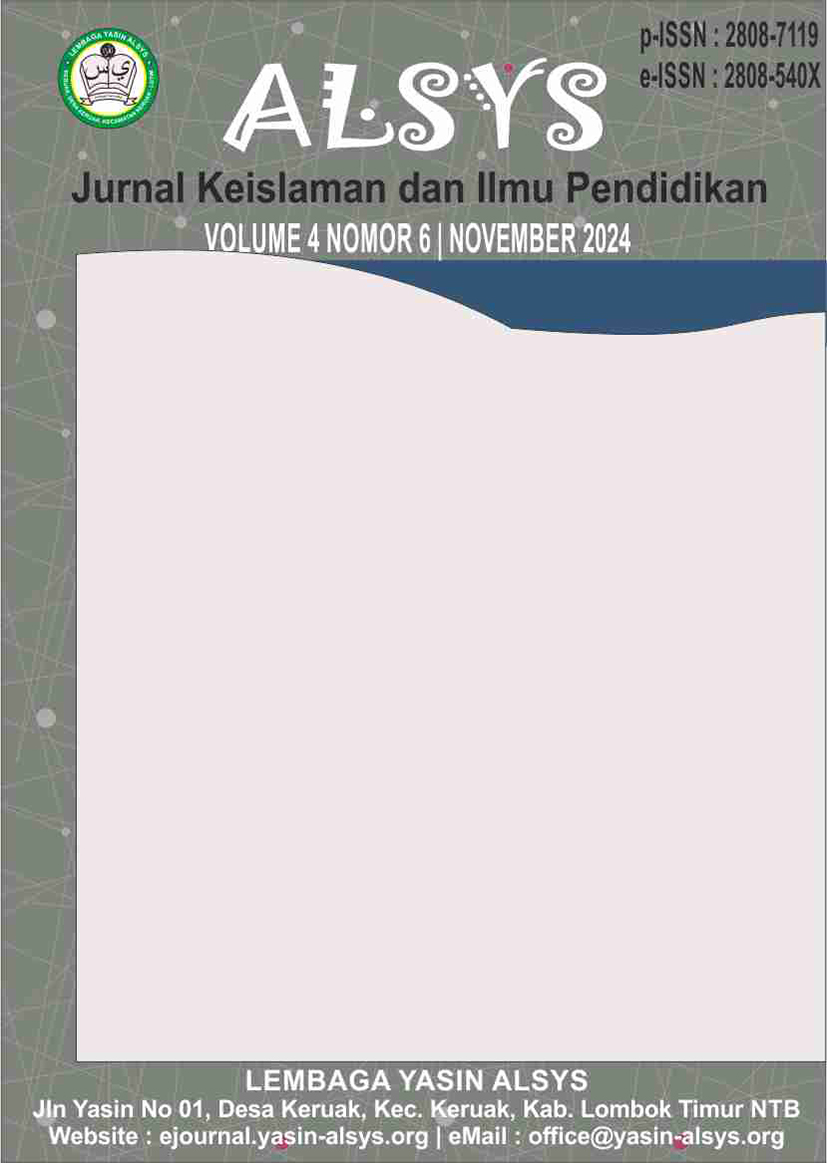
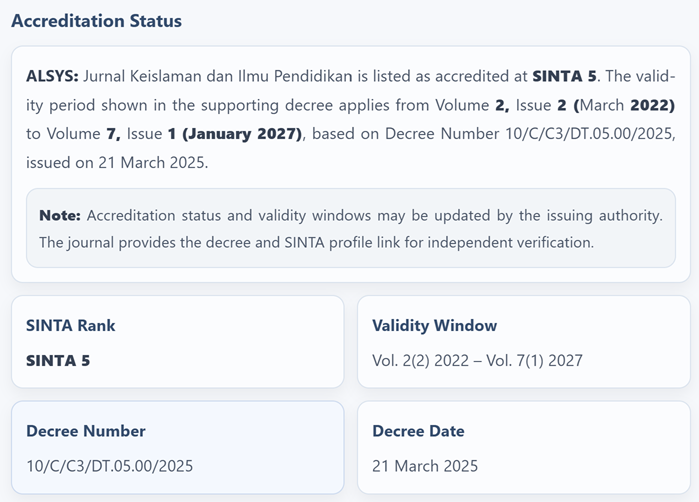
ALSYS: Jurnal Keislaman dan Ilmu Pendidikan
Latest Issue: Vol. 6 No. 5 (September 2026). This issue presents peer-reviewed contributions that strengthen scholarship at the intersection of Islamic studies and educational sciences.
Open Access Peer Reviewed Islamic & Education Studies
Indexed
To date, ALSYS has published articles by authors affiliated with institutions in four (4) countries: Indonesia, Nigeria, Iraq, and Malaysia.
ALSYS: Jurnal Keislaman dan Ilmu Pendidikan is published by Lembaga Yasin Al Sys and is issued six times per year (January, March, May, July, September, and November). All submissions undergo an initial editorial assessment followed by peer review to ensure originality, methodological rigor, ethical compliance, and clarity of scholarly contribution.
Aims
ALSYS: Jurnal Keislaman dan Ilmu Pendidikan aims to publish rigorous, peer-reviewed scholarship in two complementary domains—Islamic studies (keislaman) and educational sciences (ilmu pendidikan)—while also welcoming integrative studies that connect Islamic scholarship with educational theory and practice. The journal prioritizes manuscripts that demonstrate conceptual clarity, methodological transparency, and a clear scholarly contribution.
• Keislaman: strengthen scholarly inquiry in Qur’an and Hadith studies, theology (‘aqidah), ethics (akhlaq), jurisprudence (fiqh), Islamic thought, and the history of Islamic civilization.
• Ilmu Pendidikan: advance research on curriculum, pedagogy, learning and assessment, educational psychology, teacher education, educational leadership, and technology-enhanced learning.
• Integrative Scholarship: encourage work on Islamic education, values and character education, and the integration of religious knowledge with contemporary educational practice and research.
• Methodological Diversity: support quantitative, qualitative, mixed-methods, conceptual, and review-based studies with ethical compliance and transparent reporting.
Submissions should state a clear research question or argument, report methods or analyses transparently, and articulate a well-defined contribution grounded in relevant scholarship.
Scope
ALSYS accepts manuscripts within two primary streams—Islamic studies and educational sciences—as well as studies bridging both streams. Topics may address formal education (schools, madrasah, higher education), non-formal education (pesantren, community learning), and broader social institutions, with local to global relevance.
• Islamic Studies topics: Qur’anic and Hadith studies, ‘aqidah, akhlaq, fiqh, Islamic law and society, Islamic thought, and Islamic civilization and intellectual history.
• Educational Sciences topics: curriculum and instruction, pedagogy, assessment and evaluation, educational psychology, inclusive education, teacher professional development, educational leadership, and educational policy.
• Islamic Education intersections: Islamic curriculum and learning resources, character or values education, pesantren and madrasah studies, educational practice in Muslim communities, and integration of religious knowledge with contemporary learning.
• Formats: empirical articles (quantitative, qualitative, or mixed-methods), conceptual papers, critical perspectives, and systematic or scoping reviews with clear procedures and ethical compliance.
Priority is given to manuscripts with strong theoretical framing, transparent methods or argumentation, and implications that are logically derived from the evidence or analysis.

Mikailalsys Journal of Mathematics and Statistics (MJMS)
Latest Issue: Vol. 4 No. 2 (June 2026). This issue features peer-reviewed contributions that advance mathematics and statistics scholarship and provide evidence-informed approaches to contemporary theoretical, computational, and applied challenges across disciplines.
Open Access Peer Reviewed Mathematics & Statistics
Indexed
To date, MJMS has published articles by authors affiliated with institutions in six (6) countries: India, Nepal, Indonesia, Nigeria, Turkey, and Malaysia.
MJMS (Mikailalsys Journal of Mathematics and Statistics) is an open-access, double-blind peer-reviewed journal dedicated to advancing scholarship in mathematics and statistics, including theoretical development, methodological innovation, and applications across disciplines. The journal welcomes contributions from researchers, academics, and practitioners and encourages work that is mathematically rigorous, statistically sound, and clearly reported.
Aims
Mikailalsys Journal of Mathematics and Statistics (MJMS) aims to publish high-quality, peer-reviewed research that advances mathematical theory, strengthens statistical methodology, and demonstrates rigorous applications of mathematics and statistics to problems across scientific, engineering, social, and economic domains. The journal prioritizes clarity of assumptions, methodological transparency, and defensible contributions.
• Mathematical Foundations: advance proofs, structures, and formal analysis with clear novelty and internal rigor.
• Statistical Methods: strengthen estimation, inference, modeling, learning, and uncertainty quantification with validated performance and assumptions.
• Applied Mathematics and Modeling: promote work linking theory to real-world systems through analysis, simulation, and optimization.
• Statistical Data Analysis: encourage reproducible workflows, diagnostics, and verifiable empirical results.
• Interdisciplinary Applications: support applications in science, engineering, economics, and social research where mathematics and statistics are central.
Authors are encouraged to provide complete proofs (or proof sketches with clear lemmas), justify modeling choices, report diagnostics and robustness checks, and state limitations and generalizability conditions explicitly.
Scope
MJMS considers manuscripts spanning mathematics and statistics, including theoretical contributions, methodological developments, and applied work where mathematical or statistical rigor is central. Submissions should present clearly defined problems, assumptions, and results, supported by proofs, simulations, benchmarks, or real-data evaluations as appropriate.
• Pure Mathematics: algebra, analysis, geometry, topology, number theory, logic, and related foundational areas.
• Applied Mathematics: mathematical modeling, differential equations, dynamical systems, numerical methods, optimization, and computational mathematics.
• Statistical Theory and Inference: probability, sampling, estimation, hypothesis testing, Bayesian methods, asymptotics, and uncertainty quantification.
• Statistical Modeling and Data Science: regression, multivariate methods, time series, spatial statistics, machine learning, experimental design, and diagnostics.
• Applications: biostatistics, econometrics, actuarial science, quality and reliability, operations research, engineering statistics, social statistics, and interdisciplinary case studies.
Authors are encouraged to include reproducible supplements (data, code, appendices) where feasible, provide sensitivity or robustness analyses for empirical work, and describe computational settings and software libraries for simulation or numerical studies.

EDUMALSYS: Journal of Research in Education Management
Latest Issue: Vol. 4 No. 2 (July 2026). This issue features peer-reviewed contributions that advance education management scholarship and evidence-informed responses to contemporary leadership, governance, and quality-assurance challenges in educational institutions and systems.
Open Access Peer Reviewed Education Management
Indexed
To date, EDUMALSYS has published articles by authors affiliated with institutions in seven (7) countries: Indonesia, Tanzania, India, Nepal, Nigeria, Cambodia, and Ethiopia.
EDUMALSYS (Journal of Research in Education Management) provides an international forum for research and scholarship on the management of educational processes, with particular emphasis on evidence-based policy, institutional leadership, and practice-oriented improvement. The journal publishes research articles, theoretical papers, literature reviews, research reports, and book reviews.
Aims
EDUMALSYS: Journal of Research in Education Management aims to publish rigorous, peer-reviewed research and scholarly analyses that advance knowledge and practice in education management, including leadership, governance, policy implementation, and institutional improvement across schooling and higher education contexts.
• Evidence-Informed Educational Leadership: strengthen decision-making through robust research designs and clearly bounded claims.
• Management and Organizational Improvement: advance planning, implementation, monitoring, and continuous quality improvement in educational institutions.
• Policy and Governance Scholarship: connect research evidence to implementation realities, stakeholders, and context.
• Methodological Transparency: encourage valid measurement, appropriate analysis, and replicable reporting where applicable.
• Practice Relevance: support actionable implications for school leaders, administrators, policymakers, and educators.
Manuscripts should clearly specify the educational management focus, the research approach and analytic logic, and the contribution to management theory, policy implementation, and institutional improvement.
Scope
EDUMALSYS welcomes scholarship on education management across school and higher education settings, including system-level policy and institution-level administration. Submissions may use quantitative, qualitative, or mixed-methods designs, provided the management implications are explicit and supported by evidence.
• Educational Leadership and Administration: leadership practices, organizational culture, strategic management, change management, and leadership development.
• Policy, Governance, and Planning: education policy analysis, governance arrangements, decentralization, accountability, and implementation studies.
• Quality Assurance and Evaluation: institutional performance, accreditation, monitoring systems, school effectiveness, and evidence-based evaluation.
• Human Resources in Education: teacher and staff management, professional development, supervision, motivation, and workforce policy.
• Resources, Finance, and Systems: budgeting, resource allocation, management information systems, digital transformation, and operational governance in education.
Authors are encouraged to specify the management level, clarify stakeholders and governance context, and provide sufficient methodological detail for verification and responsible reuse.

Asian Journal of Islamic Studies and Da'wah (AJISD)
Latest Issue: Vol. 4 No. 3 (May 2026). This issue features peer-reviewed contributions that advance multidisciplinary scholarship in Islamic studies and da'wah, and provide evidence-informed responses to contemporary religious, educational, and societal challenges.
Open Access Peer Reviewed Islamic Studies & Da'wah
Indexed
To date, AJISD has published articles by authors affiliated with institutions in five (5) countries: Indonesia, Nigeria, Saudi Arabia, Morocco, and Qatar.
AJISD (Asian Journal of Islamic Studies and Da'wah) is an open-access, double-blind peer-reviewed journal that disseminates research and critical scholarship advancing Islamic Studies and Da'wah, including their educational, social, cultural, and institutional dimensions. The journal welcomes original research, theoretical analyses, and critical reviews from academics, researchers, graduate students, and policymakers in international contexts.
Aims
Asian Journal of Islamic Studies and Da'wah (AJISD) aims to publish high-quality, peer-reviewed scholarship that strengthens conceptual, historical, textual, and empirical understanding of Islamic Studies and advances evidence-informed practice in da'wah across diverse Asian and global contexts.
• Islamic Studies Scholarship: advance rigorous textual, historical, and contemporary analyses grounded in credible sources and clear argumentation.
• Da'wah Theory and Practice: strengthen communication strategies, ethics, and community engagement with empirically or analytically defensible evidence.
• Education and Capacity Building: promote Islamic pedagogy, curriculum, and learning communities where relevant to Islamic studies and da'wah.
• Methodological Transparency: encourage clear sources, analytic procedures, ethical safeguards, and bounded claims.
• Societal and Policy Relevance: support engagement with media, digital religion, social cohesion, and governance through Islamic scholarly lenses.
Manuscripts should specify the subfield, clarify context and stakeholders where relevant, and articulate contributions to scholarship and responsible religious practice.
Scope
AJISD considers manuscripts across Islamic Studies and Da'wah, including normative, historical, and contemporary research as well as empirical investigations of religious communication and community engagement. Submissions may be conceptual, textual, or field-based, provided the argumentation and evidence are rigorous and clearly reported.
• Core Islamic Studies: Qur'an and tafsir, hadith studies, theology ('aqidah), fiqh and usul al-fiqh, Islamic ethics, and Islamic intellectual traditions.
• History, Society, and Culture: Islamic history, Muslim societies in Asia, cultural expressions, identity, institutions, and contemporary socio-religious dynamics.
• Da'wah Studies and Communication: religious messaging, audience analysis, da'wah ethics, interreligious engagement, and strategic communication in offline and digital settings.
• Islamic Education and Community Development: Islamic pedagogy, curriculum, religious learning communities, mosque-based education, youth programs, and community empowerment initiatives linked to da'wah.
• Contemporary Issues and Policy: religion in public life, governance, social cohesion, gender and family, media and digital religion, and policy debates analyzed through Islamic scholarly perspectives.
Authors are encouraged to clarify sources and interpretive approach for textual studies, or sampling and ethics for field studies, and to state how the study advances Islamic scholarship and improves da'wah practice responsibly.
African Journal of Biochemistry and Molecular Biology Research
Initials: AJBMBR
• ISSN: 1595-7926 • Frequency: 3 issues per year (March, July, and November)
DOI Prefix: 10.58578/AJBMBR. The journal is an international, rigorously peer-reviewed forum for the rapid dissemination of scientific advances in biochemistry, molecular biology, and related life-science fields.
Peer Reviewed Biochemistry & Molecular Biology Life Sciences
Citation Analysis and Visibility
African Journal of Biochemistry and Molecular Biology Research (AJBMBR) is an international peer-reviewed journal devoted to the advancement of knowledge in biochemistry, molecular biology, and related life-science disciplines. The journal provides a scholarly medium for the rapid communication of original research, analytical advances, and scientifically grounded applications relevant to biological processes, health, environment, and biotechnology.
Aims
African Journal of Biochemistry and Molecular Biology Research aims to publish high-quality, peer-reviewed research that advances biochemical and molecular understanding of living systems while supporting interdisciplinary developments across the life sciences.
• Biochemical Advancement: disseminate rigorous studies in fundamental and applied biochemistry, including molecular mechanisms, metabolism, enzymes, membranes, and biomolecular interactions.
• Molecular and Cellular Inquiry: encourage research in molecular biology, genetic and cellular regulation, pathogen biology, and biologically relevant analytical methods.
• Life-Science Integration: promote interdisciplinary work linking biochemistry and molecular biology with biotechnology, physiology, microbiology, pharmacology, pathology, and health science.
• Scientific Relevance and Application: support research that contributes to biomedical, environmental, agricultural, nutritional, and translational scientific problems.
Submissions should clearly state the research problem, describe methods transparently, present defensible evidence, and articulate a well-defined contribution to biochemistry, molecular biology, or related life-science scholarship.
Scope
AJBMBR welcomes original research papers and related scholarly contributions in biochemistry, molecular biology, and associated life-science fields, especially studies with strong methodological grounding and clear scientific relevance.
• Core Biochemistry: macromolecular biochemistry, enzymology, membrane biochemistry, nutritional biochemistry, reproductive and developmental biochemistry, and biochemical regulation of cellular processes.
• Molecular and Biomedical Sciences: molecular biology, medical and clinical biochemistry, pathology, pharmacology, physiology, microbiology, parasitology, malariology, and related disease-oriented biosciences.
• Biotechnology and Bioinformatics: biotechnology, computational biology, bioinformatics, molecular data analysis, and applied laboratory innovation.
• Health and Natural Product Sciences: phytomedicine, food science, health science, toxicology, and biophysics relevant to biomolecular or physiological understanding.
• Environmental and Applied Biosciences: environmental biochemistry and other biochemical applications connected to biological systems, sustainability, and applied life-science research.
Priority is given to original research articles that make a substantial contribution to biochemical and molecular biological knowledge, demonstrate methodological rigor, and offer meaningful implications for life-science research and application.

ARZUSIN: Jurnal Manajemen dan Pendidikan Dasar
Latest Issue: Vol. 6 No. 5 (October 2026). This issue presents peer-reviewed articles that strengthen scholarly and practical perspectives in management and elementary education.
Open Access Peer Reviewed Management & Elementary Education
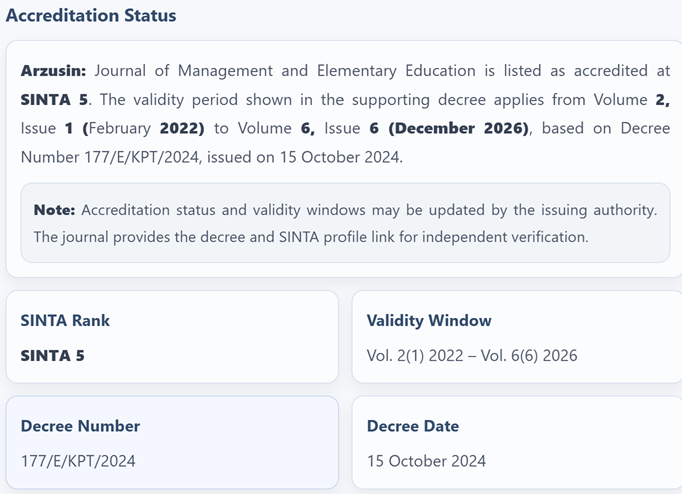
Indexed
To date, ARZUSIN has published articles by authors affiliated with institutions in five (5) countries: Indonesia, Nepal, India, Japan, and Malaysia.
ARZUSIN: Jurnal Manajemen dan Pendidikan Dasar is published by Lembaga Yasin Al Sys and is issued six times per year (February, April, June, August, October, and December). The journal provides a scholarly forum for advancing knowledge, values, and professional skills in management and elementary education through rigorous, ethical, and well-reported research.
Aims
ARZUSIN aims to publish rigorous, peer-reviewed scholarship in two complementary domains—educational management and elementary education—while welcoming integrative studies that connect leadership and governance with classroom practice and learner outcomes. The journal prioritizes manuscripts that demonstrate conceptual clarity, methodological transparency, and practical relevance for improving educational quality.
• Educational Management: advance evidence on leadership, governance, policy implementation, quality assurance, organizational culture, and school improvement.
• Elementary Education: strengthen research on curriculum, pedagogy, assessment, literacy and numeracy, inclusive practice, and student development in primary schooling.
• Contextual Scholarship: encourage studies across schools, madrasah, and pesantren, including community-based initiatives and partnerships.
• Methodological Diversity: promote quantitative, qualitative, mixed-methods, development studies, and systematic reviews with ethical compliance and transparent reporting.
Submissions should clearly articulate a research problem, report methods transparently, and demonstrate a well-defined contribution grounded in relevant scholarship and ethical standards.
Scope
ARZUSIN welcomes manuscripts in two primary streams—educational management and elementary education—as well as integrative studies linking school governance to teaching-learning quality and student outcomes. Submissions may address school, madrasah, and pesantren settings, including leadership structures and classroom-level innovations.
• Management topics: leadership and supervision, governance and accountability, quality assurance, school-based management, strategic planning, HR development, and organizational culture.
• Elementary education topics: curriculum implementation, teaching models and learning strategies, literacy and numeracy, classroom assessment, inclusive education, and learner development.
• Improvement and innovation: school improvement programs, evidence-based interventions, learning resource development, instructional media, and technology-supported learning for primary contexts.
• Formats: empirical articles (quantitative, qualitative, or mixed-methods), development and evaluation studies, conceptual papers, and systematic or scoping reviews with clear procedures.
Priority is given to manuscripts with strong conceptual framing, transparent methods, and implications that are logically derived for school or classroom improvement.

International Journal of Education, Culture, and Society (IJECS)
Latest Issue: Vol. 4 No. 2 (June 2026). This issue features peer-reviewed contributions that advance multidisciplinary scholarship in education, culture, and society, and provide evidence-informed responses to contemporary pedagogical, cultural, and societal challenges.
Open Access Peer Reviewed Education–Culture–Society
Indexed
To date, IJECS has published articles by authors affiliated with institutions in ten (10) countries: Indonesia, Nigeria, Ghana, Tanzania, Pakistan, Cameroon, Vietnam, Nepal, Morocco, and Ethiopia.
IJECS (International Journal of Education, Culture, and Society) is an open-access, double-blind peer-reviewed journal that disseminates research and critical scholarship advancing education, culture, and society, including interdisciplinary studies connecting these domains. The journal publishes original research, theoretical analyses, and critical reviews, welcoming contributions from academics, researchers, graduate students, and policymakers in international contexts.
Aims
International Journal of Education, Culture, and Society (IJECS) aims to publish rigorous, peer-reviewed scholarship that advances theory, empirical evidence, and critical understanding of the relationships among education, culture, and society. The journal welcomes interdisciplinary work that is methodologically transparent, analytically defensible, and socially relevant across diverse international contexts.
• Education Research: advance teaching, learning, curriculum, assessment, and educational policy with clear implications for practice.
• Cultural Analysis: strengthen analysis of identity, values, language, heritage, arts, and meaning-making in education and social life.
• Social Inquiry: promote research on institutions, communities, inequality, governance, and social change shaping educational experiences.
• Interdisciplinary Integration: encourage coherent links among educational phenomena, cultural practices, and societal structures through theory and method.
• Ethical and Transparent Scholarship: support clear sourcing, responsible fieldwork, and appropriately bounded conclusions.
Manuscripts should state the cultural and societal context, specify the education-related focus, justify the analytic framework, and explain how the findings inform educational practice, cultural understanding, and/or social policy.
Scope
IJECS considers manuscripts spanning education, culture, and society, including interdisciplinary work examining how cultural practices, institutions, and social structures shape educational experiences and outcomes. Submissions may be empirical, conceptual, interpretive, historical, or review-based, provided they offer clear contribution and rigorous evidence or reasoning.
• Education Studies: pedagogy, curriculum and instruction, assessment, teacher education, educational leadership, and policy implementation.
• Cultural Studies: identity, language, religion, values, arts and heritage, cultural transmission, and meaning-making in educational and social contexts.
• Sociology and Community: social stratification, inequality, family and youth, community development, migration, and social cohesion affecting schooling and learning.
• Governance, Policy, and Change: public policy, governance, citizenship, media and digital society, and social change with implications for education and culture.
• Interdisciplinary Reviews and Theoretical Work: systematic or scoping reviews, critical syntheses, and theory-building that clarify concepts and advance research agendas.
Authors are encouraged to clarify the cultural setting and social context, specify the level or sector of education, and report evidence and limitations with sufficient detail to support responsible interpretation and transferability.
Asian Journal of Early Childhood and Elementary Education (AJECEE)
Latest Issue: Vol. 4 No. 2 (April 2026). This issue features peer-reviewed contributions that advance multidisciplinary scholarship in early childhood and elementary education, and provide evidence-informed responses to contemporary learning, development, and classroom practice challenges.
Open Access Peer Reviewed ECE & Elementary
Indexed
To date, AJECEE has published articles by authors affiliated with institutions in three (3) countries: Indonesia, Nepal, and Turkey.
AJECEE (Asian Journal of Early Childhood and Elementary Education) is an open-access, double-blind peer-reviewed journal that disseminates research and critical scholarship advancing early childhood education and elementary education. The journal publishes original research, theoretical analyses, and critical reviews, and welcomes contributions from academics, researchers, graduate students, and policymakers in international contexts. AJECEE publishes six issues per year (February, April, June, August, October, and December).
Aims
Asian Journal of Early Childhood and Elementary Education (AJECEE) aims to publish rigorous, peer-reviewed research and scholarly analyses that advance knowledge, policy, and practice in early childhood and elementary education. The journal prioritizes evidence-informed approaches to teaching, learning, development, and educational systems that improve outcomes and equity for young learners.
• Learning and Pedagogy: advance teaching, learning, and assessment in ECE and elementary classrooms through defensible instructional research.
• Child Development: strengthen evidence on cognitive, socio-emotional, language, motor, and well-being development and its educational implications.
• Inclusive and Equitable Education: promote special needs inclusion, multilingual contexts, gender equity, and culturally responsive approaches.
• Family, Community, and School Partnerships: encourage collaboration that supports early learning, child well-being, and sustainable school improvement.
• Policy and Systems Research: support curriculum, teacher development, governance, and quality assurance relevant to ECE and elementary education.
Manuscripts should specify age or grade and setting, report measurement and analysis transparently, and articulate practical implications for teaching, learning support, assessment, and policy in early childhood and elementary education.
Scope
AJECEE considers manuscripts across early childhood education and elementary education, including classroom-based studies, program evaluations, curriculum research, and system-level policy analyses. Submissions may employ quantitative, qualitative, mixed-methods, or design-based approaches, provided the educational contribution is explicit and evidence-grounded.
• Early Childhood Learning and Development: play-based learning, early literacy and numeracy, language development, socio-emotional learning, and school readiness.
• Elementary Teaching, Learning, and Assessment: subject pedagogy, formative assessment, learning difficulties, intervention studies, and instructional innovation.
• Inclusive Education and Well-Being: special needs education, inclusive classrooms, child protection, health and well-being, and equitable learning supports.
• Teachers, Families, and Communities: teacher education, professional development, classroom management, parental involvement, and community-based learning ecosystems.
• Curriculum, Policy, and Quality Systems: curriculum development, quality assurance, governance, program evaluation, and early-to-primary transition policy.
Authors are encouraged to clarify age or grade appropriateness, learning context and equity considerations, and to report interventions and outcomes with sufficient detail to support replication and responsible adaptation.
African Journal of Clinical Medicine and Pharmacy Research
Initials: AJCMPR
• ISSN: 1595-7993 • Frequency: 3 issues per year (January, May, and September)
DOI Prefix: 10.58578/AJCMPR. The journal is an international, rigorously peer-reviewed forum dedicated to disseminating high-quality scholarship in clinical medicine, pharmacy, and related health sciences, with emphasis on evidence-based research, translational relevance, and responsible scientific reporting.
Open Access Peer Reviewed Clinical Medicine Pharmacy Research
Citation Analysis and Visibility
African Journal of Clinical Medicine and Pharmacy Research (AJCMPR) is an international peer-reviewed journal devoted to the advancement of clinical medicine, pharmaceutical sciences, and related health disciplines. The journal provides a scholarly channel for the rapid dissemination of original research, evidence-based clinical findings, pharmaceutical innovations, and health-science studies with clear scientific and practical relevance.
Aims
African Journal of Clinical Medicine and Pharmacy Research aims to publish rigorous, peer-reviewed scholarship that advances clinical medicine, pharmacy, and health-related sciences through scientifically sound, ethically grounded, and practically relevant research.
• Clinical Advancement: disseminate high-quality studies that strengthen diagnosis, treatment, patient care, and evidence-based clinical practice.
• Pharmacy and Therapeutics: promote research on drug development, pharmacology, pharmaceutical practice, therapeutics, and medication-related outcomes.
• Health-Science Integration: encourage interdisciplinary links among medicine, pharmacy, pathology, microbiology, physiology, public health, and allied biomedical sciences.
• Practice and Impact: support studies with meaningful implications for clinical decision-making, pharmaceutical care, healthcare systems, and patient safety.
Submissions should clearly define the medical or pharmaceutical problem, report methods transparently, present defensible evidence, and articulate a meaningful contribution to clinical or pharmacy research.
Scope
AJCMPR welcomes original research papers and related scholarly contributions in clinical medicine, pharmacy, and associated health sciences, especially studies with clear scientific rigor, biomedical relevance, and practical healthcare implications.
• Clinical Medicine: internal medicine, clinical diagnosis, therapeutic interventions, disease management, and patient-centered clinical studies.
• Pharmacy Research: pharmacology, pharmaceutics, pharmaceutical chemistry, clinical pharmacy, drug safety, and rational use of medicines.
• Biomedical and Laboratory Sciences: pathology, microbiology, physiology, molecular medicine, toxicology, and related translational or laboratory-based investigations.
• Public and Applied Health: health systems, community health, medication adherence, healthcare delivery, and applied studies relevant to medical and pharmaceutical practice.
• Interdisciplinary Health Research: studies bridging medicine, pharmacy, and allied health sciences with clear relevance to clinical or therapeutic outcomes.
Priority is given to original research articles that demonstrate methodological rigor, ethical compliance, and a clear contribution to clinical medicine, pharmaceutical science, or evidence-based healthcare practice.
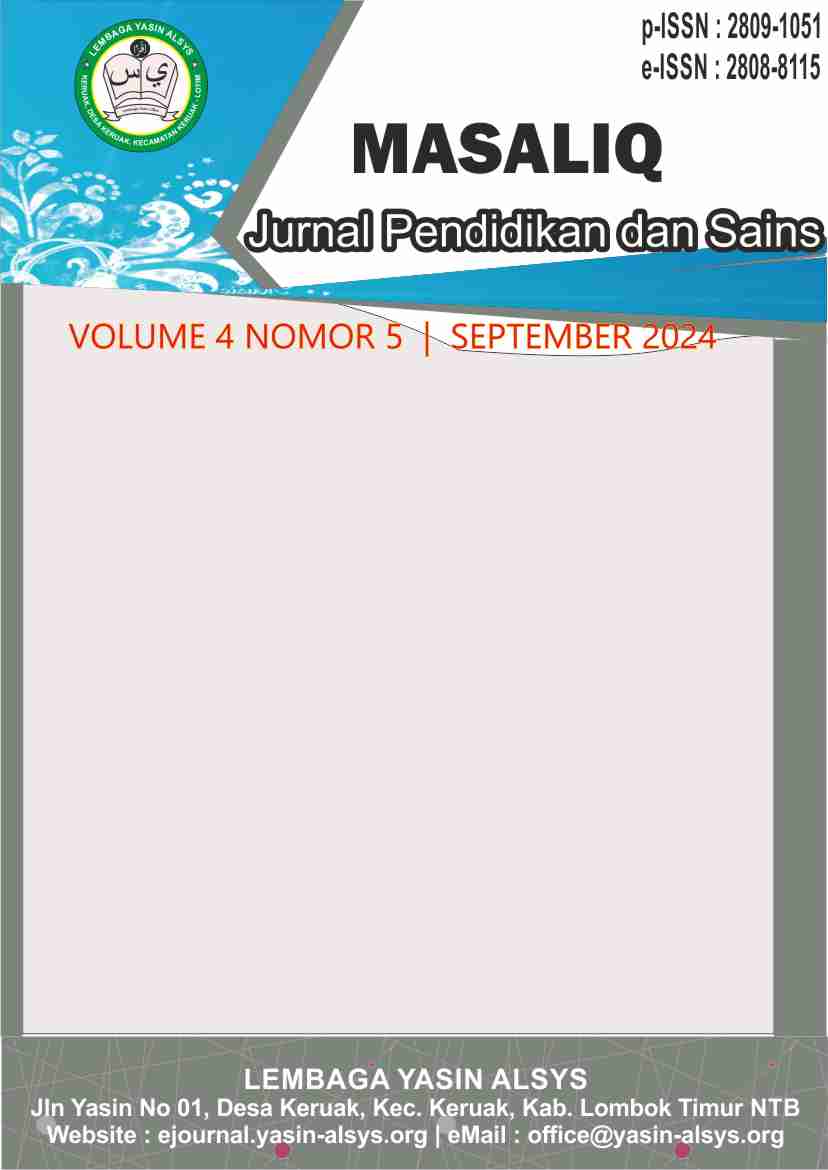
MASALIQ: Jurnal Pendidikan dan Sains
Latest Issue: Vol. 6 No. 5 (September 2026). This issue features peer-reviewed articles that advance research and practice in education and science.
Open Access Peer Reviewed Education & Science
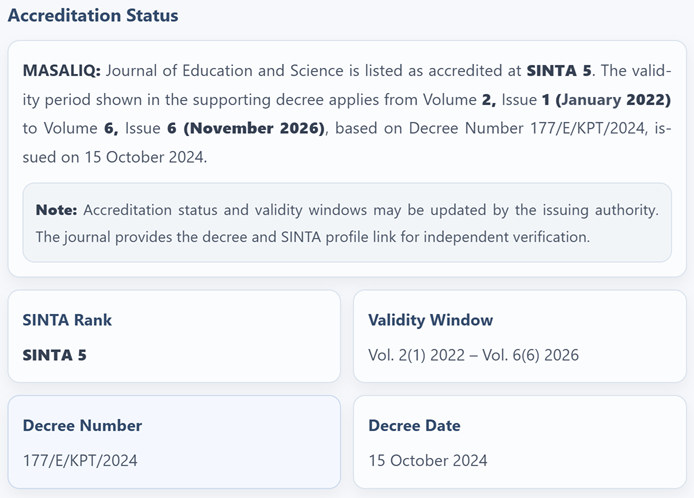
Indexed
To date, MASALIQ has published articles by authors affiliated with institutions in three (3) countries: Indonesia, Nepal, and Japan.
MASALIQ: Jurnal Pendidikan dan Sains is published by Lembaga Yasin Al Sys and is issued six times per year (January, March, May, July, September, and November). All submissions undergo an initial editorial assessment followed by peer review to ensure originality, methodological rigor, ethical compliance, and clarity of scholarly contribution.
Aims
MASALIQ: Jurnal Pendidikan dan Sains aims to publish high-quality, peer-reviewed scholarship in two complementary domains—education and science—while welcoming interdisciplinary work that connects scientific knowledge with educational innovation. The journal prioritizes manuscripts that demonstrate strong conceptual grounding, methodological rigor, and relevance to contemporary educational and scientific challenges.
• Education: advance research on curriculum, instruction, assessment, educational psychology, learning design, technology-enhanced learning, and educational management.
• Science: disseminate scientific studies, whether basic or applied, and science-informed perspectives that contribute to knowledge development and societal problem solving.
• Science Education and STEM: promote scholarship that strengthens teaching, learning, assessment, scientific literacy, and laboratory- or inquiry-based learning.
• Interdisciplinary Integration: encourage the development or evaluation of learning resources grounded in scientific concepts and evidence.
Submissions should clearly state the research problem, describe methods transparently, and articulate a well-defined contribution grounded in relevant scholarship.
Scope
MASALIQ welcomes manuscripts in two primary streams—education and science—along with integrative studies that connect scientific knowledge, STEM practice, and educational innovation. Submissions may address school, higher education, vocational, non-formal, or community contexts, and may focus on local to global issues.
• Education: teaching and learning, curriculum studies, assessment and evaluation, educational psychology, inclusive education, educational leadership, and policy.
• Science: natural sciences and applied sciences, as appropriate to the journal’s policy, including studies with clear methods, data, and reproducible analysis.
• Science Education/STEM: scientific literacy, inquiry and laboratory learning, STEM pedagogy, instructional media, and learning technology grounded in scientific concepts.
• Article Formats: empirical studies, development and evaluation of learning resources, conceptual papers, and systematic or scoping reviews with clear protocols.
Manuscripts should demonstrate scholarly rigor, ethical compliance, and clarity of contribution, with implications logically derived from evidence or argument.
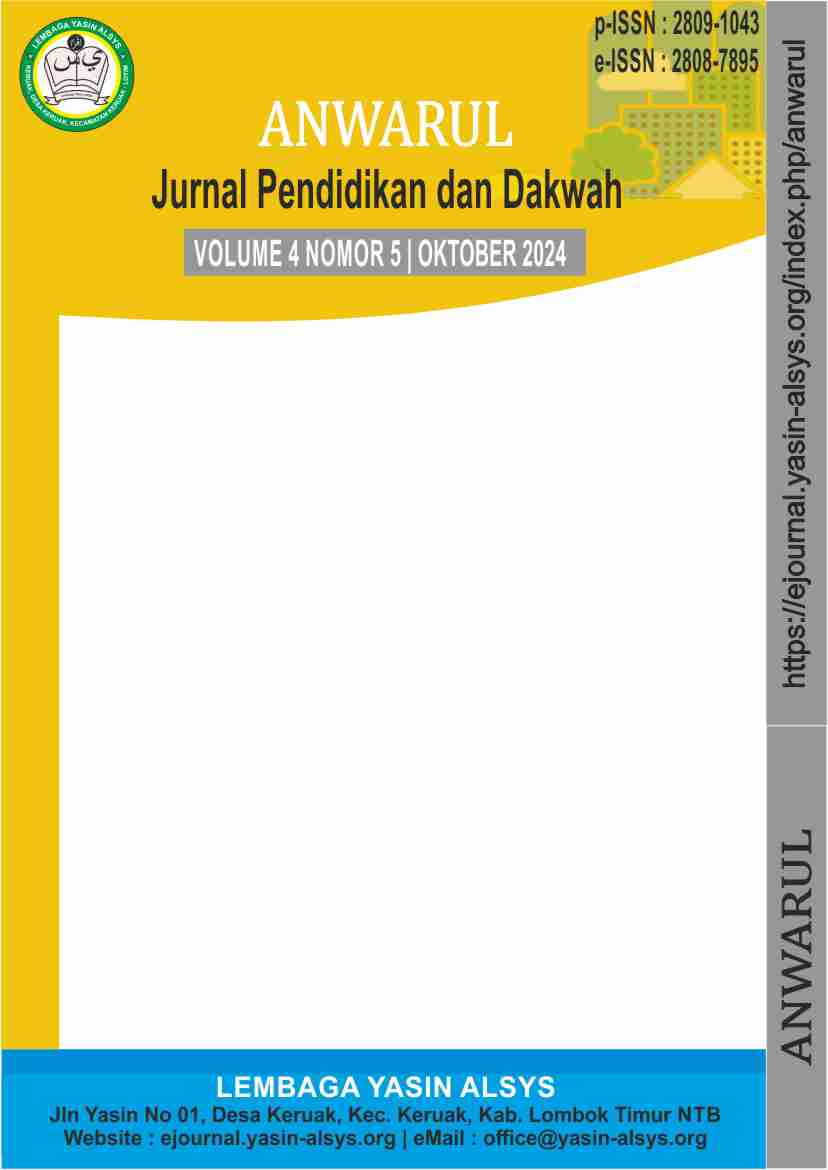
ANWARUL: Jurnal Pendidikan dan Dakwah
Latest Issue: Vol. 6 No. 5 (October 2026). This issue features peer-reviewed articles that contribute to scholarship and practice in education and da‘wah studies.
Open Access Peer Reviewed Education & Da‘wah
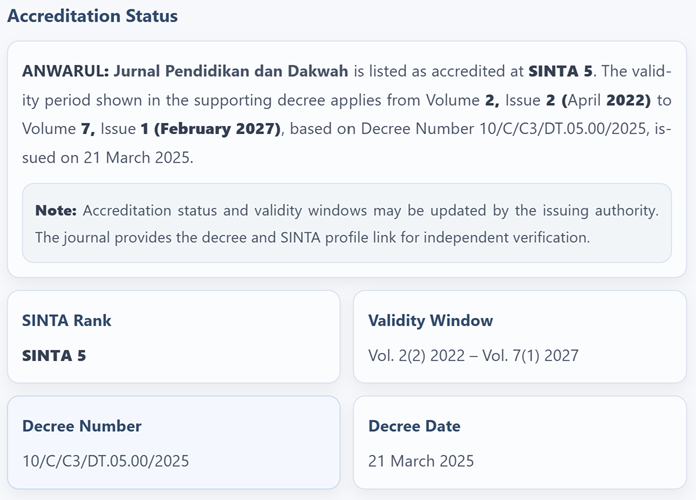
Indexed
To date, ANWARUL has published articles by authors affiliated with institutions in four (4) countries: Indonesia, Nepal, Ethiopia, and Malaysia.
ANWARUL: Jurnal Pendidikan dan Dakwah is published by Lembaga Yasin Al Sys and is issued six times per year (February, April, June, August, October, and December). All submissions undergo an initial editorial assessment followed by peer review to ensure originality, methodological rigor, ethical compliance, and clarity of scholarly contribution.
Aims
ANWARUL: Jurnal Pendidikan dan Dakwah aims to disseminate rigorous, peer-reviewed scholarship in two complementary domains—education and da‘wah—while welcoming integrative studies that connect Islamic educational thought, community engagement, and contemporary communication practices. The journal prioritizes manuscripts that demonstrate conceptual clarity, methodological transparency, and meaningful contribution to theory and/or practice.
• Education: strengthen research on curriculum, pedagogy, learning and assessment, educational psychology, teacher education, and learning innovation across educational levels.
• Da‘wah: advance scholarship on da‘wah communication, community empowerment, religious literacy, and ethical guidance in diverse social and institutional settings.
• Islamic Education: promote studies on pesantren and madrasah practices, character and values education, and curriculum development grounded in Islamic scholarship.
• Contemporary Approaches: encourage digital da‘wah, media and literacy, instructional technology, and evidence-based interventions for education and community programs.
Submissions should clearly state the research problem, describe methods transparently, and articulate a well-defined contribution grounded in relevant scholarship.
Scope
The journal welcomes manuscripts in two primary streams—education and da‘wah—along with integrative studies that connect teaching–learning processes with Islamic communication and community engagement. Submissions may address formal education, non-formal education, and community-based programs, and may focus on local to global contexts.
• Education topics: curriculum and instruction, pedagogy, assessment and evaluation, educational psychology, inclusive education, teacher development, educational leadership, and policy.
• Da‘wah topics: da‘wah strategies and ethics, religious communication, community development, counseling and guidance, social outreach, and institutional da‘wah programs.
• Islamic education: madrasah and pesantren studies, values and character education, Islamic curriculum and learning resources, and educational practices in Muslim communities.
• Media and technology: instructional media, learning technology, digital da‘wah, media literacy, and communication platforms for education and community engagement.
Accepted formats include empirical studies (quantitative, qualitative, or mixed-methods), conceptual papers, and systematic or scoping reviews with clear procedures and ethical compliance.
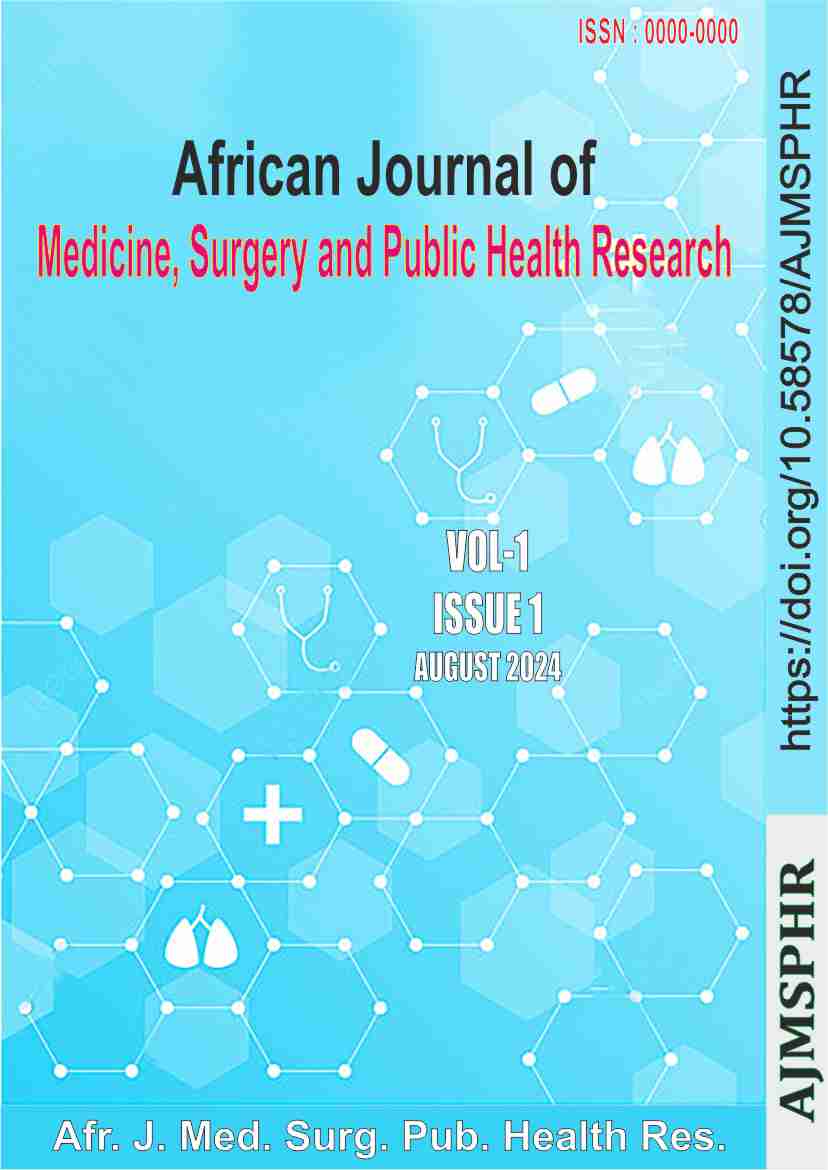
African Journal of Medicine, Surgery and Public Health Research
Initials: AJMSPHR
• ISSN: 1595-8000 • Frequency: 3 issues per year (February, June, and October)
DOI Prefix: 10.58578/AJMSPHR. The journal is an international, rigorously peer-reviewed forum dedicated to publishing high-quality scholarship in medicine, surgery, and public health, with particular emphasis on evidence-based practice, clinical relevance, preventive health, and responsible scientific reporting.
Peer Reviewed Medicine & Surgery Public Health
Citation Analysis and Visibility
African Journal of Medicine, Surgery and Public Health Research (AJMSPHR) is an international peer-reviewed journal devoted to the advancement of scholarship in medicine, surgery, and public health. The journal serves as a platform for the rapid dissemination of original research, clinical investigations, surgical studies, preventive-health scholarship, and population-based health evidence with strong scientific and societal relevance.
Aims
African Journal of Medicine, Surgery and Public Health Research aims to publish rigorous, peer-reviewed scholarship that advances medical science, surgical practice, and public health research through ethically grounded, scientifically robust, and practically relevant studies.
• Medical Research: disseminate high-quality evidence that improves clinical understanding, diagnosis, treatment, and patient care.
• Surgical Scholarship: promote research on surgical procedures, perioperative care, outcomes, innovations, and evidence-based surgical practice.
• Public Health Advancement: support preventive, epidemiological, community, and policy-oriented studies that strengthen population health and healthcare systems.
• Integrated Health Impact: encourage work linking clinical medicine, surgery, and public health to improve health outcomes across individual and community settings.
Submissions should clearly define the clinical, surgical, or public-health problem, report methods transparently, present defensible evidence, and articulate a meaningful contribution to healthcare research and practice.
Scope
AJMSPHR welcomes original research papers and related scholarly contributions in medicine, surgery, and public health, especially studies that demonstrate scientific rigor, ethical responsibility, and clear relevance to health outcomes, healthcare delivery, and disease prevention.
• Medicine: internal medicine, clinical research, disease management, diagnostics, therapeutics, and patient-centered healthcare studies.
• Surgery: general and specialized surgery, operative techniques, perioperative care, surgical outcomes, trauma care, and procedural innovation.
• Public Health: epidemiology, health promotion, disease prevention, environmental health, maternal and child health, and community-health interventions.
• Health Systems and Policy: healthcare access, service delivery, health management, workforce issues, and evidence informing public-health or clinical policy.
• Interdisciplinary Health Research: studies bridging medicine, surgery, and public health with implications for healthcare improvement and population well-being.
Priority is given to original research articles that demonstrate methodological rigor, ethical compliance, and a clear contribution to medical science, surgical knowledge, or evidence-based public-health practice.
Al-DYAS: Jurnal Inovasi dan Pengabdian kepada Masyarakat
Latest Issue: Vol. 5 No. 3 (October 2026). This issue features peer-reviewed contributions that advance innovation, applied research, and high-impact community engagement.
Open Access Peer Reviewed Innovation & Community Service
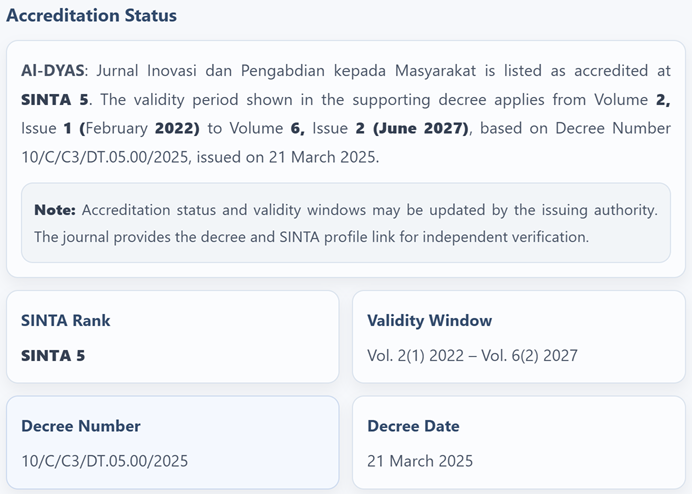
Indexed
To date, Al-DYAS has published articles by authors affiliated with institutions in two (2) countries: Indonesia and Nepal.
Al-DYAS is published by LYAS Publisher and is issued three times per year (February, June, and October). The journal provides a scholarly venue for disseminating applied research, innovation, and evidence-informed community service (pengabdian kepada masyarakat) that generate measurable social impact and strengthen institutional and community capacity.
Aims
Al-DYAS: Jurnal Inovasi dan Pengabdian kepada Masyarakat aims to publish rigorous, peer-reviewed scholarship that advances two complementary domains—innovation and community engagement—while encouraging integrative work that translates knowledge into measurable social benefit. The journal prioritizes manuscripts that demonstrate clear problem definition, transparent intervention or implementation processes, defensible evidence of outcomes, and ethically grounded practice.
• Innovation: disseminate applied research, appropriate technology, product or service development, and technology transfer with clear utility and feasibility.
• Community Engagement: strengthen evidence on empowerment, capacity building, participatory approaches, and service-learning that produce measurable community benefit.
• Implementation and Evaluation: promote the evaluation of programs, policies, and interventions, including monitoring, outcomes, sustainability, and scalability.
• Ethical Practice: uphold consent, safety, fairness, and respectful partnership in community-based work while encouraging transferable and reproducible models.
Submissions should clearly define the community problem or context, describe intervention or program methods transparently, present evidence of outcomes or impact, and articulate a replicable contribution for broader practice.
Scope
Al-DYAS welcomes manuscripts on innovation and community service that report clear implementation processes and verifiable outcomes. Submissions may address diverse sectors, including education, health, economy, environment, agriculture, technology, public services, disaster response, and social welfare, in rural to urban settings, including institutional and community partnerships.
• Community service and evaluation: needs assessment, stakeholder engagement, program design, implementation, monitoring, outcome or impact evaluation, and follow-up plans.
• Applied innovation: appropriate technology, digital solutions, product or service prototypes, technology transfer, and innovation adoption with evidence of usability and benefit.
• Empowerment and capacity building: training models, behavior change strategies, entrepreneurship and MSME support, institutional strengthening, and community resilience.
• Sustainability and scalability: cost-effectiveness, resource planning, partnership governance, sustainability strategies, replication pathways, and risk management.
Accepted formats include program reports with evaluation, applied research papers, implementation analyses, and systematic or scoping reviews that use transparent procedures and ethical safeguards.

AHKAM: Jurnal Hukum Islam dan Humaniora
Latest Issue: Vol. 5 No. 2 (June 2026). This issue presents peer-reviewed scholarship that advances research and informed debate in Islamic law, human rights, and the humanities.
Open Access Peer Reviewed Islamic Law & Humanities
Indexed
To date,
AHKAM has published articles by authors affiliated with institutions in
five (5) countries: Indonesia, India, Egypt, and Malaysia, United Kingdom.
AHKAM is published by LYAS Publisher and is issued four times per year (March, June, September, and December). The journal provides a rigorous forum for scholarly discussion in Islamic law and the humanities, with particular interest in human rights, public policy, legal ethics, and the role of Islamic values in contemporary legal reasoning.
Aims
AHKAM: Jurnal Hukum Islam dan Humaniora aims to advance rigorous, peer-reviewed scholarship in two complementary domains—Islamic law and the humanities—while encouraging interdisciplinary inquiry connecting law, society, and values. The journal prioritizes manuscripts that offer original arguments, sound methodology, whether doctrinal, socio-legal, comparative, historical, or interpretive, and clear contribution to contemporary legal and ethical debates.
• Islamic Law: strengthen debates on fiqh and contemporary Islamic legal issues, uṣūl al-fiqh, fatwa studies, maqāṣid approaches, and Islamic legal thought in changing societies.
• Humanities: enrich scholarship on ethics, philosophy, history, cultural and religious studies, and interpretive traditions that illuminate law as a value-based human practice.
• Law, Society, and Values: encourage analyses of human rights, legal policy, governance, public ethics, and socio-legal perspectives grounded in credible sources.
• Research Integrity: promote transparent argumentation, responsible citation, and ethical handling of data, texts, and participants where applicable.
Submissions should clearly state the research problem, report methods transparently where applicable, and articulate a well-defined contribution grounded in relevant scholarship and ethical standards.
Scope
AHKAM welcomes manuscripts in two primary streams—Islamic law and the humanities—as well as interdisciplinary studies that connect normative reasoning with historical, ethical, and socio-cultural analysis. Submissions may employ doctrinal or normative, comparative, socio-legal, historical, philosophical, or textual approaches, provided the argument is analytically defensible.
• Islamic law topics: contemporary and comparative fiqh, uṣūl al-fiqh, maqāṣid al-sharī‘ah, fatwa and judicial studies, family law, economic law, criminal law, and Islamic legal reform.
• Humanities topics: ethics and moral philosophy, intellectual and social history, religious studies, cultural analysis, and interpretive traditions related to law, authority, and values.
• Law and society: human rights, legal policy and governance, legal ethics, access to justice, socio-legal studies, and interdisciplinary analyses connecting law, institutions, and social change.
• Formats: doctrinal or normative research, socio-legal studies, comparative analyses, conceptual or theoretical papers, and systematic or critical reviews with clear methods.
Priority is given to manuscripts with strong theoretical framing, careful use of sources, transparent analytical steps, and conclusions that are logically derived from the argument or evidence.
TSAQOFAH: Jurnal Penelitian Guru Indonesia
Latest Issue: Vol. 6 No. 3 (May 2026). This issue features peer-reviewed studies that strengthen evidence-informed teaching practice and contemporary educational inquiry.
Open Access Peer Reviewed Research Multidisciplinary
Visibility and Indexing
To date, TSAQOFAH has published articles by authors affiliated with institutions in two (2) countries: Indonesia and Nepal.
TSAQOFAH is published by LYAS Publisher and is issued six times per year (January, March, May, July, September, and November). The journal serves as an open forum for teachers, academics, researchers, and practitioners to disseminate rigorous and ethically grounded scholarship, including teacher research and multidisciplinary studies that integrate contemporary knowledge with Islamic perspectives where relevant.
Aims
TSAQOFAH aims to publish peer-reviewed research and scholarly analyses that strengthen teacher inquiry, educational practice, and multidisciplinary knowledge development. The journal welcomes manuscripts that provide robust empirical evidence, conceptual advances, methodological contributions, or critical syntheses across education and related disciplines, including, when relevant, Islamic studies and knowledge integration in contemporary contexts.
• Educational Practice: advance evidence-informed teaching and learning through rigorous research, reflective inquiry, and pedagogical innovation.
• Multidisciplinary Perspectives: encourage contributions from related fields that enrich educational inquiry with clear theoretical and practical implications.
• Islamic Studies and Islamic Education: support analytically rigorous work with relevance to learning, ethics, community, or public discourse.
• Ethical Scholarship: promote transparent methods, responsible reporting, and ethical compliance in research involving people, texts, or communities.
Manuscripts should clearly formulate a research problem, report methods transparently, present defensible evidence, and articulate a well-defined scholarly contribution aligned with ethical standards.
Scope
TSAQOFAH considers manuscripts across education and related disciplines, including studies that situate teaching-learning within social, cultural, institutional, and ethical dimensions. Submissions may address school, madrasah, pesantren, higher education, non-formal education, and community-based programs, with local to global relevance.
• Education and Pedagogy: curriculum and instructional design, teacher education and professional development, assessment and evaluation, inclusive education, educational psychology, digital learning, and educational policy.
• Islamic Studies: Qur’anic and Hadith studies, fiqh and uṣūl al-fiqh, theology and philosophy, ethics, and Islamic history and civilization, especially when linked to contemporary issues.
• Islamic Education: teaching methodologies, curriculum and learning resources, character and values education, pesantren and madrasah studies, and educational innovation grounded in Islamic perspectives.
• Social Sciences and Humanities: sociology, anthropology, psychology and well-being, law and governance, communication and media, gender and social equity, cultural studies, and community development.
• Accepted Formats: empirical studies, action research and development studies, conceptual papers, and systematic or scoping reviews with clear procedures.
Priority is given to manuscripts with strong conceptual framing, defensible evidence, transparent reporting, and implications that are logically derived for policy and practice.
Kwaghe International Journal of Sciences and Technology
Initials: KIJST
• ISSN: 1595-7977 • Frequency: 3 issues per year (March, July, and November)
DOI Prefix: 10.58578/KIJST. The journal is an international, rigorously peer-reviewed forum devoted to the advancement of science and technology, especially scholarship related to natural sciences, agriculture, and applied scientific innovation.
Open Access Peer Reviewed Science & Technology
Citation Analysis and Visibility:
Kwaghe International Journal of Sciences and Technology (KIJST) is an international peer-reviewed journal dedicated to the rapid dissemination of new advances and scholarly knowledge in natural sciences, technology, and agriculture. The journal welcomes scientifically sound and methodologically robust work that contributes to theoretical understanding, empirical evidence, and applied problem-solving across scientific and agricultural disciplines.
Aims
Kwaghe International Journal of Sciences and Technology aims to publish rigorous, peer-reviewed scholarship that advances natural sciences, agriculture, and technology through high-quality quantitative, qualitative, and mixed-methods research. The journal prioritizes methodological transparency, scholarly relevance, and contributions that strengthen scientific knowledge and applied innovation.
• Natural Sciences: promote robust research that advances knowledge in core scientific fields and their applications.
• Agricultural Development: support scholarship that strengthens agriculture, food systems, environmental sustainability, and rural productivity.
• Scientific Methods: welcome research using quantitative, qualitative, or combined approaches, provided the design and analysis are clearly justified.
• Technology and Application: encourage work that connects scientific findings to technological innovation, practical implementation, and real-world problem-solving.
Submissions should clearly state the research problem, explain the methodological approach transparently, present defensible evidence, and demonstrate a meaningful contribution to science, technology, and/or agriculture.
Scope
KIJST welcomes articles in natural sciences, agriculture, and related scientific fields. The journal accepts research employing surveys, experiments, content analysis, observation, interviews, focus groups, documentary analysis, and other acceptable approaches, provided the analytic logic is rigorous and clearly reported.
• Natural Sciences: physics, biology, chemistry, and related scientific disciplines.
• Agriculture: soil science, animal husbandry, crop protection, fisheries, and allied agricultural studies.
• Life and Environmental Sciences: ecology, environmental science, biological systems, and applied natural-science research.
• Technology and Applied Science: scientific and technological studies with clear practical, industrial, environmental, or agricultural relevance.
• Interdisciplinary Research: studies bridging science, agriculture, and technology to address complex societal, environmental, or development-related issues.
Priority is given to original research articles that contribute clearly to the body of knowledge, demonstrate appropriate methodological rigor, and offer implications for scientific advancement, agricultural improvement, or technological application.
Kwaghe International Journal of Arts, Humanities and Religious Studies
Initials: KIJAHRS
• ISSN: 1595-8027 • Frequency: 3 issues per year (March, July, and November)
DOI Prefix: 10.58578/KIJAHRS. The journal serves as an international, rigorously peer-reviewed forum for the dissemination of scholarly work in the fields of arts, humanities, and religious studies, with particular emphasis on critical inquiry, interpretive depth, and contemporary relevance.
Open Access Peer Reviewed Arts Humanities
Citation Analysis and Visibility
Kwaghe International Journal of Arts, Humanities and Religious Studies (KIJAHRS) is an international scholarly journal committed to publishing original research, theoretical discussions, and critical analyses in arts, humanities, and religious studies. The journal welcomes contributions that deepen understanding of human culture, thought, belief, history, language, literature, ethics, and interpretive traditions, while also engaging contemporary social, cultural, and religious issues with academic rigor.
Aims
Kwaghe International Journal of Arts, Humanities and Religious Studies aims to publish high-quality, peer-reviewed scholarship that advances knowledge in the arts, humanities, and religious studies. The journal encourages critical, historical, textual, philosophical, and interpretive work that strengthens academic understanding of human experience, cultural expression, moral reflection, and religious thought in diverse local and global contexts.
• Arts and Human Expression: promote scholarship on literature, language, visual culture, heritage, and artistic interpretation.
• Humanities Inquiry: support rigorous work in philosophy, history, ethics, cultural studies, and related humanities disciplines.
• Religious Studies: welcome critical studies of religion, belief systems, theology, spirituality, and religious practices across traditions.
• Contemporary Relevance: encourage contributions that connect classical inquiry and textual traditions with present-day cultural, educational, and societal issues.
Submissions should articulate a clear scholarly question, employ an appropriate analytic or interpretive framework, engage relevant literature critically, and demonstrate a meaningful contribution to arts, humanities, and/or religious studies scholarship.
Scope
KIJAHRS welcomes original articles, theoretical papers, critical essays, and review studies in the broad fields of arts, humanities, and religious studies. The journal is open to interdisciplinary work, provided the contribution remains analytically strong, conceptually clear, and grounded in appropriate sources, evidence, or interpretive traditions.
• Arts and Cultural Studies: literature, languages, visual arts, performance, cultural heritage, aesthetics, and creative expression.
• Humanities: history, philosophy, ethics, linguistics, cultural analysis, intellectual traditions, and interpretive scholarship.
• Religious Studies: theology, comparative religion, scripture and textual studies, spirituality, ritual, and religion in society.
• Society and Values: morality, identity, tradition, intercultural dialogue, religion and public life, and social thought.
• Interdisciplinary Scholarship: studies linking arts, humanities, and religion with education, culture, communication, or social transformation.
Priority is given to manuscripts with strong conceptual framing, careful use of primary and secondary sources, transparent interpretive logic, and conclusions that are consistent with the argument and evidence presented.
Kwaghe International Journal of Engineering and Information Technology
Initials: KIJEIT
• ISSN: 1595-8035 • Frequency: 3 issues per year (January, May, and September)
DOI Prefix: 10.58578/KIJEIT. The journal is an international, rigorously peer-reviewed forum dedicated to advancing engineering and information technology scholarship, especially research that contributes to technological innovation, systems development, and engineering solutions for contemporary scientific and societal challenges.
Peer Reviewed Engineering Information Technology
Citation Analysis and Visibility
Kwaghe International Journal of Engineering and Information Technology (KIJEIT) is an international peer-reviewed journal dedicated to the dissemination of original research, theoretical developments, and applied innovation in engineering and information technology. The journal welcomes work that demonstrates technical rigor, methodological transparency, and relevance to current industrial, computational, digital, and engineering challenges in local and global contexts.
Aims
Kwaghe International Journal of Engineering and Information Technology aims to publish high-quality, peer-reviewed scholarship that advances engineering design, computational systems, digital technologies, and information-based innovation. The journal prioritizes contributions with clear technical novelty, sound validation, and practical or theoretical significance for engineering and information technology.
• Engineering Innovation: promote rigorous research on engineering systems, design, modeling, optimization, and implementation.
• Information Technology: support advances in software, computing, data systems, networking, and digital solutions.
• Interdisciplinary Integration: encourage studies connecting engineering with information technology to solve complex real-world problems.
• Applied Relevance: welcome research that demonstrates practical value, scalability, reliability, and technological impact.
Submissions should clearly define the technical problem, explain the methodological approach precisely, report validation or evaluation transparently, and demonstrate a meaningful contribution to engineering and/or information technology scholarship.
Scope
KIJEIT welcomes original research papers, theoretical studies, system designs, and applied investigations in engineering and information technology. The journal considers work in both foundational and applied domains, provided the engineering or information-technology contribution is explicit, analytically sound, and well reported.
• Computer and Information Technology: software engineering, information systems, databases, cloud computing, artificial intelligence, and data analytics.
• Electrical and Electronic Engineering: electronics, instrumentation, embedded systems, signal processing, communications, and control systems.
• Networks and Cybersecurity: network architecture, internet technologies, digital security, cryptography, and secure system implementation.
• Automation and Intelligent Systems: robotics, IoT, smart systems, human–machine interaction, and technology-supported optimization.
• Engineering Applications: computational modeling, simulation, algorithm development, system evaluation, and interdisciplinary engineering solutions.
Priority is given to manuscripts with strong technical framing, transparent evaluation procedures, and conclusions that are logically supported by experimental, computational, or analytical evidence.