
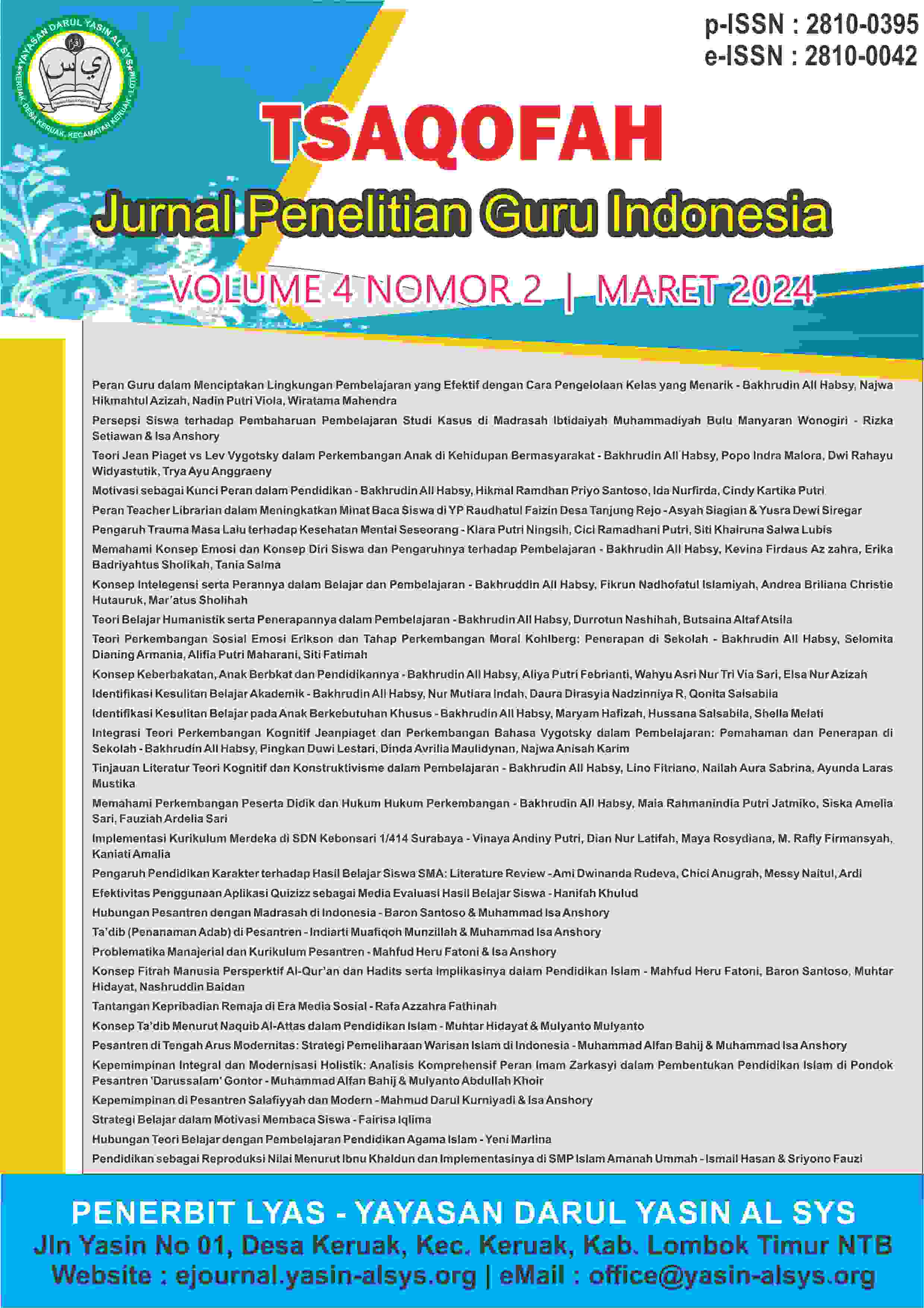
Integrasi Teori Perkembangan Kognitif Jeanpiaget dan Perkembangan Bahasa Vygotsky dalam Pembelajaran: Pemahaman dan Penerapan di Sekolah Integration of Jean Piaget's Cognitive Development Theory and Vygotsky's Language Development in Learning: Understanding and Implementation in Schools
Main Article Content
Abstract
Education has an important role in shaping children's development, especially in terms of cognition and language. In the cognitive development literature, Jean Piaget's theory and Lev Vygotsky's theory of language development have become two significant approaches in understanding how children learn, think, and communicate. This article combines these two theories and discusses their application in the context of learning in schools. Jean Piaget's theory of cognitive development emphasizes the stages of intellectual development that play a role in children's understanding of the world. In a learning context, this understanding can help teachers develop a curriculum that is appropriate to students' cognitive development stages. Meanwhile, Vygotsky's theory of language development highlights the role of social interaction and the environment in children's language development. The application of this theory includes a collaborative approach to learning that encourages more effective communication and language interaction in the classroom.




Citation Metrics:



Downloads
Citation Metrics & Similar Scopus Articles
-
Maiese K. (2027)Oxidative stress, aging, metabolism, SIRT1, and the gut microbiota: the neurocardiac basis of cognitive lossMedical Gas Research, 17(1)
-
Rezvani V. (2027)Analysis of "Agentive Suffixes" in Russian and Persian Nouns from a Cognitive Morphological PerspectiveLanguage Related Research, 17(4), 203-230
-
Azhand A. (2027)Teaching Persian derivational affixes to non-Persian speakers from a Cognitive Morphology Approach: A case study of nominal suffixes (kar, gar, ban, baz, -ande)Language Related Research, 17(4), 469-497
Article Details

Authors retain copyright and grant the journal right of first publication with the work simultaneously licensed under a Creative Commons Attribution-NonCommercial-ShareAlike 4.0 International License that allows others to share the work with an acknowledgement of the work's authorship and initial publication in this journal.
Article Sidebar
 Page Numbers:
735-750
Page Numbers:
735-750
 Digital Object ID:













 Viewed: 2.743 times
 Downloaded: 1.959 times
LYAS Publisher cordially invites qualified professionals to serve as Editors or Reviewers. Your expertise will make an important contribution to maintaining and strengthening the academic quality of our publications. Interested applicants are kindly requested to complete the application form at the following link: Editors & Reviewers


Please feel free to contact us if you need any further information about the submission process or if you have any additional questions.

 Authors:
 Copyright :
Authors retain copyright and grant the journal right of first publication.
Explore Our Journals
Find the journal that best fits your research. If this journal does not match your manuscript’s scope, explore our portfolio below to select a more suitable publication venue.