
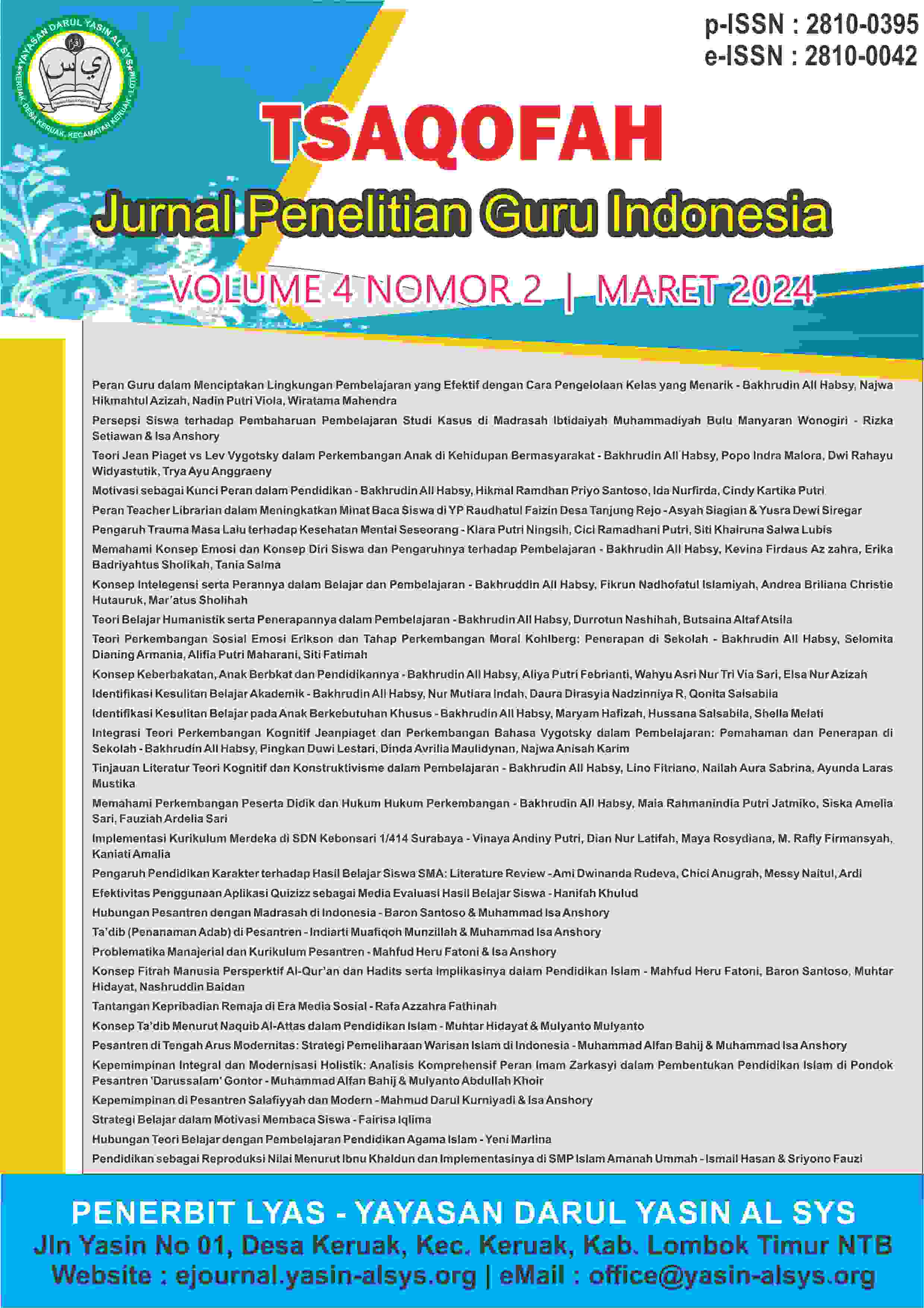
Teori Jean Piaget vs Lev Vygotsky dalam Perkembangan Anak di Kehidupan Bermasyarakat Jean Piaget's Theory vs Lev Vygotsky's Theory in the Social Context of Child Development
Main Article Content
Abstract
Child development in the context of social life is a complex and important topic in developmental psychology. Two theories that have greatly influenced the understanding of children's development in social settings are those of Jean Piaget and Lev Vygotsky. Jean Piaget's theory explains the urgency of the role of cognition in children's development. Piaget describes children constructing their own knowledge through stages of cognitive development. In the context of social life, Piaget's theory highlights how children acquire and adapt knowledge through interaction with their social environment. Children learn by exploring, asking questions, and building knowledge with peers and adults. Meanwhile, Lev Vygotsky emphasized the role of the social environment in children's development. His theory introduced the concept of real developmental fields, where children can learn from interactions with more experienced people. In social life, Vygotsky suggested that children can develop cognitive and social skills through cooperation with adults and peers. This reinforces the idea that learning is a social process that takes place in a social context. The combination of Piaget and Vygotsky's theories helps us understand how children develop an understanding of their social world and how the social environment plays an important role in this process. Through purposeful exploration and interaction in community life, children can build the foundation of social knowledge and skills needed to thrive and become contributing members of society.




Citation Metrics:



Downloads
Citation Metrics & Similar Scopus Articles
-
Benallal A. (2027)Jean Lemaitre (1934–2025)European Journal of Mechanics A Solids, 121
-
Farmer M.T. (2027)Analysis of the ex-vessel phase of the Fukushima Daichi Unit 1 reactor accident using improved MCCI tools that incorporate major modeling contributions by J.M. SeilerAnnals of Nuclear Energy, 241
-
Andersen S.T. (2027)Shared Technology in Interdisciplinary Workshops: Social Constructivist Learning in Professional EducationLecture Notes in Computer Science, 16842 LNCS, 24-29
Article Details

Authors retain copyright and grant the journal right of first publication with the work simultaneously licensed under a Creative Commons Attribution-NonCommercial-ShareAlike 4.0 International License that allows others to share the work with an acknowledgement of the work's authorship and initial publication in this journal.
Article Sidebar
 Page Numbers:
576-586
Page Numbers:
576-586
 Digital Object ID:













 Viewed: 5.790 times
 Downloaded: 16.794 times
LYAS Publisher cordially invites qualified professionals to serve as Editors or Reviewers. Your expertise will make an important contribution to maintaining and strengthening the academic quality of our publications. Interested applicants are kindly requested to complete the application form at the following link: Editors & Reviewers


Please feel free to contact us if you need any further information about the submission process or if you have any additional questions.

 Authors:
 Copyright :
Authors retain copyright and grant the journal right of first publication.
Explore Our Journals
Find the journal that best fits your research. If this journal does not match your manuscript’s scope, explore our portfolio below to select a more suitable publication venue.