
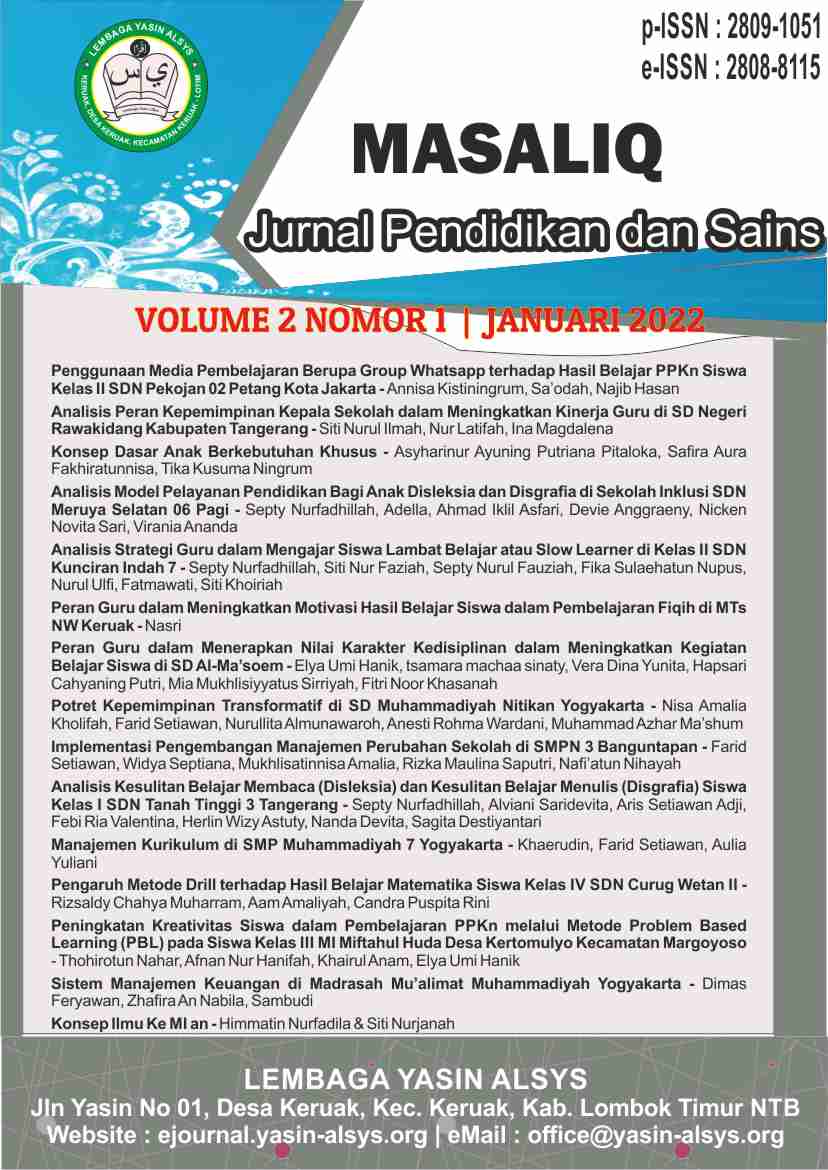
Analisis Peran Kepemimpinan Kepala Sekolah dalam Meningkatkan Kinerja Guru di SD Negeri Rawakidang Kabupaten Tangerang
Main Article Content
Abstract
Education is a community need that is expected to create quality human beings, to realize these expectations formally education is held in schools. The purpose of this study was to determine the role of the principal's leadership in improving teacher performance at SDN Rawakidang. The method in this study used qualitative research methods with a descriptive approach, data collection techniques used observation, interviews and documentation techniques. The results of the research of the principal as the head of the school conduct training and education and invite sources from outside related to KBM and according to the 2013 curriculum, always provide direction and motivation to teachers to use active methods, always supervise when the teacher is carrying out the teaching and learning process at school. class, provide guidance to teachers and education staff, the principal asks to be present 20 minutes earlier than the students and wait for students in front of the class. conclusion The role of the principal's leadership in improving teacher performance at SDN Rawakidang is to provide a democratic, disciplined attitude, and control each class during the teaching and learning process, democratic attitudes are sought to eliminate distrust in solving problems in the classroom. as well as at school, and a disciplined attitude is sought to provide a sense of responsibility.




Citation Metrics:




Downloads
Citation Metrics & Similar Scopus Articles
-
Al Khafaji S.Y. (2027)Impact of Socioeconomic Determinants on the Prevalence of Traumatic Dental Injury among Primary School ChildrenPesquisa Brasileira Em Odontopediatria E Clinica Integrada, 27
-
Khasanah A.N. (2027)Self-Health Literacy Among Students in Islamic School Science Education: A Comparative Analysis Across Gender, Grade Level, and School ContextAsean Journal of Educational Research and Technology, 6(1), 93-106
-
Ratnaningsih E. (2027)Designing a Data-Driven E-Learning Module for Teaching English to Young Learners: Integrating Needs Analysis and the ISAV Learning ModelAsean Journal of Educational Research and Technology, 6(2), 269-286
Article Details

Authors retain copyright and grant the journal right of first publication with the work simultaneously licensed under a Creative Commons Attribution-NonCommercial-ShareAlike 4.0 International License that allows others to share the work with an acknowledgement of the work's authorship and initial publication in this journal.
Article Sidebar
 Page Numbers:
12-25
 Digital Object ID:













 Viewed: 1.746 times
 Downloaded: 799 times

LYAS Publisher cordially invites qualified professionals to serve as Editors or Reviewers. Your expertise will make an important contribution to maintaining and strengthening the academic quality of our publications. Interested applicants are kindly requested to complete the application form at the following link: Editors & Reviewers


Please feel free to contact us if you need any further information about the submission process or if you have any additional questions.

 Authors:
 Copyright :
Authors retain copyright and grant the journal right of first publication.
Explore Our Journals
Find the journal that best fits your research. If this journal does not match your manuscript’s scope, explore our portfolio below to select a more suitable publication venue.