
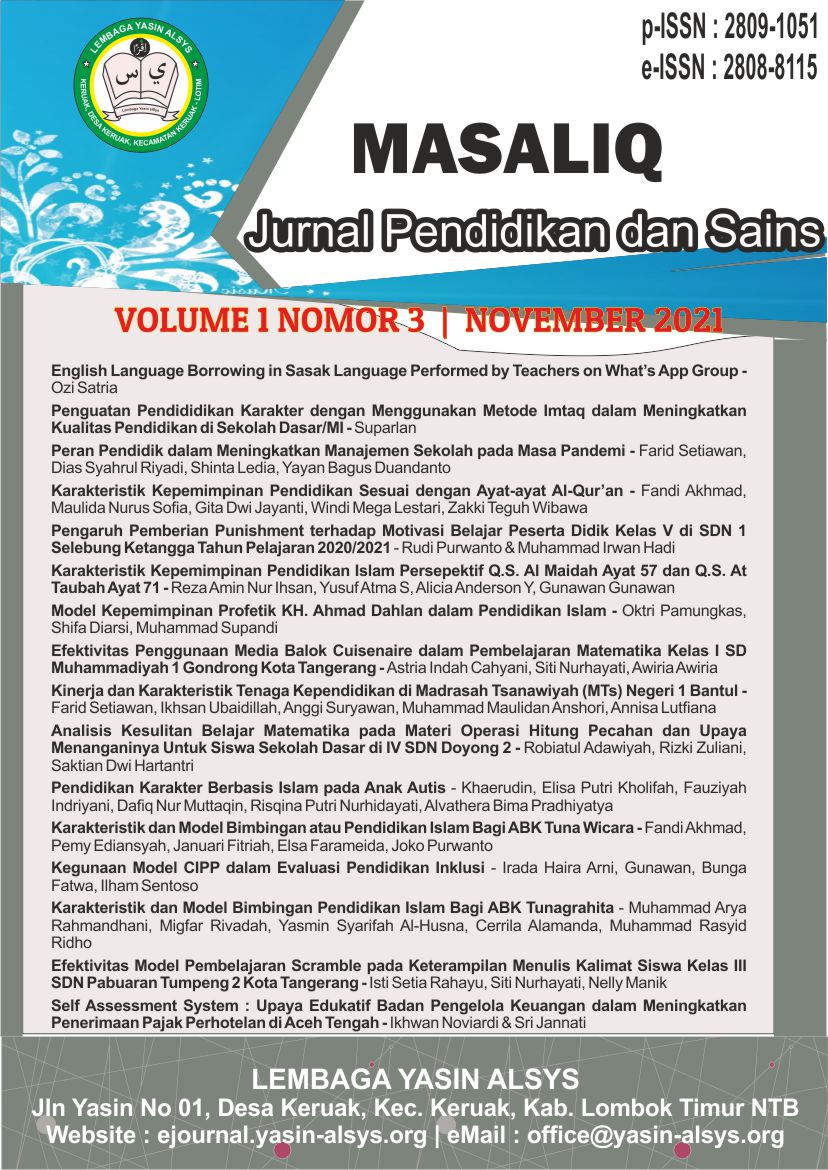
Model Kepemimpinan Profetik KH. Ahmad Dahlan dalam Pendidikan Islam
Main Article Content
Abstract
Ahmad Dahlan is one of the figures who brought changes in Islamic education to a better direction. Of course, this success cannot be separated from his leadership model which makes the Prophet Muhammad his role model in becoming a leader. He internalizes prophetic leadership in his thoughts and actions. Prophetic leadership is a leadership paradigm that refers to the concept of leadership of the prophets. This study uses a literature review method to discuss the idea of prophetic leadership in terms of humanization, liberation, and transcendence of the KH figure. Ahmad Dahlan in Islamic Education.




Citation Metrics:




Downloads
Citation Metrics & Similar Scopus Articles
-
Ding S. (2027)Digital Renewal of University Education: Barriers, Opportunities, and Contributions to Sustainable Development Goals (SDGs)Asean Journal of Educational Research and Technology, 6(2), 229-240
-
Trisnowati E. (2027)Science, Technology, Engineering, and Mathematics (STEM) and Research Skill Development (RSD) in Science Education in Higher Education: A Delphi-Based ModelAsean Journal of Educational Research and Technology, 6(2), 253-268
-
Unyaphatariyakool S. (2027)Science Teachers’ Learning Management Competency through Professional Learning Communities to Promote Scientific Creativity and Sustainable Development Goals (SDGs)Asean Journal of Educational Research and Technology, 6(2), 241-252
Article Details

Authors retain copyright and grant the journal right of first publication with the work simultaneously licensed under a Creative Commons Attribution-NonCommercial-ShareAlike 4.0 International License that allows others to share the work with an acknowledgement of the work's authorship and initial publication in this journal.
Article Sidebar
 Page Numbers:
87-103
Page Numbers:
87-103
 Digital Object ID:













 Viewed: 973 times
 Downloaded: 2.641 times

LYAS Publisher cordially invites qualified professionals to serve as Editors or Reviewers. Your expertise will make an important contribution to maintaining and strengthening the academic quality of our publications. Interested applicants are kindly requested to complete the application form at the following link: Editors & Reviewers


Please feel free to contact us if you need any further information about the submission process or if you have any additional questions.

 Authors:
 Copyright :
Authors retain copyright and grant the journal right of first publication.
Explore Our Journals
Find the journal that best fits your research. If this journal does not match your manuscript’s scope, explore our portfolio below to select a more suitable publication venue.