
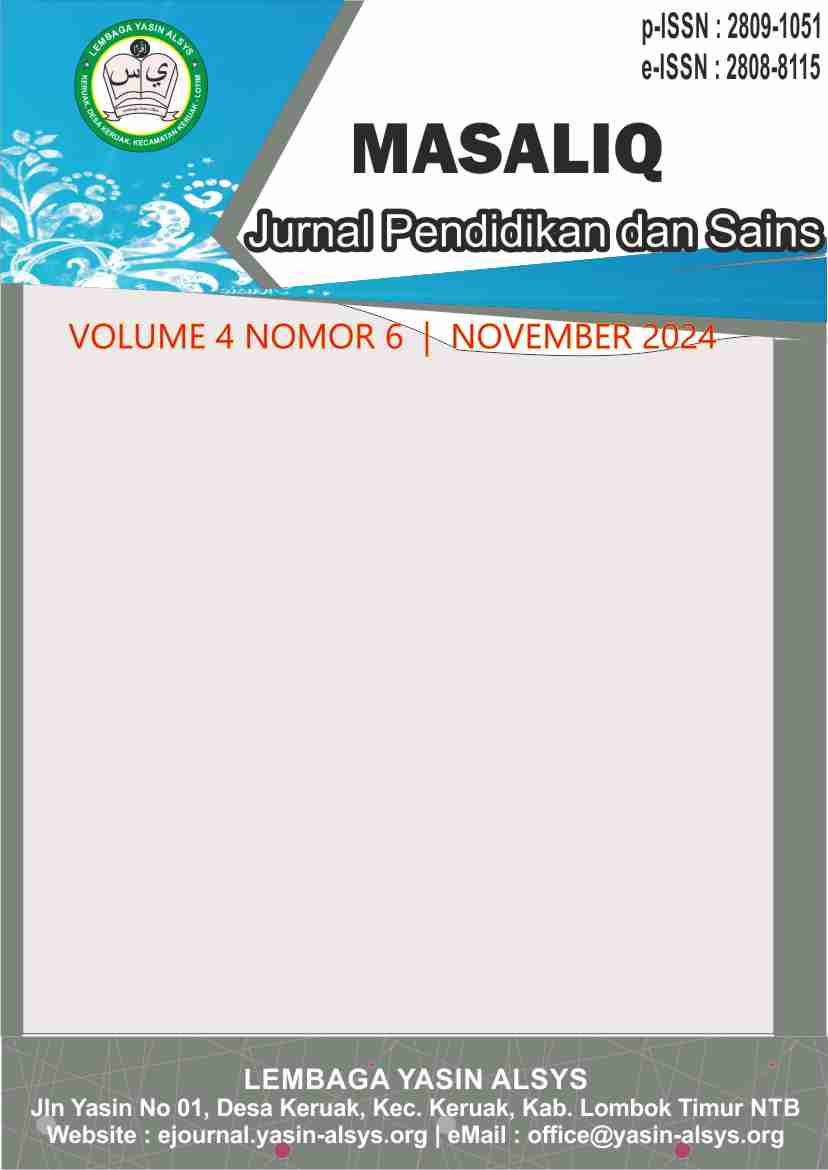
Hubungan Upaya Guru Mendisiplinkan Siswa dengan Tingkat Kedisiplinan Siswa The Relationship Between Teachers' Efforts to Discipline Students and Students' Level of Discipline

Article Sidebar
 Page Numbers:
1115-1125
Page Numbers:
1115-1125
 Digital Object Identifier:


 Viewed: 290 times
 Downloaded: 273 times












LYAS Publisher cordially invites qualified professionals to serve as Editors or Reviewers. Your expertise will make an important contribution to maintaining and strengthening the academic quality of our publications. Interested applicants are kindly requested to complete the application form at the following link: Editors & Reviewers


Please feel free to contact us if you need any further information about the submission process or if you have any additional questions.

 Authors:
Eltry Pratami Almezanda1, Dina Sukma2
 Copyright :
Authors retain copyright and grant the journal right of first publication.
Main Article Content
Abstract
This research is based on the existence of students who lack discipline and violate school rules. One of the factors that influences student discipline is the teacher's efforts. This research aims to: (1) describe students' perceptions of teachers' efforts to improve student discipline at SMP Negeri 11 Padang. (2) describe student discipline at SMP Negeri 11 Padang. (3) find out whether there is a relationship between students' perceptions of teachers' efforts to improve discipline and student discipline at SMP Negeri 11 Padang. This research uses quantitative research methods with a descriptive approach. The population of this research was 700 students at SMP Negeri 11 Padang for the 2024/2025 academic year with a research sample of 265 students selected using stratified random sampling. Data were analyzed using descriptive statistical techniques and Pearson Product Moment correlation. The results of this research indicate that the level of student discipline at SMP Negeri 11 Padang is in the high category, the teacher's efforts to discipline students at SMP Negeri 11 Padang are in the good category, and there is a positive and significant relationship between the teacher's efforts to discipline students (X) and the level of discipline student (Y) at SMP Negeri 11 Padang with a correlation coefficient of 0.756 with a significance value of 0.000 at a strong relationship level.




Citation Metrics:




Downloads
Citation Metrics & Similar Scopus Articles
-
Petrukha N. (2027)Innovative and Digital Approaches in Higher Education for Student Motivation and Sustainable Development Goals (SDGs): A Literature ReviewAsean Journal of Educational Research and Technology, 6(1), 171-182
-
Kumar A. (2027)Direct Technology Diffusion in Higher Education: Evidence from Doctoral StudentsAsean Journal of Educational Research and Technology, 6(1), 79-92
-
Irawati R. (2027)Enhancing accounting students’ writing performance through problem-based learning: Evidence from a vocational higher education contextMultidisciplinary Science Journal, 9(1)
Article Details

Authors retain copyright and grant the journal right of first publication with the work simultaneously licensed under a Creative Commons Attribution-NonCommercial-ShareAlike 4.0 International License that allows others to share the work with an acknowledgement of the work's authorship and initial publication in this journal.
References
Diananda, A. (2019). Psikologi Remaja dan Permasalahannya. Istighna: Jurnal Pendidikan dan Pemikiran Islam, 1(1),
Gunawan, H. (2012). Pendidikan Karakter. Bandung: Alfabeta.
Gunawan, Y. (2001). Pengantar Bimbingan dan Konseling. Jakarta: Pelindo.
Hidayat, K (2019) “Layanan Bimbingan Konseling Dalam Membentuk Kedisiplinan Siswa Sd Negeri Gabus 4 Kecamatan Ngrampal Kabupaten Sragen”, Surakarta : Universitas Muhammadiyah Surakarta.
Hurlock, E. B. (1996). Psikologi Perkembangan. Jakarta: Erlangga.
Hurlock, E.B. (2013). Perkembangan Anak Jilid 2. Jakarta: Erlangga.
Masrur, A. (2019). Peran Guru Bimbingan Konseling dalam Mengatasi Kedisiplinan Siswa, Skripsi, IAIN Bukittinggi.
Mute. (2016). Pengaruh Disiplin Belajar Terhadap Hasil Belajar Siswa (Studi Kasus SMP Negeri 3 Pematang Siantar. Jurnal Poliprofesi. (10) 2. 66-78.
Najmuddin, dkk. (2019). Program Kedisiplinan Siswa di Lingkungan Sekolah. Pendidikan Islam. 08(02): 183-205.
Ningsih, B. M. & Widiharto, C.A. (2014). Peningkatan Disiplin Siswa Dengan Layanan Informasi Media Film. Jurnal Pendidikan. Vol (1). No (1). ISSN 2406-8691.
Nurhayati, E. I. B. (2018). Upaya guru dalam meningkatkan kedisiplinan siswa (Studi di Mts Qubbatul Islam Karang Taliwang Kec. Cakranegara Kota Mataram).
Ramadhani, V. (2022). Deskripsi Disiplin Siswa di SMA N 1 Sungai Tarab, Tanah Datar.
Salsabila, A., Affifah, A. N., & Cahyati, S. Y. (2020). Penanaman Karakter Disiplin pada Siswa SDN Jelupang 01. Edisi, 2(2), 318-333.
Smith, M. B. (2011). Pengaruh Layanan Konseling Kelompok Terhadap Disiplin Belajar Siswa di SMA Negeri 1 Atinggola Kabupaten Gorontalo Utara. Jurnal Penelitian dan Pendidikan, 8(1), 22-32.
Suprihatiningrum, D., Nafi'ah, S. A., & Janah, R. (2021). Peran Guru Dalam Meningkatkan Kedisiplinan Siswa SD Negeri Tanjunganom Banyuurip Kabupaten Purworejo. As-Sibyan, 4(1), 52-66.
Suwignyo, H., & Nusantoro, E. (2015). Pengaruh Layanan Bimbingan Kelompok Terhadap Kedisiplinan Belajar pada Siswa Kelas VIII D. Indonesian Journal of Guidance and Counseling: Theory and Application, 4(3).
Tu’u, Tulus. (2008). Peran Disiplin pada Perilaku dan Prestasi Siswa. Jakarta: PT. Grasindo.
Tulus Tu’u. (2004) . Peran Disiplin Pada Perilaku Dan Prestasi Siswa. Jakarta: Grasindo.
Utari, N. D., Ulfah, M., & Warneri, W. (2019). Analisis faktor penyebab ketidakdisiplinan siswa di SMA Santun Untan Pontianak. Jurnal Pendidikan Dan Pembelajaran Khatulistiwa, 8(3), 1–10.
Wirantasa, Umar. (2017). Pengaruh Kedisiplinan Siswa terhadap Prestasi Belajar Matematika. Formatif. 07(01): 83-95.Wiyani, Novan Ardy. (2013). Manajemen Kelas : Teori dan Aplikasi Untuk Menciptakan Kelas Yang Kondusif. Yogyakarta : AR RUZZ MEDIA.