
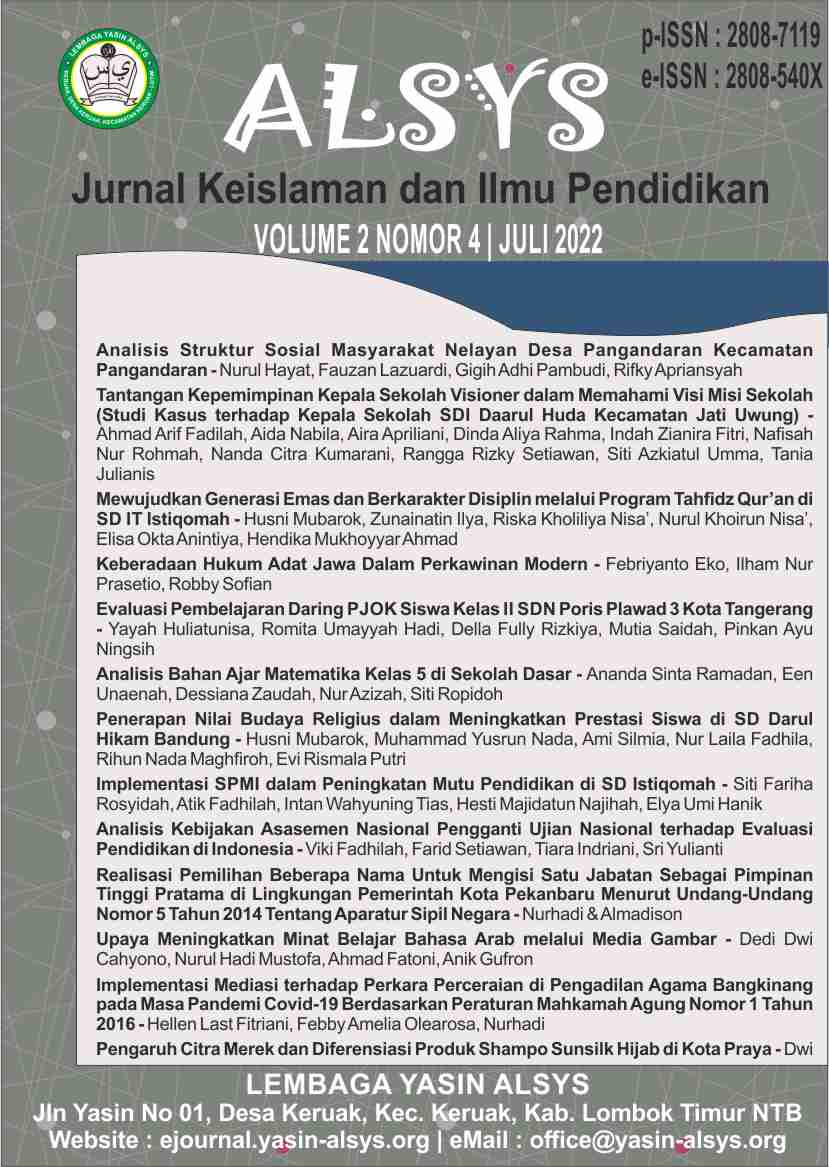
Implementasi Mediasi terhadap Perkara Perceraian di Pengadilan Agama Bangkinang pada Masa Pandemi Covid-19 Berdasarkan Peraturan Mahkamah Agung Nomor 1 Tahun 2016
Main Article Content
Abstract
The writing of this article was motivated by the Implementation of Mediation on Divorce Cases at the Bangkinang Religious Court during the Covid-19 Pandemic based on Supreme Court Regulation Number 1 of 2016, that the divorce rate increased from before the pandemic period. Of course, the Bangkinang Religious Court in this case is the executor in carrying out the PERMA which is assisted by mediators in reconciling the litigants, especially divorce cases which continue to increase from 2020 to 2021 during the current pandemic and many mediation implementations have failed. This study discusses how to implement mediation in divorce cases at the Bangkinang Religious Court during the COVID-19 pandemic based on Supreme Court Regulation Number 1 of 2016 and the inhibiting factors for the implementation of mediation for divorce cases at the Bangkinang Religious Court during the covid-19 pandemic. This study uses a sociological legal research method (socio legal research), which is one type of research that goes directly to the field to adjust theory and reality in the field through observation and interviews. The sources used include primary legal materials, secondary legal materials and tertiary legal materials. Then the sampling technique with purposive sampling technique. The results of this study are that the implementation of mediation at the Bangkinang Religious Court is not optimal to reduce the divorce rate because there are still many mediations that fail and there are still obstacles faced by the Bangkinang Religious Court, namely the strong desire of the parties to divorce, because in general the failure of mediation is because the parties already have a strong desire to divorce, the defendant and the respondent do not have good intentions and there are still mediator judges who do not have a certificate as a mediator, of course, compared to a mediator who already has a certificate of ability, it must still be under his knowledge because to get a mediator certificate a lot of knowledge is gained.




Citation Metrics:




Downloads
Citation Metrics & Similar Scopus Articles
-
Hardiyanto R. (2027)Development and testing the effectiveness of KNX-based smart building learning media using a 4-D model for control systems at vocational schoolsMultidisciplinary Science Journal, 9(2)
-
Vostruhová A. (2027)Measuring Religiosity in the Context of Contemporary Transformations of SpiritualityReligio, 35(1)
-
Nuraini H. (2027)Folklore in learning and its implications for cultural literacy: A bibliometric study and systematic literature reviewMultidisciplinary Reviews, 10(2)
Article Details

Authors retain copyright and grant the journal right of first publication with the work simultaneously licensed under a Creative Commons Attribution-NonCommercial-ShareAlike 4.0 International License that allows others to share the work with an acknowledgement of the work's authorship and initial publication in this journal.
Article Sidebar
 Page Numbers:
555-566
Page Numbers:
555-566
 Digital Object ID:













 Viewed: 410 times
 Downloaded: 360 times

LYAS Publisher cordially invites qualified professionals to serve as Editors or Reviewers. Your expertise will make an important contribution to maintaining and strengthening the academic quality of our publications. Interested applicants are kindly requested to complete the application form at the following link: Editors & Reviewers


Please feel free to contact us if you need any further information about the submission process or if you have any additional questions.

 Authors:
 Copyright :
Authors retain copyright and grant the journal right of first publication.
Explore Our Journals
Find the journal that best fits your research. If this journal does not match your manuscript’s scope, explore our portfolio below to select a more suitable publication venue.