
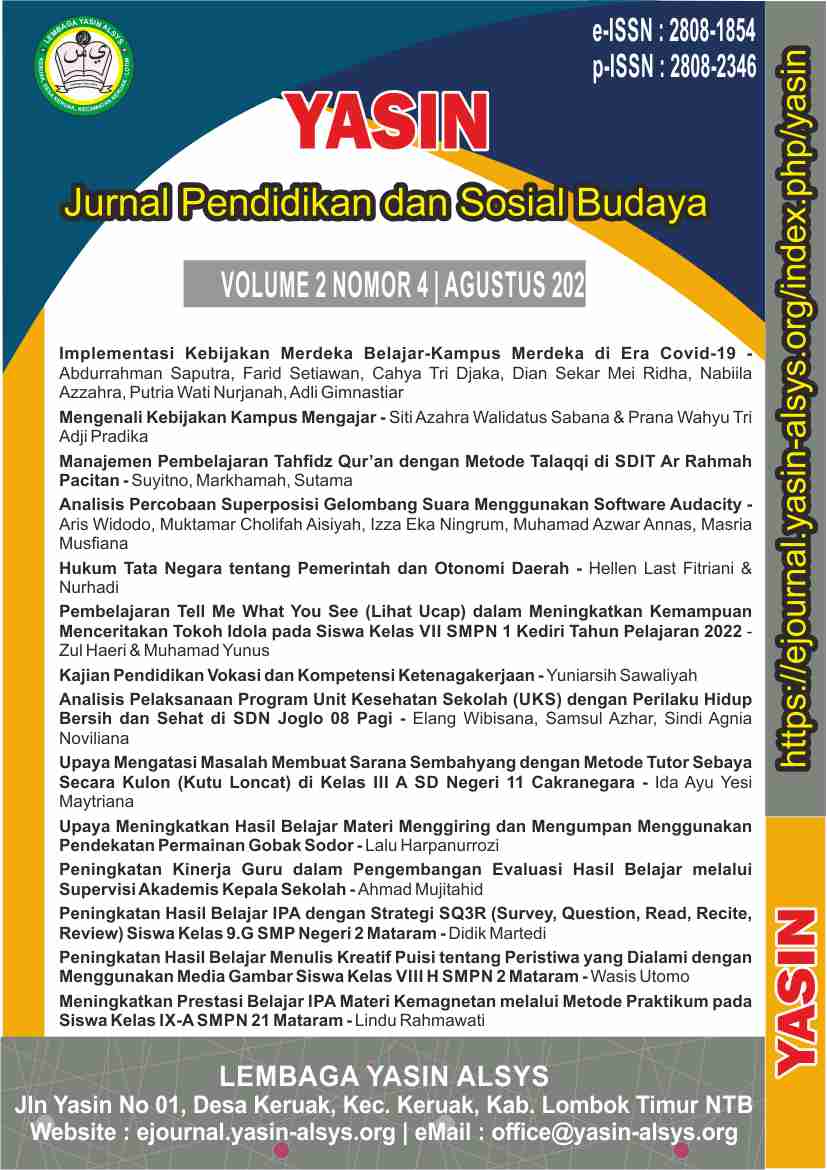
Hukum Tata Negara tentang Pemerintah dan Otonomi Daerah
Main Article Content
Abstract
State Philosophy Officially explaining the 1945 Constitution, in general, regarding the main idea in the preamble of the 1945 Constitution, it is said that "a state that has sovereignty over the people based on democracy and deliberation of representatives". So the state will not run well without regional or autonomous administrators. Therefore, it is necessary to know what local government is, the principles, the relationship between the center and the regions, authority, council representation, systematics for forming regional and autonomous governments? Furthermore, it can be explained that according to Law Number 23 of 2014 concerning Regional Government, regional government is the implementation of government affairs by regional governments and the Regional People's Representative Council (DPRD) using the principle of autonomy and co-administration with the principle of autonomy as wide as possible in the system and principles of the State. The Unity of the Republic of Indonesia as referred to in the 1945 Constitution of the Republic of Indonesia. The relationship between the central and local governments by Clarke and Stewart is conceptualized in three forms, namely: The Relative Autonomy Model, The Agency Model and The Interaction Model. Local government powers include: Externalities; Accountability and Efficiency. The legislation in question includes: (i) Law no. 18 of 1965 concerning the Principles of Regional Government (hereinafter referred to as Law 18/1965), (ii) Law no. 5 of 1974 concerning the Principles of Regional Government (hereinafter referred to as Law 5/1974), (iii) Law no. 22 of 1999 concerning Regional Government (hereinafter referred to as Law 22/1999), (iv) Law no. 32 of 2004 concerning Regional Government (hereinafter referred to as Law 32/2004), (v) PERPPU No. 3 of 2005 concerning Amendments to Law no. 32 of 2004 concerning Regional Government (hereinafter referred to as PERPPU 3/2005), (vi) Law no. 8 of 2005 concerning Stipulation as Law on PERPPU No. 3 of 2005 concerning Amendments to Law no. 32 of 2004 concerning Regional Government (hereinafter referred to as Law 8/2005), and (vii) Law no. 12 of 2008 concerning the Second Amendment to Law no. 32 of 2004 concerning Regional Government (hereinafter referred to as Law 12/2008). . In the general explanation of Law Number 32 of 2004 it is stated that the formation of regions is basically intended to improve public services in order to accelerate the realization of community welfare as well as as a means of political education at the local level.




Citation Metrics:




Downloads
Citation Metrics & Similar Scopus Articles
-
Erguigue A. (2027)Flood Susceptibility Mapping Using Unsupervised Learning: A Case Study in the City of Tata, MoroccoLecture Notes in Networks and Systems, 2050 LNNS, 29-41
-
International Conference on Artificial Intelligence and Geomatic Technology, ICAIGT 2026Lecture Notes in Networks and Systems, 2050 LNNS
-
Bellay M. (2027)Molecular and environmental indicators of Listeria monocytogenes persistence in food processing facilities: a multi sector approachFood Microbiology, 142
Article Details

Authors retain copyright and grant the journal right of first publication with the work simultaneously licensed under a Creative Commons Attribution-NonCommercial-ShareAlike 4.0 International License that allows others to share the work with an acknowledgement of the work's authorship and initial publication in this journal.
Article Sidebar
 Page Numbers:
467-503
Page Numbers:
467-503
 Digital Object ID:













 Viewed: 862 times
 Downloaded: 730 times

LYAS Publisher cordially invites qualified professionals to serve as Editors or Reviewers. Your expertise will make an important contribution to maintaining and strengthening the academic quality of our publications. Interested applicants are kindly requested to complete the application form at the following link: Editors & Reviewers


Please feel free to contact us if you need any further information about the submission process or if you have any additional questions.

 Authors:
 Copyright :
Authors retain copyright and grant the journal right of first publication.
Explore Our Journals
Find the journal that best fits your research. If this journal does not match your manuscript’s scope, explore our portfolio below to select a more suitable publication venue.