
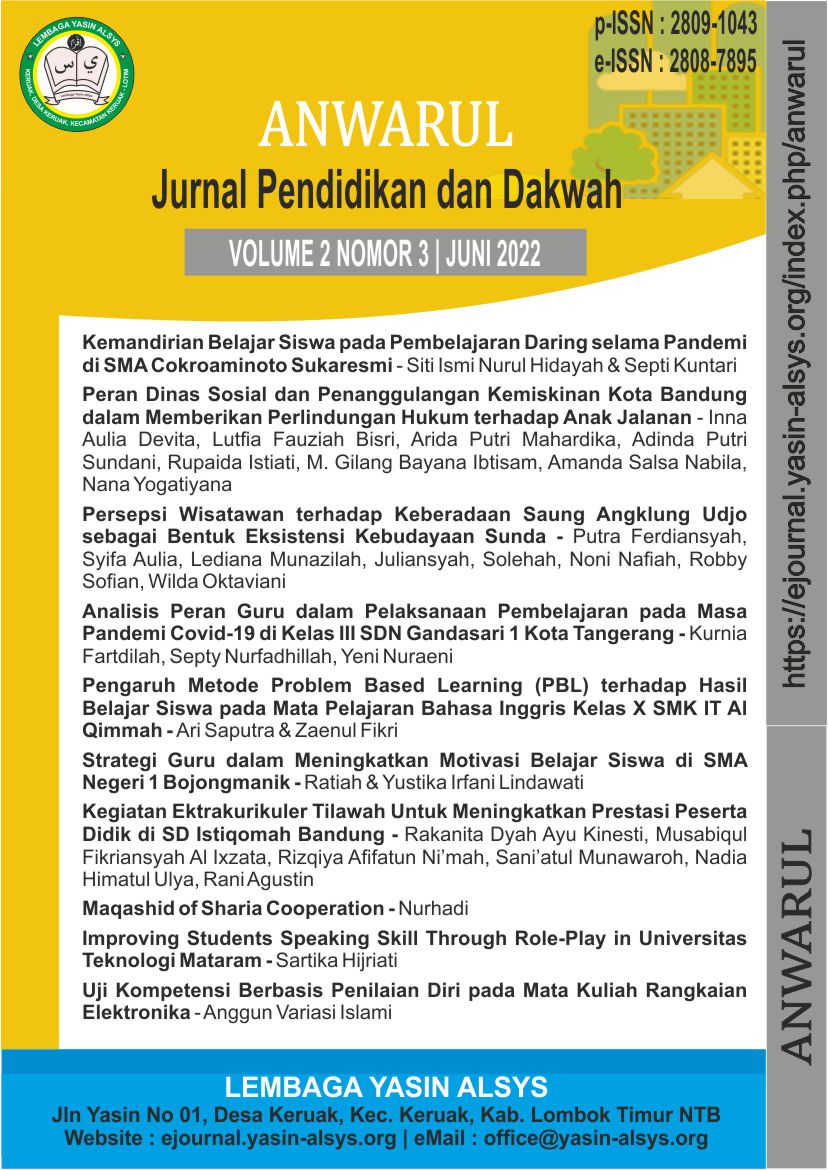
Maqashid of Sharia Cooperation
Main Article Content
Abstract
Maqashid The Islamic cooperative is a congregation in a business or community-based business activity. His own philosophy is independence, starting from the self then becoming the independence of the group (people). Or vice versa, group independence that encourages individual independence within it. The resources collected from members are a way to achieve economic sovereignty, so that cooperating is actually a long-term business strategy that secures the business interests of each member from unfair competition. Cooperating is building a fortress from efforts to destroy and colonize large investors and more established business owners. Maqashid The sharia cooperative at the religious level is a concentration of power in driving out the forbidden forms of muamalah and misleading ideologies. Only solidarity that is able to withstand the onslaught of expansion of capitalist business ventures, institutionalized solidarity is called cooperative. Maqashid syirkah sharia cooperatives contain six maqashid: 1). The accumulation of large amounts of capital so that it can be used to hold large jobs; 2). Streamlining macroeconomic rates; 3). The creation of broader and more adequate jobs; 4). The establishment of a sense of brotherhood among fellow capital holders and work partners; 5). The idea of advancing the company is better because it comes from many people too; 6). General transactions can end or cancel.




Citation Metrics:




Downloads
Citation Metrics & Similar Scopus Articles
-
Castellanos Martínez J.M. (2027)The Fragility of Collective Action in Community Forest Management: Social Feedbacks, Trust, and Cooperation DynamicsHuman Ecology, 55(2)
-
Luo J. (2027)Operando identification of HSAB-guided interfacial cooperation in electrochemical isopropanol dehydrogenationApplied Catalysis B Environmental, 402
-
Muñoz Tabora J. (2027)Congestion management in electric distribution systems through flexibility services: a bibliometric and analytical reviewElectric Power Systems Research, 265
Article Details

Authors retain copyright and grant the journal right of first publication with the work simultaneously licensed under a Creative Commons Attribution-NonCommercial-ShareAlike 4.0 International License that allows others to share the work with an acknowledgement of the work's authorship and initial publication in this journal.
Article Sidebar
 Page Numbers:
279-302
Page Numbers:
279-302
 Digital Object ID:













 Viewed: 310 times
 Downloaded: 407 times

LYAS Publisher cordially invites qualified professionals to serve as Editors or Reviewers. Your expertise will make an important contribution to maintaining and strengthening the academic quality of our publications. Interested applicants are kindly requested to complete the application form at the following link: Editors & Reviewers


Please feel free to contact us if you need any further information about the submission process or if you have any additional questions.

 Authors:
 Copyright :
Authors retain copyright and grant the journal right of first publication.
Explore Our Journals
Find the journal that best fits your research. If this journal does not match your manuscript’s scope, explore our portfolio below to select a more suitable publication venue.