
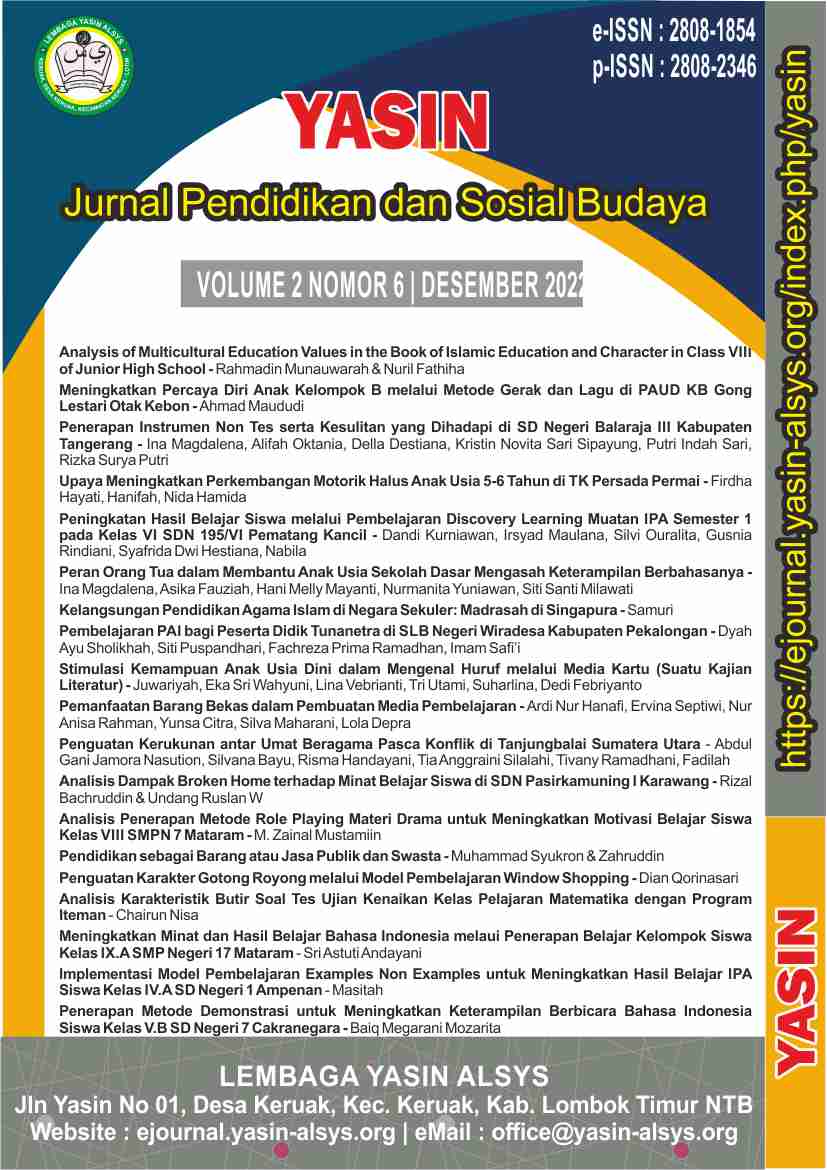
Pendidikan sebagai Barang atau Jasa Publik dan Swasta

Article Sidebar
 Page Numbers:
839-850
Page Numbers:
839-850
 Digital Object Identifier:


 Viewed: 1.962 times
 Downloaded: 7.295 times












LYAS Publisher cordially invites qualified professionals to serve as Editors or Reviewers. Your expertise will make an important contribution to maintaining and strengthening the academic quality of our publications. Interested applicants are kindly requested to complete the application form at the following link: Editors & Reviewers


Please feel free to contact us if you need any further information about the submission process or if you have any additional questions.

 Authors:
Muhammad Syukron1*, Zahruddin Zahruddin2
 Copyright :
Authors retain copyright and grant the journal right of first publication.
Explore Our Journals
Find the journal that best fits your research. If this journal does not match your manuscript’s scope, explore our portfolio below to select a more suitable publication venue.
Main Article Content
Abstract
In Indonesia, education is no longer purely a public good because some of it has been privatized by the government, so that people can no longer get it for free. It can be seen from the large number of private schools not only from local origins, but many international schools have been established in Indonesia, and also occur in various countries. This type of research is qualitative research using documentation study data collection methods in the form of relevant books and journals. Data analysis techniques start from data collection, data reduction, presentation and discussion of data then conclusions are drawn. The result of this research is that education can be a public good and can be a private good. Education as a public good because its provision is free, universal and equal access is the basis for producing other public goods. Education as a private good because of a necessity there is competition in getting a decent education. The competition must be purely a competition of intelligence and intellect, not a competition for money or position.




Citation Metrics:




Downloads
Citation Metrics & Similar Scopus Articles
-
Irawati R. (2027)Enhancing accounting students’ writing performance through problem-based learning: Evidence from a vocational higher education contextMultidisciplinary Science Journal, 9(1)
-
Ding S. (2027)Digital Renewal of University Education: Barriers, Opportunities, and Contributions to Sustainable Development Goals (SDGs)Asean Journal of Educational Research and Technology, 6(2), 229-240
-
Unyaphatariyakool S. (2027)Science Teachers’ Learning Management Competency through Professional Learning Communities to Promote Scientific Creativity and Sustainable Development Goals (SDGs)Asean Journal of Educational Research and Technology, 6(2), 241-252
Article Details

Authors retain copyright and grant the journal right of first publication with the work simultaneously licensed under a Creative Commons Attribution-NonCommercial-ShareAlike 4.0 International License that allows others to share the work with an acknowledgement of the work's authorship and initial publication in this journal.