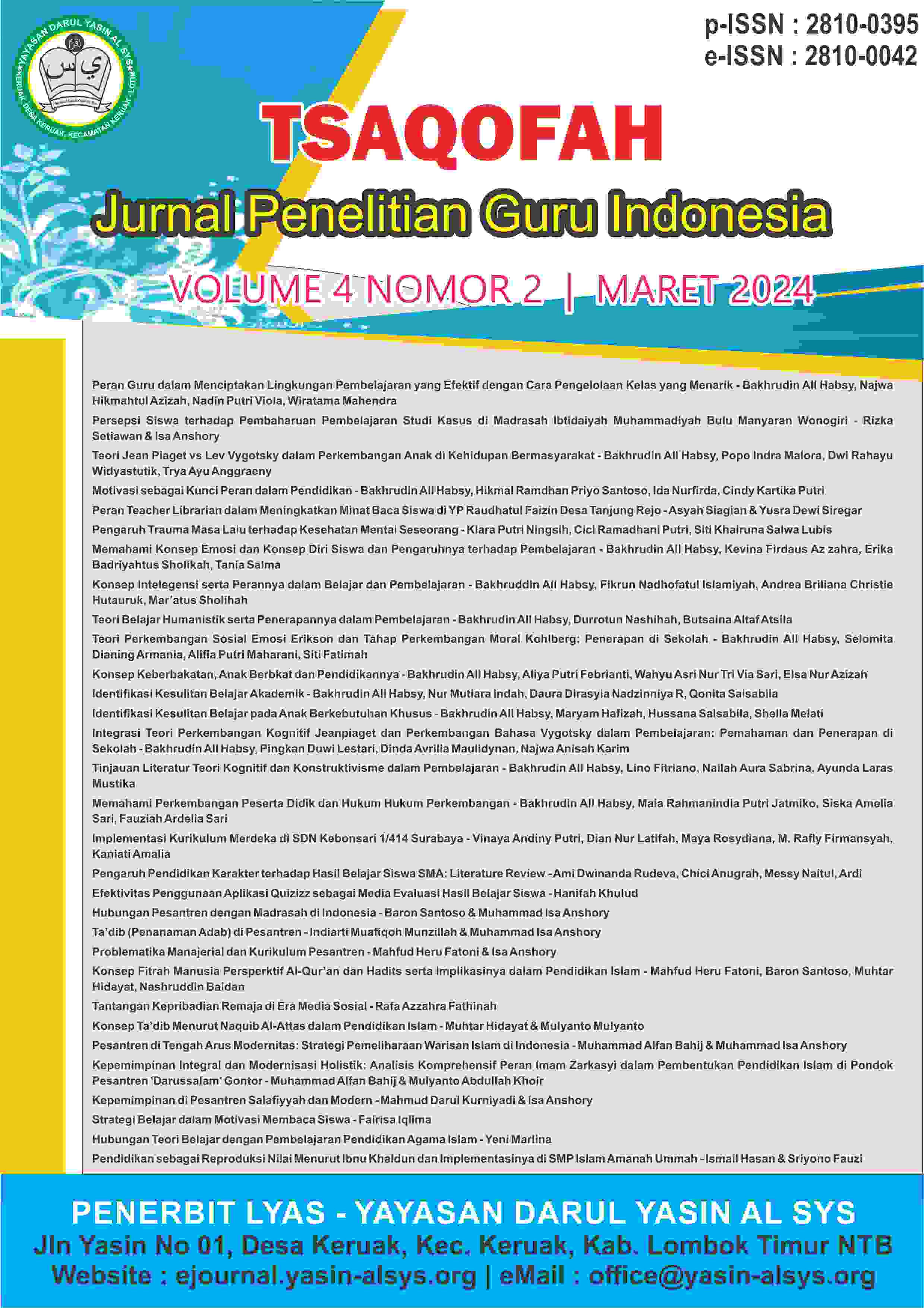
Pendidikan sebagai Reproduksi Nilai Menurut Ibnu Khaldun dan Implementasinya di SMP Islam Amanah Ummah Education as the Reproduction of Values According to Ibn Khaldun and Its Implementation in Amanah Ummah Islamic Junior High School
Main Article Content
Abstract
Many philosophers have contributed their thoughts to the field of education, including Ibn Khaldun. He was a bold individual who introduced innovative ideas. Specifically in the realms of knowledge and education, he successfully mapped and positioned Islamic and general knowledge effectively, making it easy for anyone to study and conduct further research. This study aims to analyze Ibn Khaldun's thoughts on education as the reproduction of values and its implementation in Amanah Ummah Junior High School, Sukoharjo. The research employs a qualitative method (Field Research). The results obtained by the author include the following: concerning the aspect of Islamic educational goals, Ibn Khaldun's perspectives are; 1) shaping the Complete Individual (Insan Kamil), 2) the importance of teachers having models and approaches in teaching, 3) using techniques appropriate to the subject matter, and 4) implementing knowledge into positive values.




Citation Metrics:



Downloads
Citation Metrics & Similar Scopus Articles
-
Cotton A. (2027)From affiliation to mobilization: differential indicators of insider threat actors in higher educationSecurity Journal, 40(1)
-
Doszhan T. (2027)TIME-MANAGEMENT AND INDEPENDENT-LIVING SKILLS OF ADOLESCENTS WITH MILD INTELLECTUAL DISABILITIES: INCLUSIVE EDUCATION CAPACITY, QUALITY EDUCATION AND REDUCED INEQUALITIES IN KAZAKHSTANBangladesh Journal of Multidisciplinary Scientific Research, 12(1), 103-117
-
Malika K. (2027)EDUCATIONAL ROBOTICS AND SMART LEARNING IN PRIMARY SCHOOLS OF KAZAKHSTAN: A SCIENTIFIC-METHODOLOGICAL FRAMEWORK FOR QUALITY EDUCATION, INNOVATION AND DIGITAL INCLUSIONBangladesh Journal of Multidisciplinary Scientific Research, 12(1), 64-80
Article Details

Authors retain copyright and grant the journal right of first publication with the work simultaneously licensed under a Creative Commons Attribution-NonCommercial-ShareAlike 4.0 International License that allows others to share the work with an acknowledgement of the work's authorship and initial publication in this journal.
Article Sidebar
 Page Numbers:
931-947
 Digital Object ID:













 Viewed: 492 times
 Downloaded: 416 times
LYAS Publisher cordially invites qualified professionals to serve as Editors or Reviewers. Your expertise will make an important contribution to maintaining and strengthening the academic quality of our publications. Interested applicants are kindly requested to complete the application form at the following link: Editors & Reviewers


Please feel free to contact us if you need any further information about the submission process or if you have any additional questions.

 Authors:
 Copyright :
Authors retain copyright and grant the journal right of first publication.
Explore Our Journals
Find the journal that best fits your research. If this journal does not match your manuscript’s scope, explore our portfolio below to select a more suitable publication venue.