
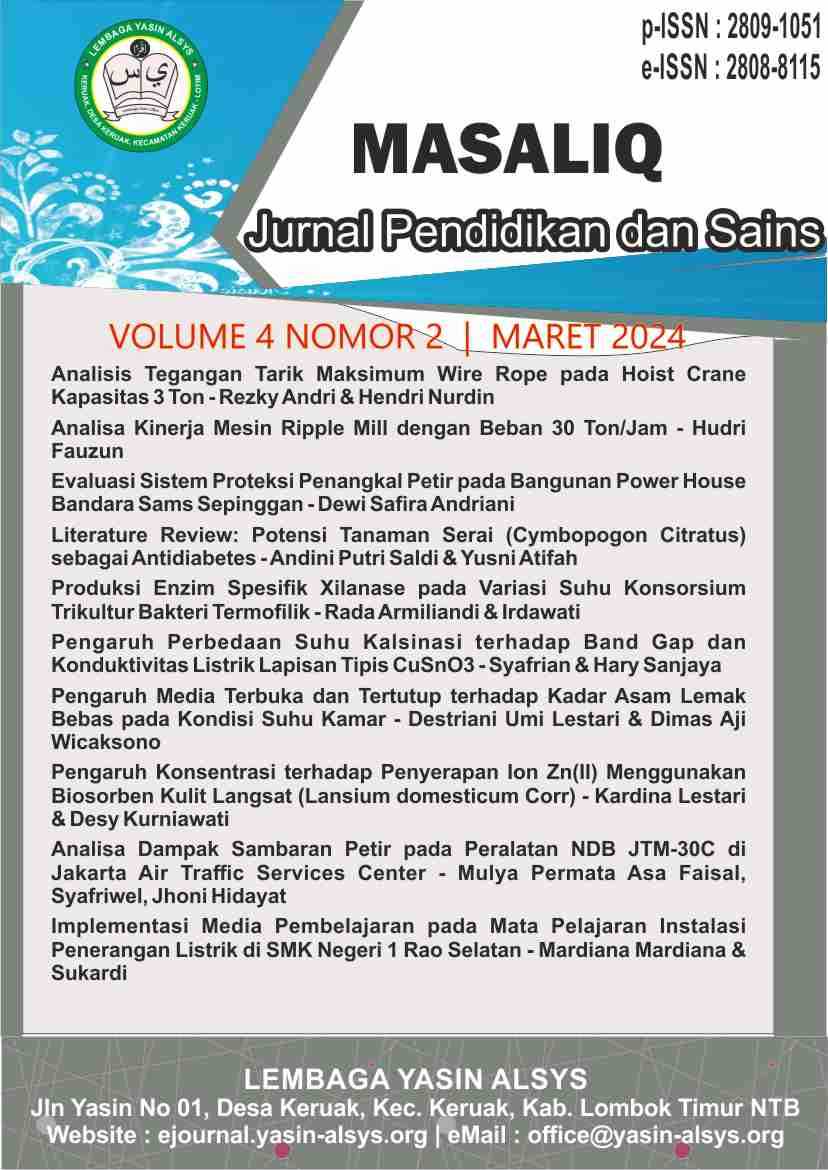
Literature Review: Potensi Tanaman Serai (Cymbopogon Citratus) sebagai Antidiabetes Literature Review: The Potential of Lemongrass (Cymbopogon citratus) as Antidiabetic Agent
Main Article Content
Abstract
The World Health Organization (WHO) explains that more than 220 million people worldwide have diabetes mellitus. Diabetes mellitus is a chronic metabolic disorder caused by not producing enough insulin. Treatment of DM is costly and often has side effects that can be detrimental to the body. Therefore, traditional medicine using herbal plants has begun to be developed at this time. A plant that has the potential as an antidiabetic is lemongrass. This study aims to determine the potential of lemongrass plants as antidiabetics. The method used in writing this article is Literature Review Article (LRA). The database source uses Publis or Perrish. The data used are journal articles published from 2013 to 2023. The results of the literature review that has been carried out know that lemongrass plants have potential as antidiabetics. The antidiabetic ability of lemongrass is due to the presence of secondary metabolite compounds such as flavonoids, tannins, steroids, alkaloids, and triterpenoids contained in lemongrass plants that have the ability to reduce blood glucose levels.




Citation Metrics:




Downloads
Citation Metrics & Similar Scopus Articles
-
Kunaev V.A. (2028)Blast Furnace Slag as an Alternative to Natural Mineral Materials in Pavement Engineering: A ReviewKompleksnoe Ispolzovanie Mineralnogo Syra, 346(3), 108-130
-
Prada S.I. (2027)Missing in action: unaddressed cost-of-illness studies in Colombia – A 30-year reviewBiomedica, 47(1)
-
Sheng T. (2027)Photothermal Superhydrophobic Textiles: An Emerging Paradigm from Passive Water Repellency to Active Thermal ManagementNano Micro Letters, 19(1)
Article Details

Authors retain copyright and grant the journal right of first publication with the work simultaneously licensed under a Creative Commons Attribution-NonCommercial-ShareAlike 4.0 International License that allows others to share the work with an acknowledgement of the work's authorship and initial publication in this journal.
Article Sidebar
 Page Numbers:
488-497
Page Numbers:
488-497
 Digital Object ID:













 Viewed: 794 times
 Downloaded: 869 times

LYAS Publisher cordially invites qualified professionals to serve as Editors or Reviewers. Your expertise will make an important contribution to maintaining and strengthening the academic quality of our publications. Interested applicants are kindly requested to complete the application form at the following link: Editors & Reviewers


Please feel free to contact us if you need any further information about the submission process or if you have any additional questions.

 Authors:
 Copyright :
Authors retain copyright and grant the journal right of first publication.
Explore Our Journals
Find the journal that best fits your research. If this journal does not match your manuscript’s scope, explore our portfolio below to select a more suitable publication venue.