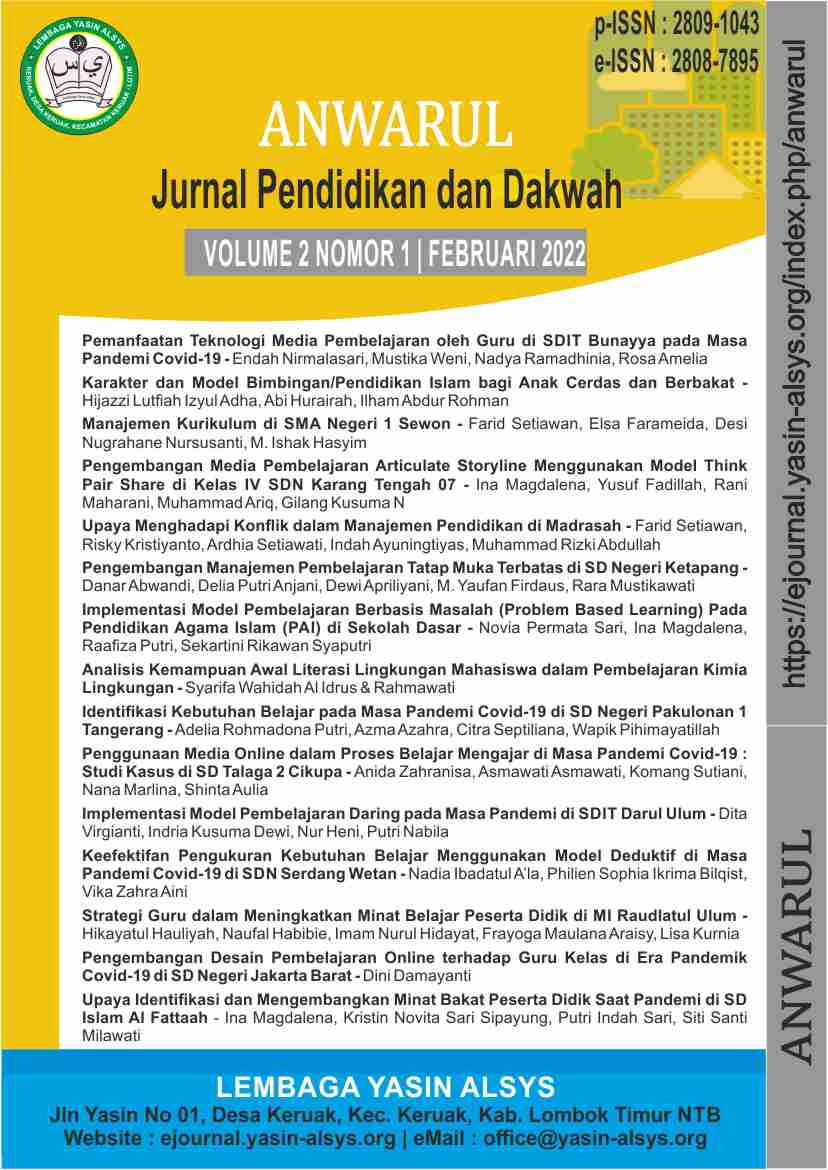
Upaya Identifikasi dan Mengembangkan Minat Bakat Peserta Didik Saat Pandemi di SD Islam Al Fattaah
Main Article Content
Abstract
Every child has different abilities and cognitive abilities. This is motivated by heredity and environmental factors. Hereditary factors can be from the father's or mother's genes. One example of environmental factors is how to educate parents about their children or the good and bad of the surrounding environment. That is why parenting and the environment have a big influence on the quality of children. Most elementary school children have not been able to recognize their identity and have not been able to develop the abilities that exist in themselves. The purpose of this study is to describe the method of identifying and developing interests and talents for the students of Al-Fattaah Islamic Elementary School. This study uses a qualitative method with a descriptive qualitative design (case study). The data collection technique used direct interviews with the deputy head of the Al Fattaah Islamic Elementary School curriculum. Developing talent with some effort is quite effective to do. This can be seen from the results of interviews received by interviewers that with the existence of extracurricular and four aspects, namely academic, skills, character, and spiritual in learning activities, students can find interests and talents. Where these interests and talents will be developed by the Al Fattaah Islamic Elementary School teachers.




Citation Metrics:




Downloads
Citation Metrics & Similar Scopus Articles
-
Irawati R. (2027)Enhancing accounting students’ writing performance through problem-based learning: Evidence from a vocational higher education contextMultidisciplinary Science Journal, 9(1)
-
Sun G. (2027)Recent advances in covalent organic frameworks-based S-scheme photocatalystsJournal of Materials Science and Technology, 289, 242-255
-
Chen S. (2027)Interface Contact Optimization via Phosphomolybdic Acid Enables 24.9% Efficiency in MoOX-Based Silicon Solar CellsNano Micro Letters, 19(1)
Article Details

Authors retain copyright and grant the journal right of first publication with the work simultaneously licensed under a Creative Commons Attribution-NonCommercial-ShareAlike 4.0 International License that allows others to share the work with an acknowledgement of the work's authorship and initial publication in this journal.
Article Sidebar
 Page Numbers:
171-179
 Digital Object ID:













 Viewed: 961 times
 Downloaded: 404 times

LYAS Publisher cordially invites qualified professionals to serve as Editors or Reviewers. Your expertise will make an important contribution to maintaining and strengthening the academic quality of our publications. Interested applicants are kindly requested to complete the application form at the following link: Editors & Reviewers


Please feel free to contact us if you need any further information about the submission process or if you have any additional questions.

 Authors:
 Copyright :
Authors retain copyright and grant the journal right of first publication.
Explore Our Journals
Find the journal that best fits your research. If this journal does not match your manuscript’s scope, explore our portfolio below to select a more suitable publication venue.