
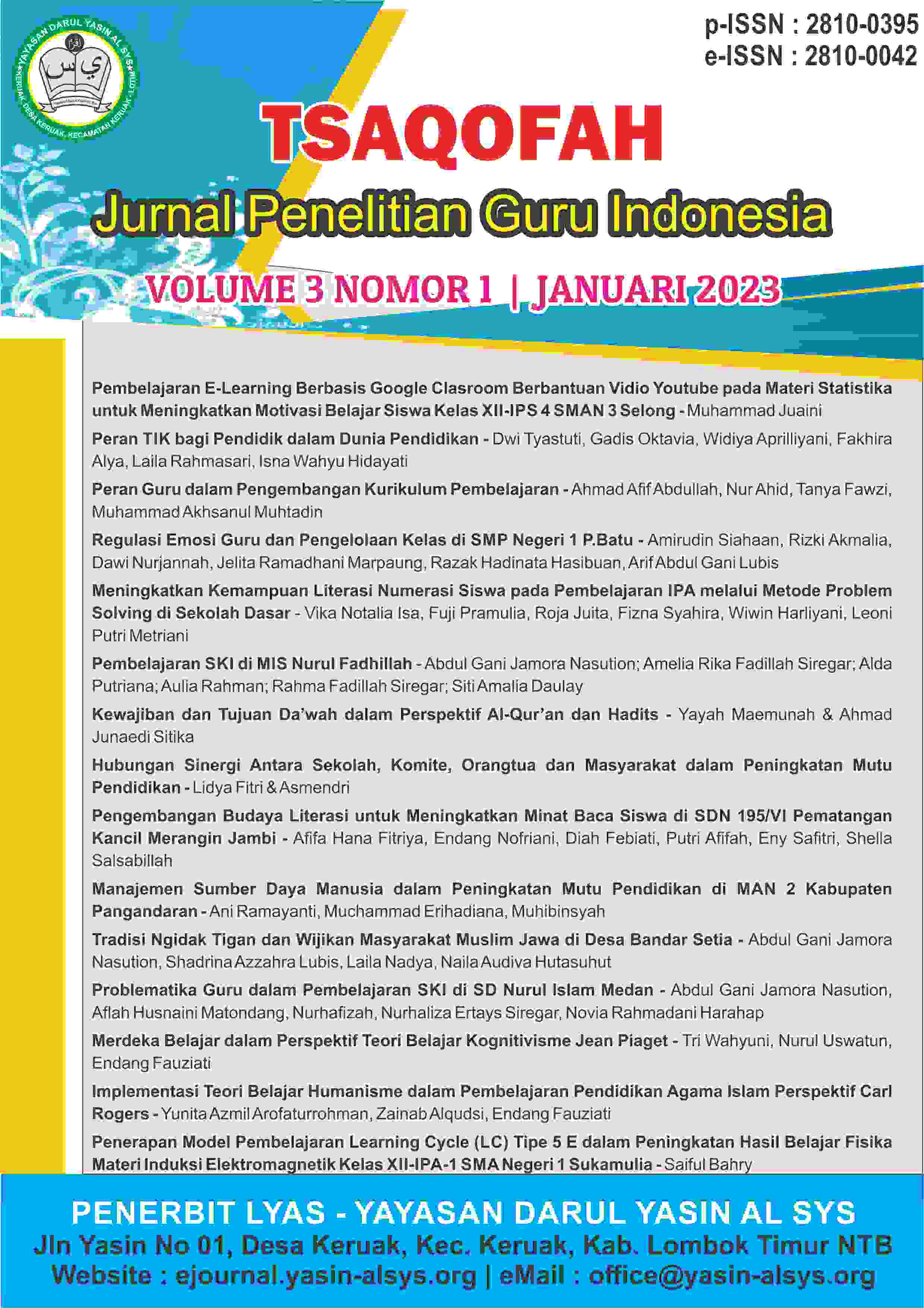
Implementasi Teori Belajar Humanisme dalam Pembelajaran Pendidikan Agama Islam Perspektif Carl Rogers

Main Article Content
Abstract
Learning humanism is important to apply in every educational institution, the purpose of this education is to humanize humans and has the task of educating, nurturing and guiding children to become whole human beings, behavior, morality, ethics and knowledge. This study aims to describe the implementation of humanism learning theory in learning Islamic Religious Education Carl Rogers Perspective. The type of research used is descriptive qualitative with the library research method, namely library research. Research data obtained from the recording of books and journals. Learning Islamic Religious Education in relation to the theory of humanism can be applied through the study of monotheism, jurisprudence and morals. The application of humanistic theory to the learning of Islamic Religious Education can be done by incorporating it through learning planning. Educators need to pay attention to the character and experiences of each student, because each student certainly has different characters and experiences.




Citation Metrics:




Downloads
Citation Metrics & Similar Scopus Articles
-
Ratnaningsih E. (2027)Designing a Data-Driven E-Learning Module for Teaching English to Young Learners: Integrating Needs Analysis and the ISAV Learning ModelAsean Journal of Educational Research and Technology, 6(2), 269-286
-
Unyaphatariyakool S. (2027)Science Teachers’ Learning Management Competency through Professional Learning Communities to Promote Scientific Creativity and Sustainable Development Goals (SDGs)Asean Journal of Educational Research and Technology, 6(2), 241-252
-
Azhand A. (2027)Teaching Persian derivational affixes to non-Persian speakers from a Cognitive Morphology Approach: A case study of nominal suffixes (kar, gar, ban, baz, -ande)Language Related Research, 17(4), 469-497
Article Details

Authors retain copyright and grant the journal right of first publication with the work simultaneously licensed under a Creative Commons Attribution-NonCommercial-ShareAlike 4.0 International License that allows others to share the work with an acknowledgement of the work's authorship and initial publication in this journal.
Article Sidebar
 Page Numbers:
140-147
Page Numbers:
140-147
 Digital Object Identifier:













 Viewed: 1.481 times
 Downloaded: 1.216 times

LYAS Publisher cordially invites qualified professionals to serve as Editors or Reviewers. Your expertise will make an important contribution to maintaining and strengthening the academic quality of our publications. Interested applicants are kindly requested to complete the application form at the following link: Editors & Reviewers


Please feel free to contact us if you need any further information about the submission process or if you have any additional questions.

 Authors:
Yunita Azmil Arofaturrohman1, Zainab Alqudsi2, Endang Fauziati3
 Copyright :
Authors retain copyright and grant the journal right of first publication.
Explore Our Journals
Find the journal that best fits your research. If this journal does not match your manuscript’s scope, explore our portfolio below to select a more suitable publication venue.