
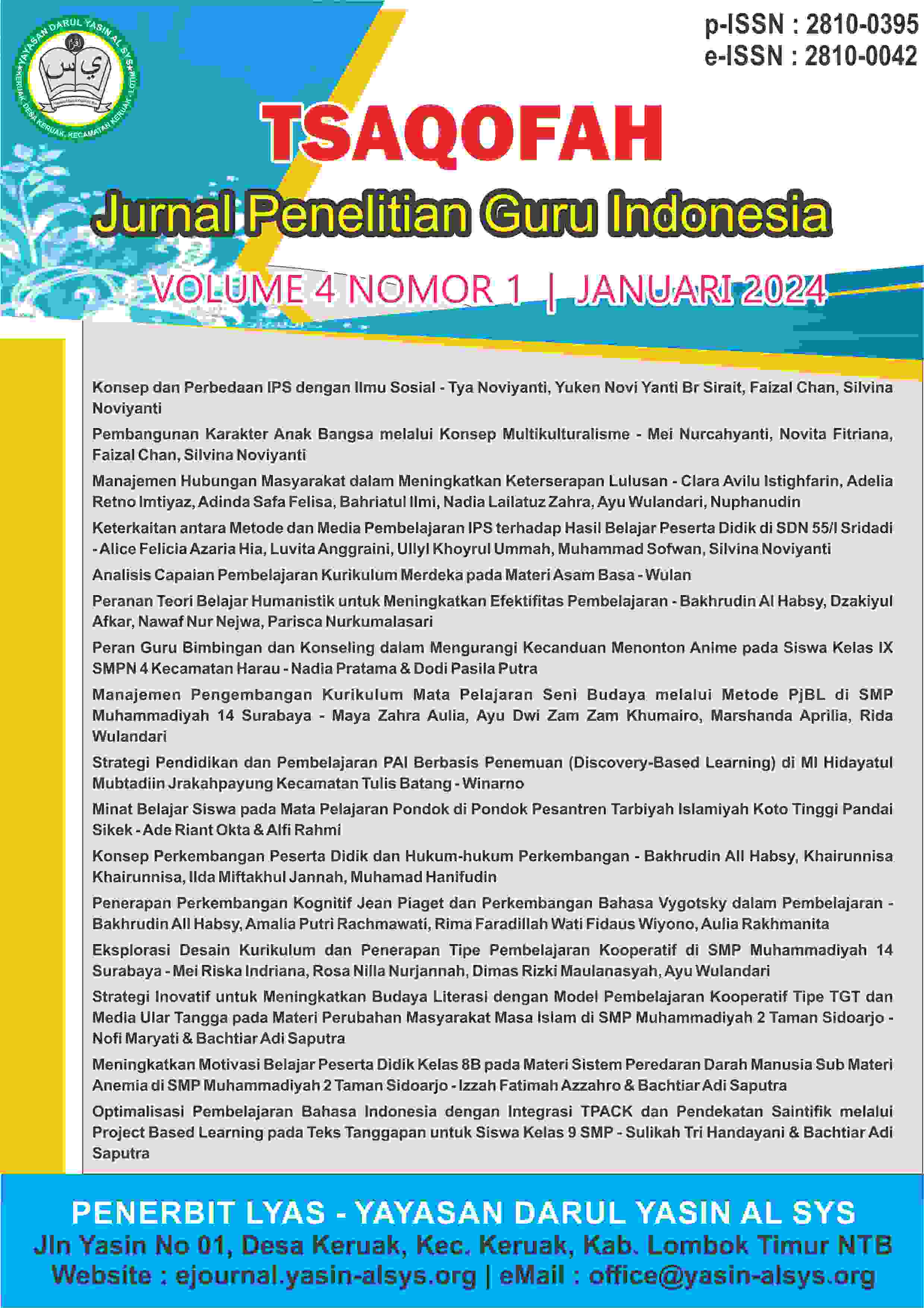
Analisis Capaian Pembelajaran Kurikulum Merdeka pada Materi Asam Basa Analysis of the Achievements of the Independent Curriculum in the Acid-Base Material

Article Sidebar
 Page Numbers:
58-65
Page Numbers:
58-65
 Digital Object Identifier:


 Viewed: 1.837 times
 Downloaded: 859 times












LYAS Publisher cordially invites qualified professionals to serve as Editors or Reviewers. Your expertise will make an important contribution to maintaining and strengthening the academic quality of our publications. Interested applicants are kindly requested to complete the application form at the following link: Editors & Reviewers


Please feel free to contact us if you need any further information about the submission process or if you have any additional questions.

 Authors:
Wulan Wulan1
 Copyright :
Authors retain copyright and grant the journal right of first publication.
Main Article Content
Abstract
Changes in the curriculum cause changes in the preparation of learning tools, one of which is about learning outcomes. Learning outcomes are abilities obtained through internalization of knowledge, attitudes, skills, competencies and accumulated work experience. This article attempts to provide an overview of the material content in the chemistry subject on the topic of acids and bases, guided by university books and Ministry of Education and Culture books in accordance with learning outcomes. Literature study is the method in this research by collecting data through online media, articles and books relating to chemistry learning outcomes in the Independent Curriculum. Data collection techniques are carried out by distinguishing, organizing and finding implied messages. Analysis of learning outcomes produces learning objectives, flow of learning objectives, and content of chemistry material on the topic of acids and bases that will be studied by students. To see the consistency in this research, a reliability test was carried out by experts (lecturers). Based on the results of the research that has been carried out, it can be concluded that the third alternative is to create learning objectives in chemistry subjects. Because in chemistry learning outcomes there are two elements, namely chemical understanding and process skills.




Citation Metrics:




Downloads
Citation Metrics & Similar Scopus Articles
-
Ratnaningsih E. (2027)Designing a Data-Driven E-Learning Module for Teaching English to Young Learners: Integrating Needs Analysis and the ISAV Learning ModelAsean Journal of Educational Research and Technology, 6(2), 269-286
-
Unyaphatariyakool S. (2027)Science Teachers’ Learning Management Competency through Professional Learning Communities to Promote Scientific Creativity and Sustainable Development Goals (SDGs)Asean Journal of Educational Research and Technology, 6(2), 241-252
-
Azhand A. (2027)Teaching Persian derivational affixes to non-Persian speakers from a Cognitive Morphology Approach: A case study of nominal suffixes (kar, gar, ban, baz, -ande)Language Related Research, 17(4), 469-497
Article Details

Authors retain copyright and grant the journal right of first publication with the work simultaneously licensed under a Creative Commons Attribution-NonCommercial-ShareAlike 4.0 International License that allows others to share the work with an acknowledgement of the work's authorship and initial publication in this journal.