
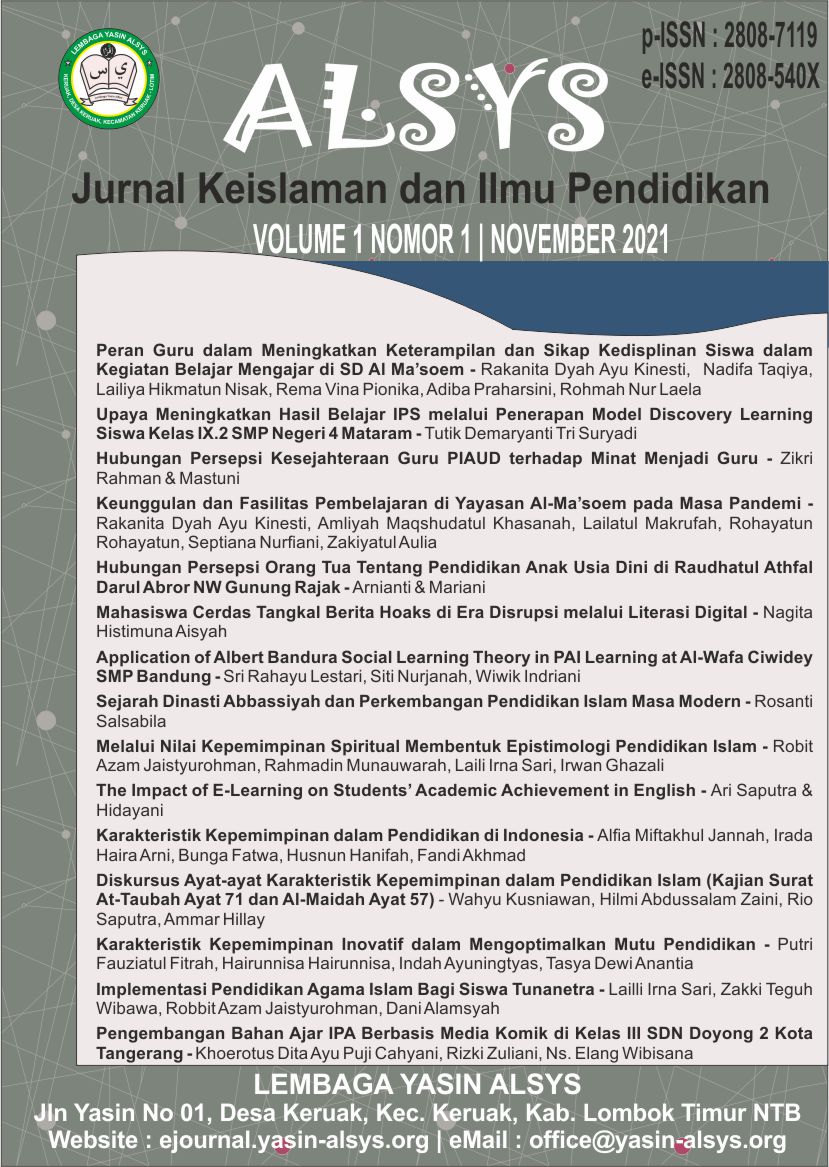
Application of Albert Bandura Social Learning Theory in PAI Learning at Al-Wafa Ciwidey SMP Bandung
Main Article Content
Abstract
This article discusses the application of social learning theory which aims to determine the application of the social concept of the Albert Bandura theory at Al-Wafa Ciwidey Junior High School in Bandung, the supporting factors for the application of the Albert Bandura social learning theory at Al-Wafa Ciwidey Middle School Bandung, the inhibiting factors for the application of Albert Bandura social learning theory at SMP Al-Wafa Ciwidey Bandung. This type of research is a qualitative descriptive with a phenomonological approach. Retrieval of data through the method of observation, interviews. The data source is the teacher of Islamic religious education subjects. After that, it is analyzed by drawing conclusions. The results of this study, the application of social learning theory with the concept of modeling principles in Islamic religious education learning at Al-Wafa Middle School have been applied to aspects of attention, retention, production, and motivation. And the supporting factor in the application of social learning theory is the ability of teachers which includes pedagogic, professional, personal and social skills in guiding, directing and encouraging students to be active during the learning process as well as interesting learning media. While the inhibiting factor is the low motivation of students to learn and less varied learning media. The impact of the application of social learning theory at SMP Al-Wafa Ciwidey Bandung is that students become more ready to learn because at the initial stage the attention stage has been carried out. Then finally students become more motivated because of the reward and punishment system and usually students will be more motivated when learning is packaged in activities such as games.




Citation Metrics:




Downloads
Citation Metrics & Similar Scopus Articles
-
Yerzhanova N.K. (2028)Application of bank protection structures for regulation of channel processes in the lower reaches of the Shu RiverKompleksnoe Ispolzovanie Mineralnogo Syra, 346(3), 5-18
-
Samy M. (2028)Recent Advances in Polymeric Nanocomposite Carriers of Various Active Ingredients for Controlled and Sustained Drug Release: A ReviewKompleksnoe Ispolzovanie Mineralnogo Syra, 346(3), 72-98
-
Bakhtybayev N.B. (2028)Research and Improvement of Methods for Predicting Hidden Fracturing in a Rock Mass at a Polymetallic MineKompleksnoe Ispolzovanie Mineralnogo Syra, 344(1), 109-116
Article Details

Authors retain copyright and grant the journal right of first publication with the work simultaneously licensed under a Creative Commons Attribution-NonCommercial-ShareAlike 4.0 International License that allows others to share the work with an acknowledgement of the work's authorship and initial publication in this journal.
Article Sidebar
 Page Numbers:
83-96
Page Numbers:
83-96
 Digital Object ID:













 Viewed: 1.679 times
 Downloaded: 3.869 times

LYAS Publisher cordially invites qualified professionals to serve as Editors or Reviewers. Your expertise will make an important contribution to maintaining and strengthening the academic quality of our publications. Interested applicants are kindly requested to complete the application form at the following link: Editors & Reviewers


Please feel free to contact us if you need any further information about the submission process or if you have any additional questions.

 Authors:
 Copyright :
Authors retain copyright and grant the journal right of first publication.
Explore Our Journals
Find the journal that best fits your research. If this journal does not match your manuscript’s scope, explore our portfolio below to select a more suitable publication venue.