
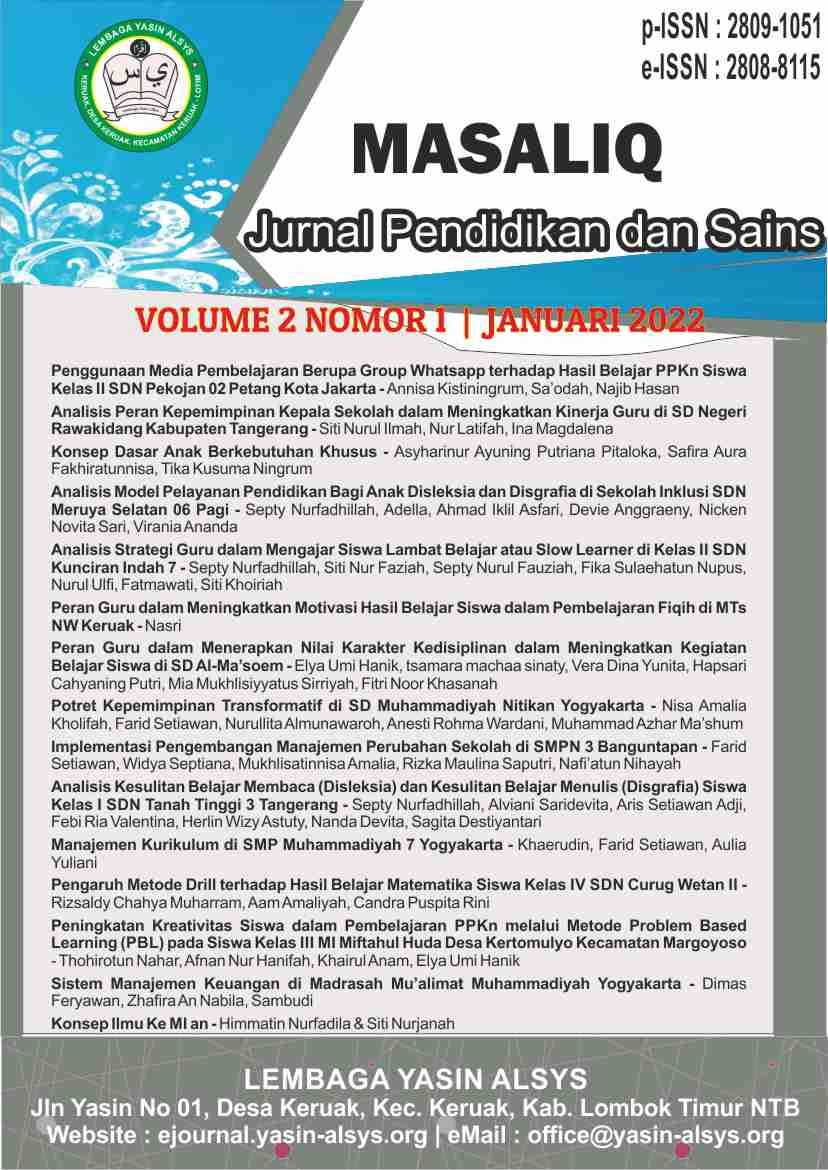
Konsep Ilmu Ke MI an
Main Article Content
Abstract
Science is a system of meaning of reality and truth, sourced from revelation supported by reason and intuition. With the nadzar and fikr process, the ratio will be able to articulate, formulate propositions, express opinions, argue, make analogies, make decisions, and draw conclusions. In the Islamic worldview, science is closely related to faith, 'aql, qalb, and taqwah. Not only is knowledge systematically collected, but science is also a methodology. Where the right methodology will certainly not conflict with the right one. Peter R Senn in Science in Perspective describes more firmly that “Science is like a building made of bricks. These stones or basic elements are never directly found in the natural environment. Science and its derivations appear repeatedly in the Qur'an and occupy the second position after the word monotheism. In Sahih Bukhari, the chapter of knowledge (kitab al-'ilm) is juxtaposed with the chapter of faith (Kitab al-iman). This shows how the most important and comprehensive concept contained in the Qur'an and as-Sunnah is the science ('ilm) of Madrasah Ibtidaiyah at the elementary school level which is taken for 6 years organized by the Ministry of Religion. Scientific planting at this level becomes the basic concept in further education.




Citation Metrics:




Downloads
Citation Metrics & Similar Scopus Articles
-
Fadzli A.I.M. (2026)THE CONSTITUTION OF MEDINA AND THE ORIGINS OF CITIZENSHIP CONCEPT: A CONTEMPORARY REAPPRAISALIium Law Journal, 34(1), 559-604
-
Yusriadi Y. (2026)Indexical Hierarchies in Ulu Kapuas Malay Mantras: Vernacular Islamic Multilingualism in West KalimantanAscarya Journal of Islamic Science Culture and Social Studies, 6(1), 61-73
-
Abdul Rahman R. (2026)Refining Marine Turtle Conservation: Introducing Marine Turtle Management Areas (MATMAs) as a Spatial Conservation ToolAquatic Conservation Marine and Freshwater Ecosystems, 36(7)
Article Details

Authors retain copyright and grant the journal right of first publication with the work simultaneously licensed under a Creative Commons Attribution-NonCommercial-ShareAlike 4.0 International License that allows others to share the work with an acknowledgement of the work's authorship and initial publication in this journal.
Article Sidebar
 Page Numbers:
167-184
Page Numbers:
167-184
 Digital Object ID:













 Viewed: 702 times
 Downloaded: 1.780 times

LYAS Publisher cordially invites qualified professionals to serve as Editors or Reviewers. Your expertise will make an important contribution to maintaining and strengthening the academic quality of our publications. Interested applicants are kindly requested to complete the application form at the following link: Editors & Reviewers


Please feel free to contact us if you need any further information about the submission process or if you have any additional questions.

 Authors:
 Copyright :
Authors retain copyright and grant the journal right of first publication.
Explore Our Journals
Find the journal that best fits your research. If this journal does not match your manuscript’s scope, explore our portfolio below to select a more suitable publication venue.