
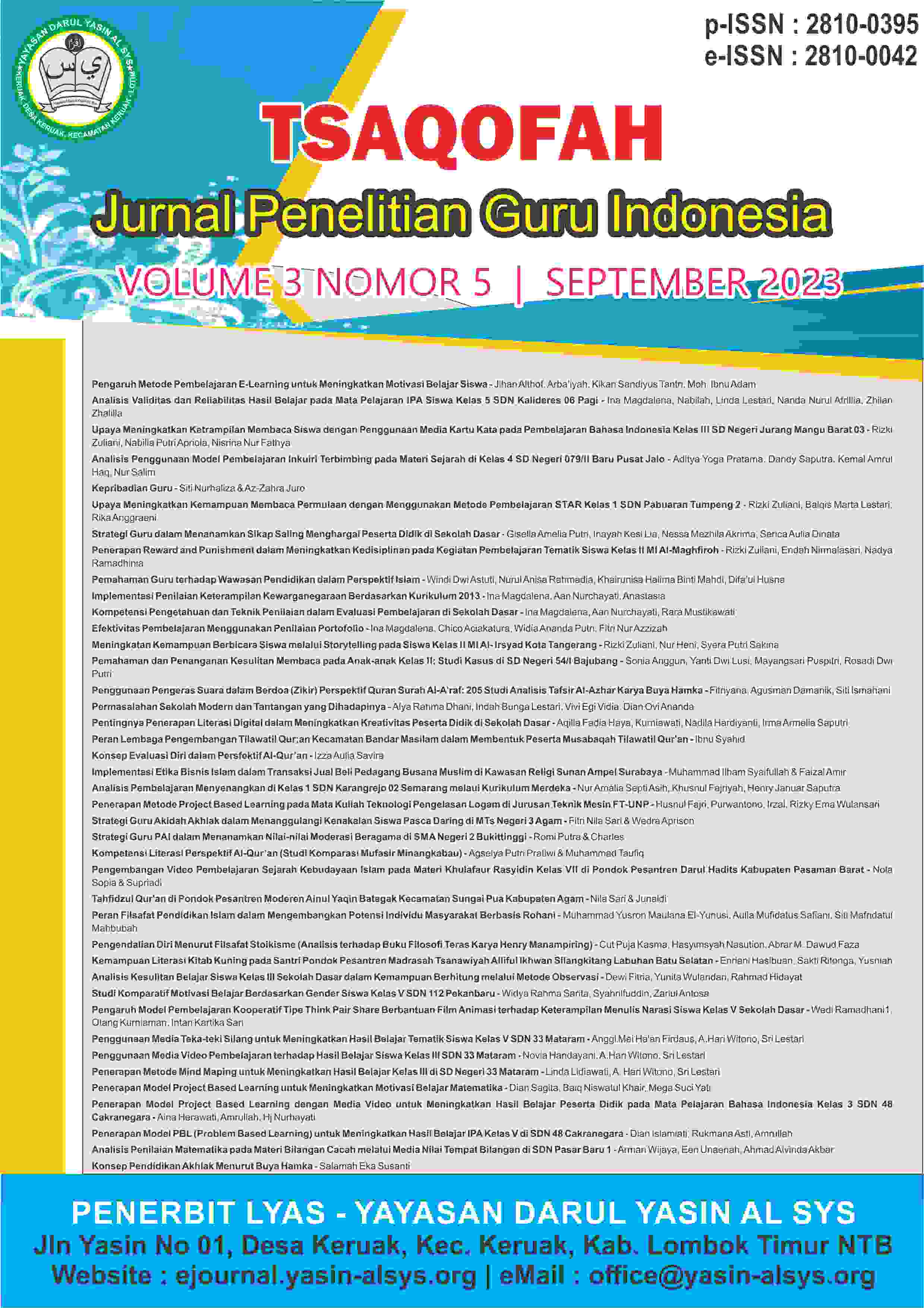
Konsep Evaluasi Diri dalam Persfektif Al-Qur’an
Main Article Content
Abstract
The concept of self-evaluation is an achievement of oneself. Which in every day we must have made mistakes. For this reason, it is necessary for each individual to evaluate every immoral act or act prohibited by Allah SWT in order to make us human beings who are of a higher quality before Allah SWT. The purpose of this study is to find out the concept of self-evaluation in the Koran. This research is included in library research (Library Research), namely research conducted using literature (library) in the form of commentary books such as the interpretations of At-Tabari, Ibn Katsir, Al-Azhar, Sya'rawi, and Al-Misbah, as well as books, theses or journals that study related to the concept of self-evaluation which is descriptive analysis, namely analyzing from several interpretation books taken as a reference. The approach used in this study is the Maudhu'i (thematic) interpretation method approach, namely looking at themes related to the concept of self-evaluation in the Koran. The method used is the content analysis method, namely analyzing the interpretation of the mufassir figures on verses related to self-evaluation. Based on the results of the research that the writer has done, it can be concluded that the writer does not find many verses that directly discuss self-evaluation, but here the writer takes several verses and the interpretations of the commentators related to self-evaluation. The author takes the interpretations of Imam Ath-Tabari, Ibnu Katsir, Buya Hamka, Imam Asy-Sya'rawi, and M. Quraish Shihab. Which they explain the need to evaluate themselves by leaving all the immorality that is forbidden by Allah and doing good deeds ordered by Allah, where each of these deeds will be accounted for in the afterlife.




Citation Metrics:



Downloads
Citation Metrics & Similar Scopus Articles
-
Lukpanov R.E. (2027)Evaluation of the Effect of Additives on the Workability of Concrete Mix as Part of a Study of a Modified Wall BlockKompleksnoe Ispolzovanie Mineralnogo Syra, 342(3), 100-110
-
Paul Shourov K. (2027)Critical review of tools and techniques for predicting microplastics pollution in watershed runoffEnvironmental Pollution and Management, 4, 27-47
-
Sheng T. (2027)Photothermal Superhydrophobic Textiles: An Emerging Paradigm from Passive Water Repellency to Active Thermal ManagementNano Micro Letters, 19(1)
Article Details

Authors retain copyright and grant the journal right of first publication with the work simultaneously licensed under a Creative Commons Attribution-NonCommercial-ShareAlike 4.0 International License that allows others to share the work with an acknowledgement of the work's authorship and initial publication in this journal.
Article Sidebar
 Page Numbers:
874-884
Page Numbers:
874-884
 Digital Object ID:













 Viewed: 400 times
 Downloaded: 349 times
LYAS Publisher cordially invites qualified professionals to serve as Editors or Reviewers. Your expertise will make an important contribution to maintaining and strengthening the academic quality of our publications. Interested applicants are kindly requested to complete the application form at the following link: Editors & Reviewers


Please feel free to contact us if you need any further information about the submission process or if you have any additional questions.

 Authors:
 Copyright :
Authors retain copyright and grant the journal right of first publication.
Explore Our Journals
Find the journal that best fits your research. If this journal does not match your manuscript’s scope, explore our portfolio below to select a more suitable publication venue.