
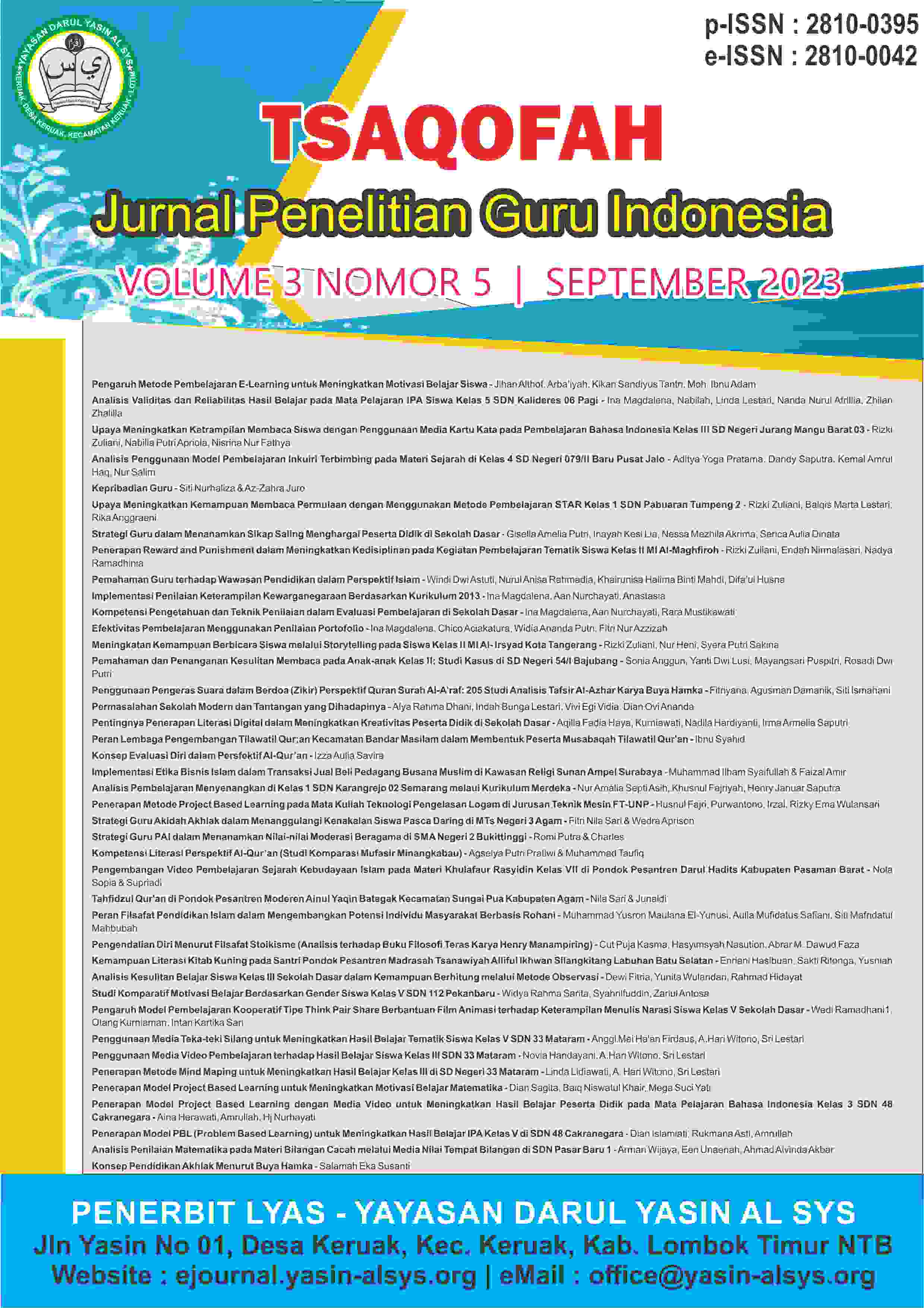
Penggunaan Pengeras Suara dalam Berdoa (Zikir) Perspektif Quran Surah Al-A’raf: 205 Studi Analisis Tafsir Al-Azhar Karya Buya Hamka

Article Sidebar
 Page Numbers:
832-841
Page Numbers:
832-841
 Digital Object Identifier:


 Viewed: 506 times
 Downloaded: 734 times












LYAS Publisher cordially invites qualified professionals to serve as Editors or Reviewers. Your expertise will make an important contribution to maintaining and strengthening the academic quality of our publications. Interested applicants are kindly requested to complete the application form at the following link: Editors & Reviewers


Please feel free to contact us if you need any further information about the submission process or if you have any additional questions.

 Authors:
Fitriyana Fitriyana1, Agusman Damanik2, Siti Ismahani3
 Copyright :
Authors retain copyright and grant the journal right of first publication.
Main Article Content
Abstract
Humans basically often ask or plead to other than Allah Swt. In order to fulfill their desires instantly and this phenomenon is known as polytheism. Islam has a way to avoid it, namely by dhikr. Remembrance is an activity or speech that aims to remember the Creator, namely Allah Swt, with the intention of getting closer to Him, usually by mentioning Asmaul Husna (names of Allah). Dhikr can be done anytime and anywhere except places where it is prohibited, the dhikr order is made with the aim of obeying Him, as a reminder of the afterlife, sincere and confident in the help of Allah Swt. The data used is a literature study that is used in ways to pursue various information about the procedures for remembrance in Islam through books or the internet that are appropriate to the cases discussed. solving the problem of how to do dhikr in Islam, namely l) zikir zhohir, 2) dhikr khofi. In conclusion, remembrance can be done verbally (dhikr zhohir), heart (dhikr khofi) and is a commendable action where we remember through praises to Allah Swt. The results of this study indicate that it is permissible to recite the dhikr out loud using a loudspeaker or low voice with the provisions that have been explained by the Koran itself and the opinion of the clergy in order to avoid unwanted things. This research is included in the library research category and the data analysis technique used in this research is descriptive comparative analysis technique. The main sources of data are the Koran, the book of Tafsir Al-Azhar, coupled with related literature such as journals, theses, books or related articles. The purpose of this research is to find out how Buya Hamka interprets QS. Al-A'raf 205.




Citation Metrics:




Downloads
Citation Metrics & Similar Scopus Articles
-
Dewi S.I. (2026)Voicing the body: Postcolonial feminist praxis and narratives of body autonomy in Indonesian women's podcastsWomen S Studies International Forum, 117
-
Ghafar N.M.A. (2026)A CONSUMPTION-BASED EVALUATION OF RETIREMENT SAVINGS ADEQUACY IN MALAYSIAJournal of Quality Measurement and Analysis, 22(S1), 145-162
-
Rahman Z.A. (2026)Strengthening Islamic Governance Through the Application of the Kano Model: A Case Study of the UMI Principles in KelantanJournal of Quality Measurement and Analysis, 22(S1), 381-393
Article Details

Authors retain copyright and grant the journal right of first publication with the work simultaneously licensed under a Creative Commons Attribution-NonCommercial-ShareAlike 4.0 International License that allows others to share the work with an acknowledgement of the work's authorship and initial publication in this journal.