
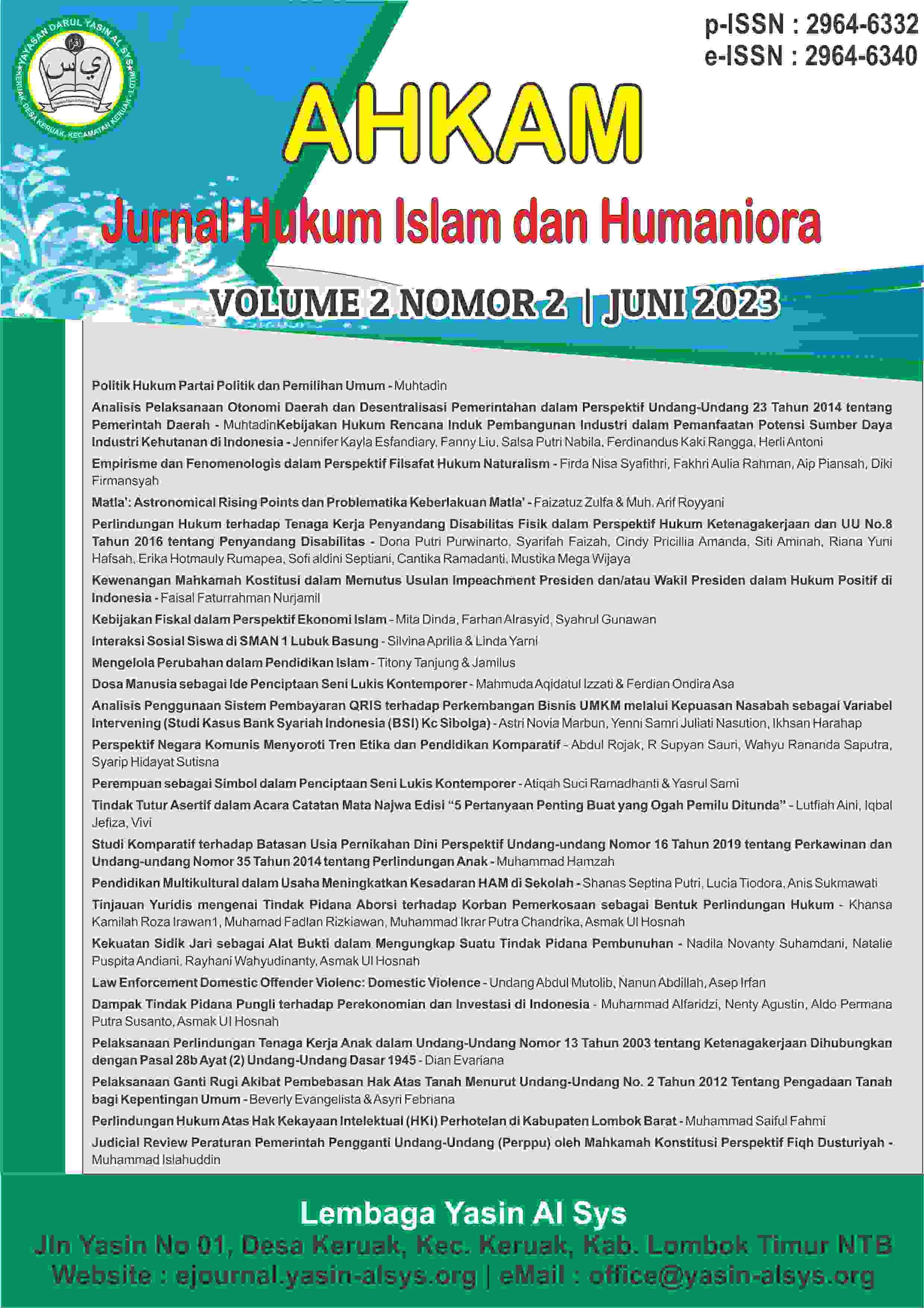
Judicial Review Peraturan Pemerintah Pengganti Undang-Undang (Perppu) oleh Mahkamah Konstitusi Perspektif Fiqh Dusturiyah

Article Sidebar
 Page Numbers:
517-531
Page Numbers:
517-531
 Digital Object Identifier:


 Viewed: 374 times
 Downloaded: 357 times












LYAS Publisher cordially invites qualified professionals to serve as Editors or Reviewers. Your expertise will make an important contribution to maintaining and strengthening the academic quality of our publications. Interested applicants are kindly requested to complete the application form at the following link: Editors & Reviewers


Please feel free to contact us if you need any further information about the submission process or if you have any additional questions.

 Authors:
Muhammad Islahuddin1
 Copyright :
Authors retain copyright and grant the journal right of first publication.
Main Article Content
Abstract
In this study, the author takes the title Judicial review of Government Regulations in Lieu of Laws (PERPPU) by the Constitutional Court from the Fiqh Dusturiyah Perspective. The issue raised in this paper is whether the Constitutional Court has the authority to conduct a judicial review of a Perppu. The research objective of this paper is to find out and study the authority of the Constitutional Court in conducting a judicial review of the Perppu. The type of research used in this research is normative legal research. The approach used in this study is the legal political approach. The data used in this study is secondary data consisting of primary legal materials and secondary legal materials. Legal research uses the deductive thinking method, which means a method of thinking that begins and begins with general propositions that have been recognized for their truth and ends with a specific conclusion. The results of this study conclude that the Constitutional Court has the authority to examine the Perpu for several reasons. Starting from a sociological and teleological interpretation, it is very likely that the Perpu will contain material that contradicts the 1945 Constitution of the Republic of Indonesia or violates people's rights, without being able to be examined before being discussed by the DPR, so it is best if the Constitutional Court can conduct a judicial review of the Perpu. Judicial review of the Perpu by the Constitutional Court is also in the context of upholding the principles of the Indonesian legal state and the supremacy of the constitution. In siyasash fiqh studies, there is a judiciary institution known as the Al-Mazalim Region, which specifically deals with the tyranny of the rulers against the people, including in making policies or laws. The judiciary of the al-Mazalim Region resembles the Constitutional Court in terms of safeguarding people's rights which may be violated through the making of policies or laws. In line with the conclusions above, it is best if the law-making bodies, in this case the DPR and the President, immediately fill in the legal vacuum regarding the judicial review of the Perpu by the Constitutional Court.




Citation Metrics:




Downloads
Citation Metrics & Similar Scopus Articles
-
Yuan Z. (2027)GAVEL-NER: A lightweight multi-view alignment framework for deployment-oriented judicial entity extractionExpert Systems with Applications, 333
-
Wang P. (2027)Research on Hybrid Encryption Schemes for Judicial Blockchain: Policy-Enhanced Attribute-Based Encryption and Homomorphic EncryptionCommunications in Computer and Information Science, 3005 CCIS, 75-90
-
Aravindh Rajan V. (2027)Enhancing Judicial Research Using a Pre-indexed Retrieval-Augmented Generation SystemLecture Notes in Networks and Systems, 2024 LNNS, 576-586
Article Details

This work is licensed under a Creative Commons Attribution-NonCommercial-ShareAlike 4.0 International License.
Authors retain copyright and grant the journal right of first publication with the work simultaneously licensed under a Creative Commons Attribution-NonCommercial-ShareAlike 4.0 International License that allows others to share the work with an acknowledgement of the work's authorship and initial publication in this journal.
References
Ali Marwan HSB. (2020). Judicial Review Dan Legislative Review Terhadap Peraturan Pemerintah Pengganti Undang-Undang, Jurnal Legislasi Indonesia Vol 17 No. 1 - Maret: 51-61. https://doi.org/10.54629/jli.v17i1
Bagir Manan. (1992). Dasar-Dasar Perundang-Undangan Indonesia, Jakarta : Ind-Hill-Co.
Efendi, (2017). Hak Uji Materi Pemerintah Terhadap Peraturan Daerah ; Kajian Terhadap Kewenangan Pemerintah Pusat Pasca Putusan Mahkamah Konstitusi Nomor 137/PUU-XIII/2015, Jurnal Asy-Syir’ah, 51 (1), 133. https://doi.org/10.14421/ajish.v51i1.324
Hardyanto. (2014). Judicial Review Peraturan Pemerintah Pengganti Undang-Undang (Perppu) oleh Mahkamah Konstitusi, tesis : Program Studi Magister Ilmu Hukum Program Pascasarjana Universitas Atma Jaya Yogyakarta
Imam Amrusi Jailani, dkk. (2011). Hukum Tata Negara Islam, Surabaya: IAIN Press.
Jimly Asshiddiqie. (2007). Hukum Tata Negara Darurat, Jakarta : PT. Rajawali Grafindo Persada
Kustianto Adi Saputro. (2018). Tinjauan Fiqh Siyasah Terhadap Kewenangan Mahkamah Konstitusi Melakukan Judicial Review Peraturan Pemerintah Pengganti Undang-Undang (perpu), Surabaya : Universitas Islam Negeri Sunan Ampel Fakultas Syariah dan Hukum.
Maria Farida. (2007). Ilmu Perundang-Undangan: Jenis, Fungsi, dan Materi Muatan, Yogyakarta : Kanisius
Muhammad Iqbal. (2014). Fiqh Siyasah; Kontekstualisasi Doktrin Politik Islam, Jakarta :Kencana Prenada Media Group,.
Moh Mahfud MD. (2012). Membangun Politik Hukum, Menegakkan Konstitusi, Jakarta : Rajawali Pers
Moh Mahfud MD, (2012). Konstitusi dan Hukum dalam Kontroversi Isu, Jakarta : Rajawali Pers
Saldi Isra.(2010). Perkembangan Pengujian Perundang-undangan di Mahkamah Konstitusi; Dari Berpikir Hukum Tekstual ke Hukum Progresif, Jakarta: Pusat Studi Konstitusi Fakultas Hukum Universitas Andalas.
Sirajuddin, Fatkhurohman, Zulkarnain. (2015). Legistative Drafting ; Pelembagaan Metode Partisipatif dalam Pembentukan Peraturan Perundang-undangan, Malang : Setara Press.
Yuliandri, (2011). Tantangan Pelemahan Judicial Review Sebagai Mekanisme Pengawasan Terhadap Pembentukan Undang-Undang, Jurnal Legislasi Indonesia, 8 (4), 641. http://asy-syirah.uin-suka.com/index.php/AS/article/view/51107/208
Zainal Arifin Hoesein. (2009). Judicial Review di Mahkamah Agung, tiga Dekade Pengujian Peraturan Perundang-undangan, Jakarta : PT. Raja Grafindo Persada.