
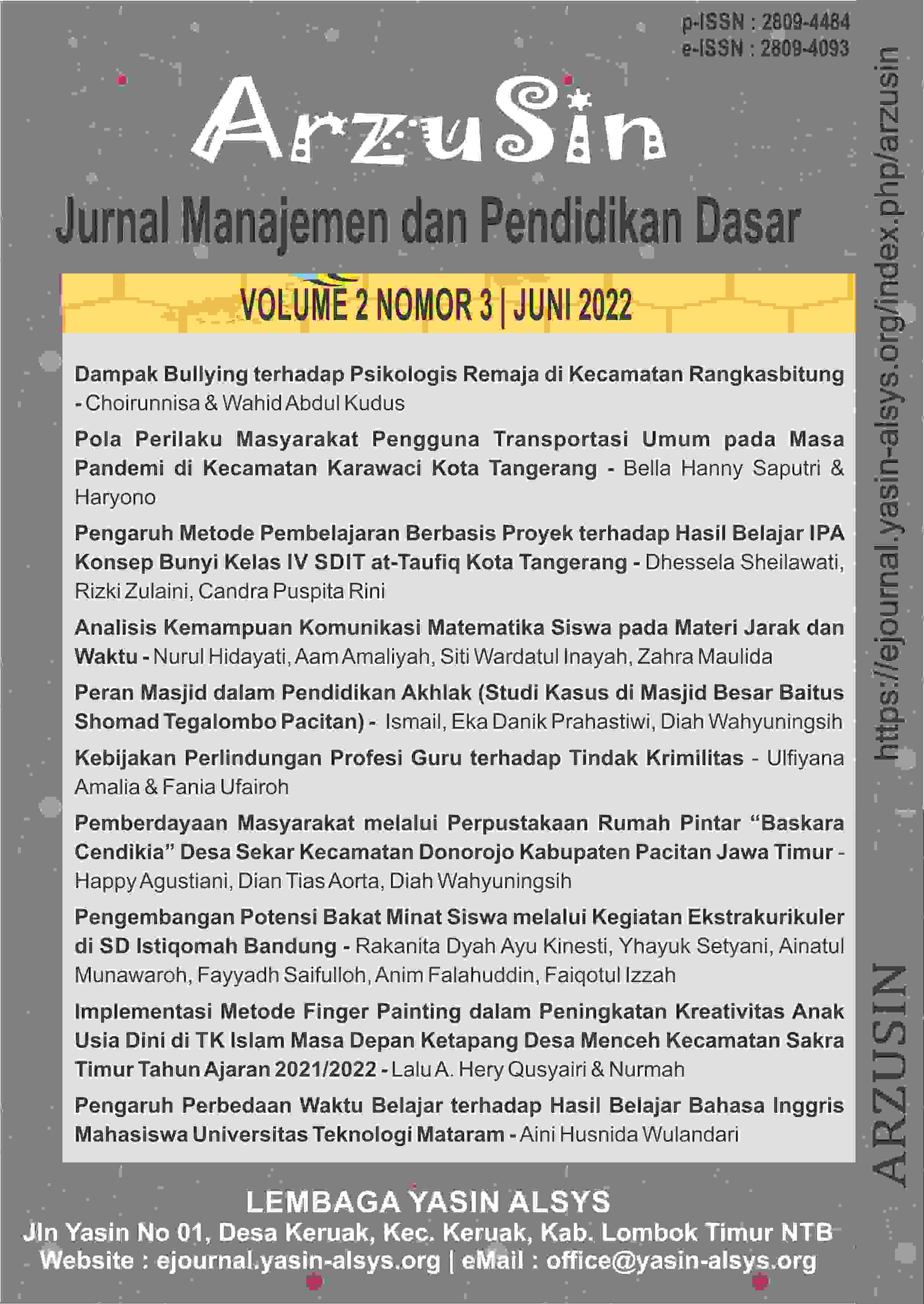
Dampak Bullying terhadap Psikologis Remaja di Kecamatan Rangkasbitung

Article Sidebar
 Page Numbers:
205-218
Page Numbers:
205-218
 Digital Object Identifier:


 Viewed: 2.162 times
 Downloaded: 2.105 times












LYAS Publisher cordially invites qualified professionals to serve as Editors or Reviewers. Your expertise will make an important contribution to maintaining and strengthening the academic quality of our publications. Interested applicants are kindly requested to complete the application form at the following link: Editors & Reviewers


Please feel free to contact us if you need any further information about the submission process or if you have any additional questions.

 Authors:
Choirunnisa Choirunnisa1, Wahid Abdul Kudus2
 Copyright :
Authors retain copyright and grant the journal right of first publication.
Main Article Content
Abstract
Bullying can be referred to as an act of violence where in this day and age there are many acts of bullying against school children, both elementary, junior high and even high school / vocational school. By knowing deviant behavior or morals that are not good in themselves, including teenagers, it can make teachers or parents think that they have failed in educating the individual's behavior, because bullying can be caused by the behavior of someone who thinks he has power among others so that he will be arbitrary to weak individuals. However, the forms of bullying are different, not only physically but also verbally, where the words that are uttered as if they think they are just a joke can actually bring down the spirit of someone they are ridiculing. So that the impact of bullying felt by these students is very diverse due to one factor and another, especially in Rangkasbitung District itself which has diversity in each individual school child. This research method uses a qualitative descriptive method by collecting data through the interview and observation process. The results of this study are (1) the forms of bullying, (2) the factors that cause bullying, (3) the psychological impact of adolescents due to bullying and, (4) how to prevent and overcome bullying.




Citation Metrics:




Downloads
Citation Metrics & Similar Scopus Articles
-
Muñoz-Fernández N. (2026)Students’ perceptions of teachers’ responses to LGBTQ+ bullying and general bullying: a latent profile analysisSocial Psychology of Education, 29(1)
-
Yang D. (2026)The relationship between adolescent bullying victimization, self-control and cyberbullying: a cross-lagged panel modelBMC Psychology, 14(1)
-
Gamil R. (2026)Workplace bullying in intensive care units: intern nurses’ experiences and responsesBMC Nursing, 25(1)
Article Details

Authors retain copyright and grant the journal right of first publication with the work simultaneously licensed under a Creative Commons Attribution-NonCommercial-ShareAlike 4.0 International License that allows others to share the work with an acknowledgement of the work's authorship and initial publication in this journal.