
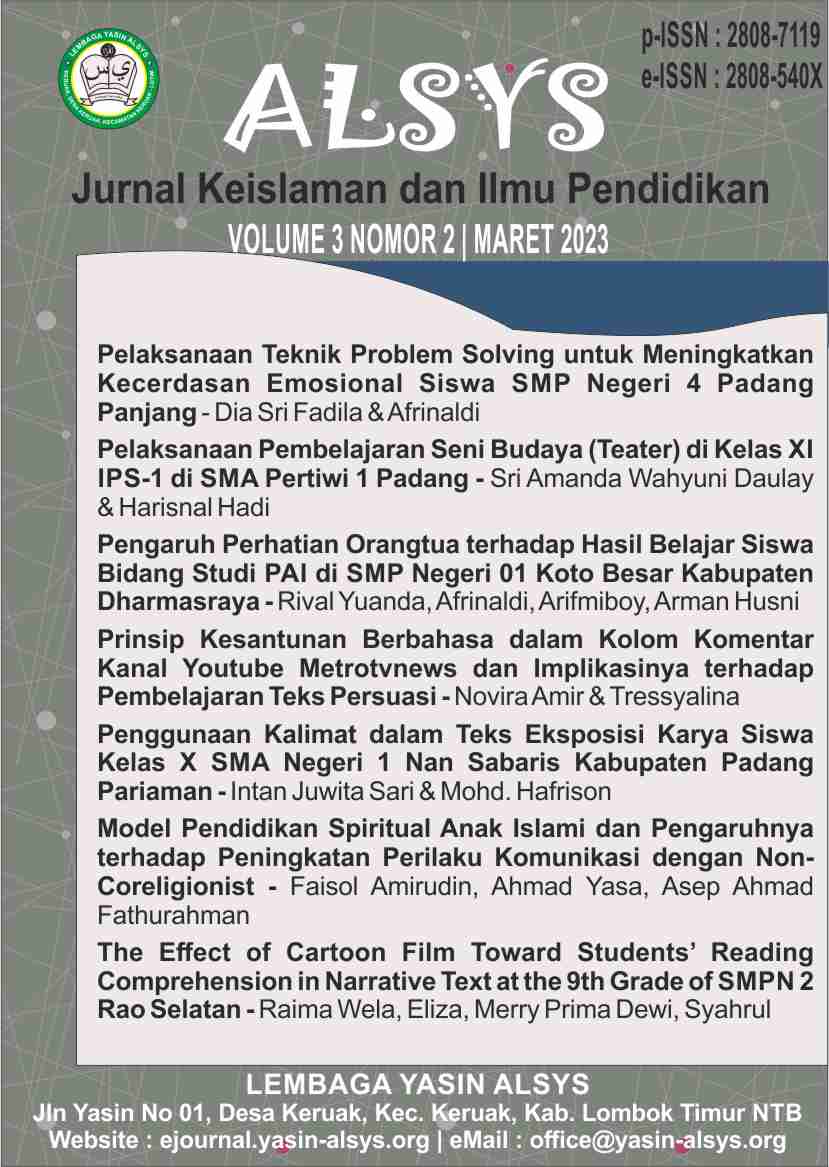
Pelaksanaan Teknik Problem Solving untuk Meningkatkan Kecerdasan Emosional Siswa SMP Negeri 4 Padang Panjang
Main Article Content
Abstract
This research departs from the phenomenon that there are students who have low emotional intelligence, in which students often utter harsh words and mock each other between one student and another so that it can be said that students have not been able to control or regulate their emotions in learning and socializing and students also not being able to build good relationships with friends around him and Shiva also doesn't know how to improve his emotional intelligence.The goal to be achieved in this study is to find out whether there is a significant difference or improvement between before and after being given problem solving techniques to improve the emotional intelligence of SMPN 4 Padang Panjang students. This research is a pre-experimental study using the One Group Pretest and Posttest Design model. The population is grade 8.2 students of SMPN 4 Padang Panjang, while the sample is 11 students who are indicated to have emotional intelligence problems based on the purposive sampling technique and the results of the pretest. The instrument that the authors use in data collection is the Likert scale. The data analysis technique used the Wilcoxon test, while the data analysis requirements used hypothesis testing with the help of SPSS version 25.The results of research that have been known from the results of the Z test (Wilcoxon) show that there is a difference between the pretest and posttest values. From the results of the Wilcoxon test calculation, a significant p-value of 0.003 was obtained. Based on the applicable regulations, it is known that the results of the Wilcoxon Sig test are p-value of 0.003 <α (α = 0.05), which means that Ha is accepted and Ho is rejected. From the results of the Wilcoxon test calculations, it can be concluded that students' emotional intelligence has increased after being given treatment using problem solving techniques.




Citation Metrics:




Downloads
Citation Metrics & Similar Scopus Articles
-
Wangtaphan W. (2027)From Individual Reasoning to Collaborative Engagement: Continuity of Student Problematic in Grade 1 Mathematical Problem SolvingAsean Journal of Educational Research and Technology, 6(2), 287-300
-
Kazhikenova S.S. (2028)Modelling and Solving Problems of Sustainable Efficiency of Technological Processes in MetallurgyKompleksnoe Ispolzovanie Mineralnogo Syra, 344(1), 65-78
-
Wang H. (2027)A Mixed Finite Element Method for Elliptic Interface Problems on Local Anisotropic Hybrid MeshesAdvances in Applied Mathematics and Mechanics, 19(1), 70-94
Article Details

Authors retain copyright and grant the journal right of first publication with the work simultaneously licensed under a Creative Commons Attribution-NonCommercial-ShareAlike 4.0 International License that allows others to share the work with an acknowledgement of the work's authorship and initial publication in this journal.
Article Sidebar
 Page Numbers:
66-76
Page Numbers:
66-76
 Digital Object ID:













 Viewed: 362 times
 Downloaded: 433 times

LYAS Publisher cordially invites qualified professionals to serve as Editors or Reviewers. Your expertise will make an important contribution to maintaining and strengthening the academic quality of our publications. Interested applicants are kindly requested to complete the application form at the following link: Editors & Reviewers


Please feel free to contact us if you need any further information about the submission process or if you have any additional questions.

 Authors:
 Copyright :
Authors retain copyright and grant the journal right of first publication.
Explore Our Journals
Find the journal that best fits your research. If this journal does not match your manuscript’s scope, explore our portfolio below to select a more suitable publication venue.