
The Effect of Workload and Demographic Characteristics on Employee Performance: A Case Study of Secretariat Division Employees at the Subang District Court
Main Article Content
Abstract
Employee performance is essential to the effectiveness of public organizations, particularly judicial institutions confronted with complex administrative demands and public service responsibilities. This study examines the effects of workload and demographic characteristics on employee performance at the Subang District Court. A quantitative associative design using a survey method was employed. The study involved all 70 employees, selected through saturated sampling. Data were collected using a Likert-scale questionnaire, observations, and documentation and analyzed through multiple linear regression, classical assumption testing, t-tests, an F-test, and the coefficient of determination. The findings indicate that workload does not have a statistically significant individual effect on employee performance, whereas demographic characteristics have a positive and significant effect. Collectively, workload and demographic characteristics significantly influence employee performance and explain 24% of its variance. These findings demonstrate that demographic characteristics play a more prominent role than workload in explaining employee performance within the examined organizational context. The study contributes empirical evidence concerning the determinants of employee performance in a judicial institution and highlights the importance of considering individual characteristics in public-sector human resource management. Practically, the findings support more effective workload allocation and competency-based employee placement to strengthen organizational performance.




Citation Metrics:




Downloads
Citation Metrics & Similar Scopus Articles
-
Lim C.K. (2028)Synergistic Effect of Dual Ionic Liquid PVDF-HFP Polymer Inclusion Membranes: Linking Mechanical, Chemical, Microstructural and Gold Recovery PerformanceKompleksnoe Ispolzovanie Mineralnogo Syra, 345(2), 130-141
-
Toleubek K.E. (2028)Mineralogical characteristics of oxidized copper-porphyry ores at the Koktaszhal depositKompleksnoe Ispolzovanie Mineralnogo Syra, 346(3), 28-39
-
Vishnevskaya N.A. (2028)Analytical Review of the Methods of Studying Open Pit Slope Stability Under the Conditions of Mining Operations DigitalizationKompleksnoe Ispolzovanie Mineralnogo Syra, 344(1), 99-108
Article Details

Authors retain copyright and grant the journal right of first publication with the work simultaneously licensed under a Creative Commons Attribution-NonCommercial-ShareAlike 4.0 International License that allows others to share the work with an acknowledgement of the work's authorship and initial publication in this journal.
References
Amalia, I., Maria, S., Herlina, H., T, Z., & Redjeki, F. (2024). Pengaruh Gaya Kepemimpinan dan Disiplin Kerja terhadap Kinerja Karyawan di PT Inti Medika Sarana Bandung. Mandiri Economics Journal, 1(1), 1–12. http://ejournal.universitasmandiri.ac.id/index.php/maconomics/article/view/68
Arraniri, I., Firmansyah, H., Wiliana, E., Setyaningsih, D., Susiati, A., Megaster, T., Rachmawati, E., Wardhana, A., Yuliatmo, W., Purwaningsih, N., Maliah, Mawardiningsih, W., Trisavinaningdiah, A., Arif, M., & Alini. (2021). Manajemen Sumber Daya Manusia. Insania.
Cahyati, P., Kartilah, T., Djamiatul, H., Hartono, D., & Adini, S. (2024). Pengaruh Beban Kerja terhadap Stress Kerja Perawat di Ruang Rawat Inap RSUD Dr. Soekardjo Kota Tasikmalaya. Media Informasi, 20(2), 51–59. https://doi.org/10.37160/mijournal.v20i2.637
Danarsih, R. U., Wiyono, G., & Kirana, K. C. (2021). Analisis Kinerja Berbasis Beban Kerja dan Konflik Kerja dengan Mediator Stres Kerja. Efisiensi: Kajian Ilmu Administrasi, 18(2), 126–141. https://doi.org/10.21831/efisiensi.v18i2.41527
Dessler, G. (2020). Human resource management (16th ed.). Pearson Education.
Dinata, I. P. S., Ismail, D., & Ekasani, K. A. (2023). Pengaruh Sosiodemografi terhadap Kinerja Karyawan. Jurnal Ilmiah Pariwisata dan Bisnis, 2(8), 1783–1797. https://doi.org/10.22334/paris.v2i8.502
Dirgantara, T., & Santoso, R. P. (2024). Sosiodemografis dan Rata-Rata Produktivitas Tenaga Kerja di Indonesia. Jurnal Kebijakan Ekonomi dan Keuangan, 3(1), 97–108. https://doi.org/10.20885/JKEK.vol3.iss1.art13
Firdaus, V. (2023). Beban Kerja, Lingkungan Kerja, dan Turnover Intention dan Pengaruhnya terhadap Kinerja Karyawan. Jurnal Ecoment Global, 8(1), 1–9. https://doi.org/10.35908/jeg.v8i1.2244
Griffin, R. W. (2022). Fundamentals of management (10th ed.). Cengage Learning.
Hasibuan, M. S. P. (2020). Manajemen: Dasar, Pengertian, dan Masalah. Bumi Aksara.
Luthans, F., Luthans, B. C., & Luthans, K. W. (2021). Organizational behavior: An evidence-based approach (14th ed.). Information Age Publishing.
Mangkunegara, A. P. (2021). Manajemen Sumber Daya Manusia Perusahaan. Remaja Rosdakarya.
Nurhandayani, A. (2022). Pengaruh Lingkungan Kerja, Kepuasan Kerja, dan Beban Kerja terhadap Kinerja. Jurnal Ekonomi dan Bisnis Digital (Ekobil), 1(2), 108–110. https://doi.org/10.58765/ekobil.v1i2.65
Pahira, S. H., & Rinaldy, R. (2023). Pentingnya Manajemen Sumber Daya Manusia (MSDM) dalam Meningkatkan Kinerja Organisasi. COMSERVA: Jurnal Penelitian dan Pengabdian Masyarakat, 3(3), 810–817. https://doi.org/10.59141/comserva.v3i03.882
Pamungkas, B., & Nursyamsi, I. (2024). Pengaruh Motivasi dan Disiplin Kerja terhadap Kinerja Pegawai. Jurnal Penelitian Ekonomi Manajemen dan Bisnis, 3(4), 222–232. https://doi.org/10.55606/jekombis.v3i4.4356
Ramadhani, R., & Firmansyah, Y. (2023). Dampak Keberagaman Demografis Tenaga Kerja terhadap Kinerja Karyawan di PT XYZ. Ultima Management: Jurnal Ilmu Manajemen, 15(1), 100–123. https://doi.org/10.31937/manajemen.v15i1.3183
Robbins, S. P., & Judge, T. A. (2022). Organizational behavior (19th ed.). Pearson Education.
Sakti, D. P. B., Simamora, R. B., Karim, A., Arnida, Nurmayanti, S., Alhamidi, E. M. A., Abidin, N., Siregar, B. G., Darsana, I. M., Mitrin, A., Salijah, E., Mayliza, R., & Sinaga, T. M. (2023). Manajemen Sumber Daya Manusia. Intelektual Manifes Media.
Sukmawati, R., & Hermana, C. (2024). Pengaruh Beban Kerja dan Stres Kerja terhadap Kinerja Karyawan. Jurnal Riset Manajemen dan Bisnis (JRMB), 4(1), 51–56. https://doi.org/10.29313/jrmb.v4i1.4019
Susilawati, L., Nugroho, M. T., & Wahyuni, S. (2025). Pengaruh Beban Kerja terhadap Kinerja Karyawan. Jurnal Ekonomi, Manajemen, Akuntansi dan Keuangan, 6(4), 1–12. https://doi.org/10.53697/emak.v6i4.3045
Suwarto. (2020). Faktor-Faktor yang Mempengaruhi Kinerja Pegawai. Eksis: Jurnal Ilmiah Ekonomi dan Bisnis, 11(1), 15–24. https://doi.org/10.33087/eksis.v11i1.180
Widodo, D. S., & Yandi, A. (2022). Model Kinerja Karyawan: Kompetensi, Kompensasi, dan Motivasi (Literature Review MSDM). Jurnal Ilmu Multidisiplin, 1(1), 1–14. https://doi.org/10.38035/jim.v1i1.1
Yuliantini, T., & Suryatiningsih, S. (2021). Pengaruh Disiplin Kerja dan Beban Kerja terhadap Kinerja Karyawan (Studi pada Karyawan PT ISS Indonesia). Populis: Jurnal Sosial dan Humaniora, 6(2), 104–120. https://doi.org/10.47313/pjsh.v6i2.1255
Yuliastutik, E. (2024). Hubungan Karakteristik Demografi dan Beban Kerja dengan Kinerja Perawat di RSUD Tidar Kota Magelang [Undergraduate thesis, Universitas Muhammadiyah Magelang]. Repository UNIMMA. https://repositori.unimma.ac.id/id/eprint/4497
Article Sidebar
 Page Numbers:
6370-6385
 Digital Object ID:













 Viewed: 88 times
 Downloaded: 102 times

LYAS Publisher cordially invites qualified professionals to serve as Editors or Reviewers. Your expertise will make an important contribution to maintaining and strengthening the academic quality of our publications. Interested applicants are kindly requested to complete the application form at the following link: Editors & Reviewers
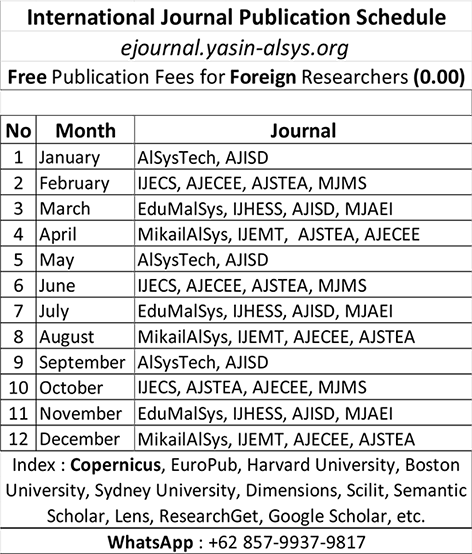
Please feel free to contact us if you need any further information about the submission process or if you have any additional questions.

 Authors:
 Copyright :
Authors retain copyright and grant the journal right of first publication.
Explore Our Journals
Find the journal that best fits your research. If this journal does not match your manuscript’s scope, explore our portfolio below to select a more suitable publication venue.