
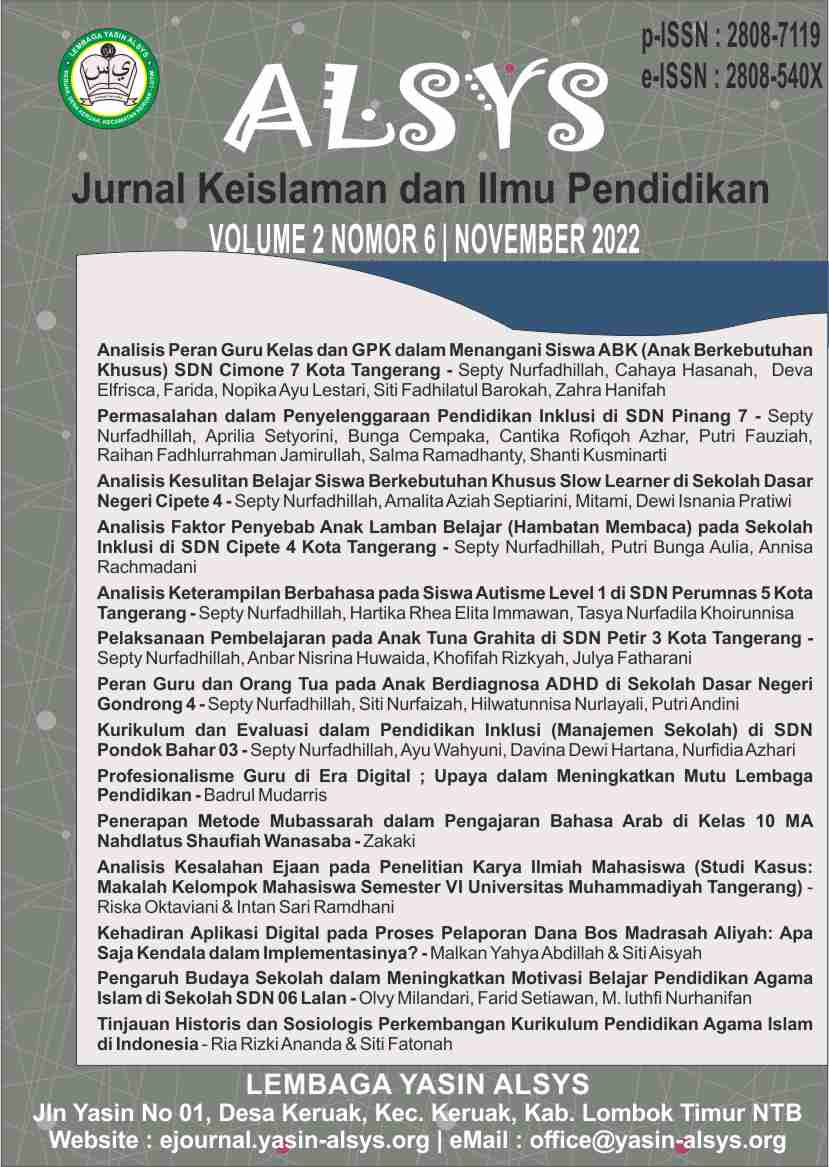
Pengaruh Budaya Sekolah dalam Meningkatkan Motivasi Belajar Pendidikan Agama Islam di Sekolah SDN 06 Lalan
Main Article Content
Abstract
The success of implementing learning in schools cannot be separated from the influence from within each student. The success of a learner in learning is strongly influenced by various aspects of himself, one of which is his motivation in learning. Motivation in learning is not only obtained from family support, but also from how habits are formed in the school environment. The purpose of writing this article is to illustrate how influential the habits that grow in the school environment are for increasing a student's learning motivation, which will also affect the success of implementing learning in an educational institution. This research uses qualitative research methods using library study techniques, where we take various literature such as journals, articles, or books related to the influence of habits that grow in schools to increase learning motivation and also the authors collect data by interviewing public elementary school teachers. 06 LALAN to further strengthen the research that will be carried out. After taking some data both from the literature and interviews, the writer analyzes the data obtained and develops it into a piece of writing.




Citation Metrics:




Downloads
Citation Metrics & Similar Scopus Articles
-
Azhand A. (2027)Teaching Persian derivational affixes to non-Persian speakers from a Cognitive Morphology Approach: A case study of nominal suffixes (kar, gar, ban, baz, -ande)Language Related Research, 17(4), 469-497
-
Naemi Z. (2027)The Relationship between Second Language Learning Strategies, Learning Engagement, and Writing Skill in the Arabic Writing CurriculumLanguage Related Research, 17(4), 331-360
-
Abdel Hameed M. (2027)Optimized machine learning models for identification of autism spectrum disorderInternational Journal of Cognitive Computing in Engineering, 8, 1-22
Article Details

Authors retain copyright and grant the journal right of first publication with the work simultaneously licensed under a Creative Commons Attribution-NonCommercial-ShareAlike 4.0 International License that allows others to share the work with an acknowledgement of the work's authorship and initial publication in this journal.
Article Sidebar
 Page Numbers:
763-774
Page Numbers:
763-774
 Digital Object ID:













 Viewed: 568 times
 Downloaded: 408 times

LYAS Publisher cordially invites qualified professionals to serve as Editors or Reviewers. Your expertise will make an important contribution to maintaining and strengthening the academic quality of our publications. Interested applicants are kindly requested to complete the application form at the following link: Editors & Reviewers


Please feel free to contact us if you need any further information about the submission process or if you have any additional questions.

 Authors:
 Copyright :
Authors retain copyright and grant the journal right of first publication.
Explore Our Journals
Find the journal that best fits your research. If this journal does not match your manuscript’s scope, explore our portfolio below to select a more suitable publication venue.