
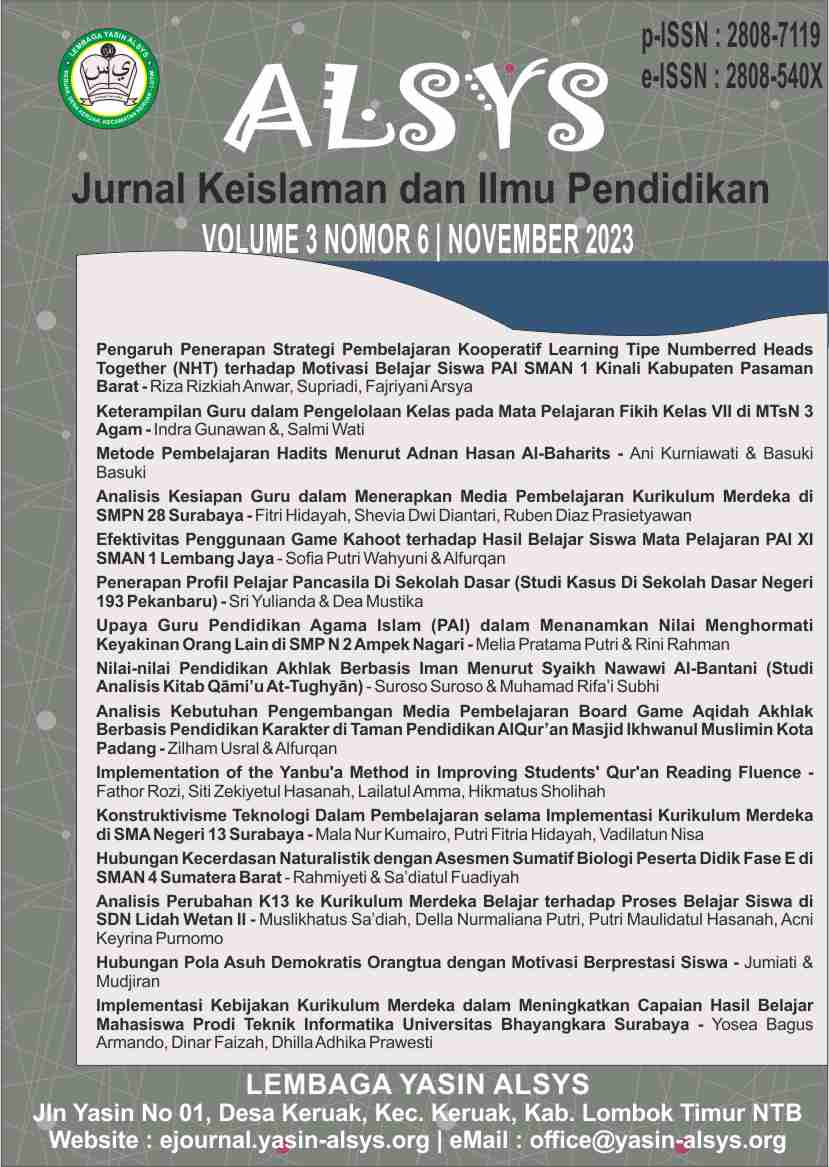
Nilai-nilai Pendidikan Akhlak Berbasis Iman Menurut Syaikh Nawawi Al-Bantani (Studi Analisis Kitab Qāmi’u At-Tughyān)

Article Sidebar
 Page Numbers:
645-655
Page Numbers:
645-655
 Digital Object Identifier:


 Viewed: 442 times
 Downloaded: 368 times












LYAS Publisher cordially invites qualified professionals to serve as Editors or Reviewers. Your expertise will make an important contribution to maintaining and strengthening the academic quality of our publications. Interested applicants are kindly requested to complete the application form at the following link: Editors & Reviewers


Please feel free to contact us if you need any further information about the submission process or if you have any additional questions.

 Authors:
Suroso Suroso1, Muhamad Rifa’i Subhi2
 Copyright :
Authors retain copyright and grant the journal right of first publication.
Main Article Content
Abstract
Character development efforts through a variety of educational institutions and through various methods continue to be developed. This shows that morals really need to be fostered, and this formation turns out to bring results in the form of the formation of Muslim individuals who are noble, obedient to Allah and His Messenger, respect for mothers, fathers, compassion for fellow beings and so on. This condition of coaching is increasingly felt necessary especially when there are more challenges and temptations as a result of advances in science and technology. Today, for example, people will easily communicate with anything in this world, which is good or bad, because the existence of telecommunication equipments. The problems in article this study are: first¸ What is The Values of Manners Education based on Faith according to ShaykhNawawi al-Bantani in the book Qāmīu at-Tughyān? second¸ What is the relevance Values of Manners Education based on Faith according to ShaykhNawawi al-Bantani in the Qāmī'u at-Tughyā book with the current context of moral education?The purpose of this study is to describe and critically analyze the Values of Manners Education based on Faith according to ShaykhNawawi al-Bantani in the book Qāmīu at-Tughyān and its relevance to the current context of moral education.While the usefulness of this research theoretically is to add scientific insight about moral education and can be a reference material in digging up information in order to add to scientific treasures. And its practical uses for education observers namely contribute to becoming a reference and scientific treasure in deepening scientific horizons. This study uses a descriptive qualitative analysis approach with a type of library research. While the data collection techniques is based on documentation. And the data analysis technique is the content analysis technique. The results of this study indicate that the classification of faith-based moral education in the book Qāmi'u At-Tughyān According to Shaykh Muhammad Nawawi Al-Bantani can be divided into five categories. First, morals towards Allah Swt.Second, morals towards Prophet Muhammad Saw.Third, morals towards Religious expert. Fourth, morals towards fellow people and Fifth, morals towards ourself.




Citation Metrics:




Downloads
Citation Metrics & Similar Scopus Articles
-
Ding S. (2027)Digital Renewal of University Education: Barriers, Opportunities, and Contributions to Sustainable Development Goals (SDGs)Asean Journal of Educational Research and Technology, 6(2), 229-240
-
Raime S. (2027)Mental Health and Neurodivergence Disclosure Risk Mitigation in Private Higher Education Institutions: An Integrated Risk-Protection Framework to Support Sustainable Development Goals (SDGs)Asean Journal of Educational Research and Technology, 6(1), 183-200
-
Irawati R. (2027)Enhancing accounting students’ writing performance through problem-based learning: Evidence from a vocational higher education contextMultidisciplinary Science Journal, 9(1)
Article Details

Authors retain copyright and grant the journal right of first publication with the work simultaneously licensed under a Creative Commons Attribution-NonCommercial-ShareAlike 4.0 International License that allows others to share the work with an acknowledgement of the work's authorship and initial publication in this journal.