
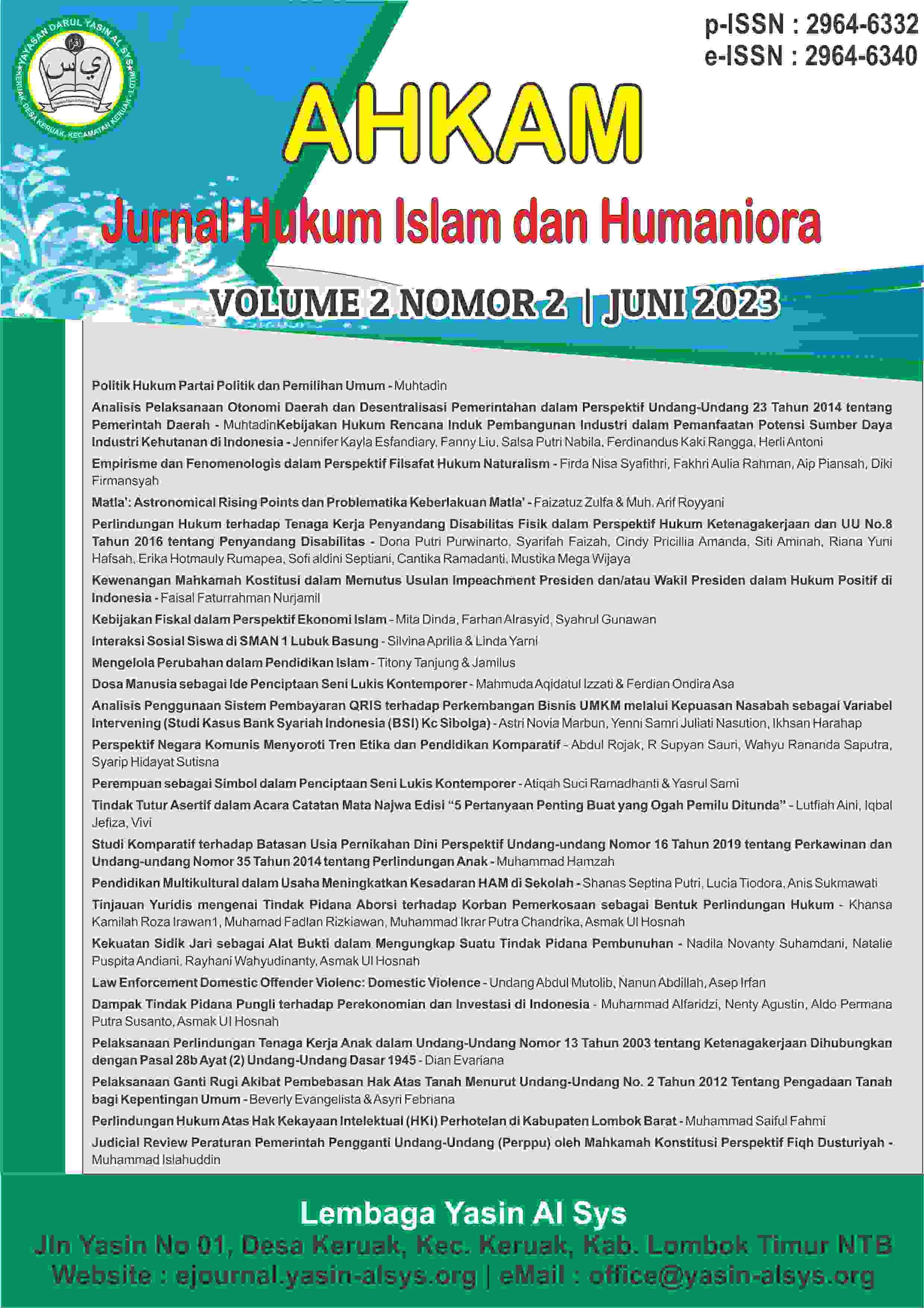
Empirisme dan Fenomenologis dalam Perspektif Filsafat Hukum Naturalism
Main Article Content
Abstract
Legal thought is characterized by the development of legal philosophy schools of thought. The emergence of a legal school was a response or criticism of the previous legal school, or it emerged as a response to the social development of society at that time. Currents that emerge and develop in the realm of legal thought include natural law, legal positivism (pure legal theory), utilitarianism, legal realism, American sociological jurisprudence, and schools of history. The entire history of legal philosophy makes it clear that the real problem in the field of legal philosophy is none other than this problem: what is natural law? From the beginning, natural law has been the subject of legal philosophy and until today this problem always reappears in people's minds. The research method that the writer uses in this research is descriptive analytic. The author uses data collection techniques in the form of a literature study by taking into account issues related to Empiricism and Phenomenology in the Legal Perspective of Naturalism. The research results have implications for the Legal Philosophy of Naturalism which can be seen in terms of empiricism and phenomenology. Based on the theory of natural law, there are those who argue that the beginning of all goods is not owned by anyone. Such goods are called ResNullius (See Article 519 BW. which states: "Items that are not owned by anyone"). By agreement between them, humans divide these goods, thereby obtaining individual property rights.




Citation Metrics:




Downloads
Citation Metrics & Similar Scopus Articles
-
Iskandar T.A.b.T.M. (2026)The Hukum Kanun Pahang: A Forgotten Malay-Islamic Constitutional and Maritime LegacyAl Shajarah, 31(1), 1-25
-
Bachri S. (2026)A Benefit-Based Reconstruction of Contemporary Copyright Inheritance in Indonesian Islamic LawMilrev Metro Islamic Law Review, 5(2), 1205-1223
-
Goyal E. (2026)Correction: Comparative transcriptome profiling of contrasting finger millet (Eleusine coracana (L.) Gaertn) genotypes under heat stress (Molecular Biology Reports, (2024), 51, 1, (283), 10.1007/s11033-024-09233-x)Molecular Biology Reports, 53(1)
Article Details

Authors retain copyright and grant the journal right of first publication with the work simultaneously licensed under a Creative Commons Attribution-NonCommercial-ShareAlike 4.0 International License that allows others to share the work with an acknowledgement of the work's authorship and initial publication in this journal.
References
Al Munir, M. I. (2004). Tinjauan Terhadap Metode Empirisme dan Rasionalisme. Jurnal Filsafat, Vol. 38 No.
Ali, M. (2017). Pemetaan Tesis dalam Aliran-Aliran Filsafat Hukum dan Konsekuensi Metodologisnya. Jurnal Hukum Ius Quia Iustum, Vol. 24(2).
Amin, S. (2019). Keadilan Dalam Perspektif Filsafat Hukum Terhadap Masyarakat. Jurnal El Afkar, Vol. 8 No.
Aprita, S., & Adhitya, R. (2020). Filsafat Hukum. PT. Raja Grafindo Persada.
Bekker, A. (1984). Metode - Metode Filsafat. Ghalia Indonesia.
Bertens, K. (1981). Filsafat Barat dalam Abad XX. PT. Gramedia.
Hadiwidjono, H. (1980). Sari Sejarah Filsafat Barat 2. Yayasan Kanisius.
Hammersma, H. (1983). Tokoh - Tokoh Filsafat Barat Modern. PT. Gramedia.
Handayani, Johannes, & Kikis. (2018). Peranan Filsafat Hukum dalam Mewujudkan Keadilan. Jurnal Muara Ilmu Sosial, Humaniora Dan Seni, Vol. 2 No.
Hardiansyah. (2013). Teori Pengetahuan Edmund Husserl. Jurnal Substantia, Vol. 15 No.
Karam, Y. (1980). Tarikh al-Falsafat al-Hadithah. Alumni.
Lutfi, K. R. (2014). Teori Hukum Alam dan Kepatuhan Negara Terhadap Hukum Internasional. Jurnal Yuridis, Vol. 1 No.
Nazir, M. (2008). Metode Penelitian. Ghalia Indonesia.
Praja, J. S. (2003). Aliran - Aliran Filsafat dan Etika. Prenadamedia Group.
Article Sidebar
 Page Numbers:
267-281
Page Numbers:
267-281
 Digital Object ID:













 Viewed: 913 times
 Downloaded: 917 times

LYAS Publisher cordially invites qualified professionals to serve as Editors or Reviewers. Your expertise will make an important contribution to maintaining and strengthening the academic quality of our publications. Interested applicants are kindly requested to complete the application form at the following link: Editors & Reviewers


Please feel free to contact us if you need any further information about the submission process or if you have any additional questions.

 Authors:
 Copyright :
Authors retain copyright and grant the journal right of first publication.
Explore Our Journals
Find the journal that best fits your research. If this journal does not match your manuscript’s scope, explore our portfolio below to select a more suitable publication venue.