
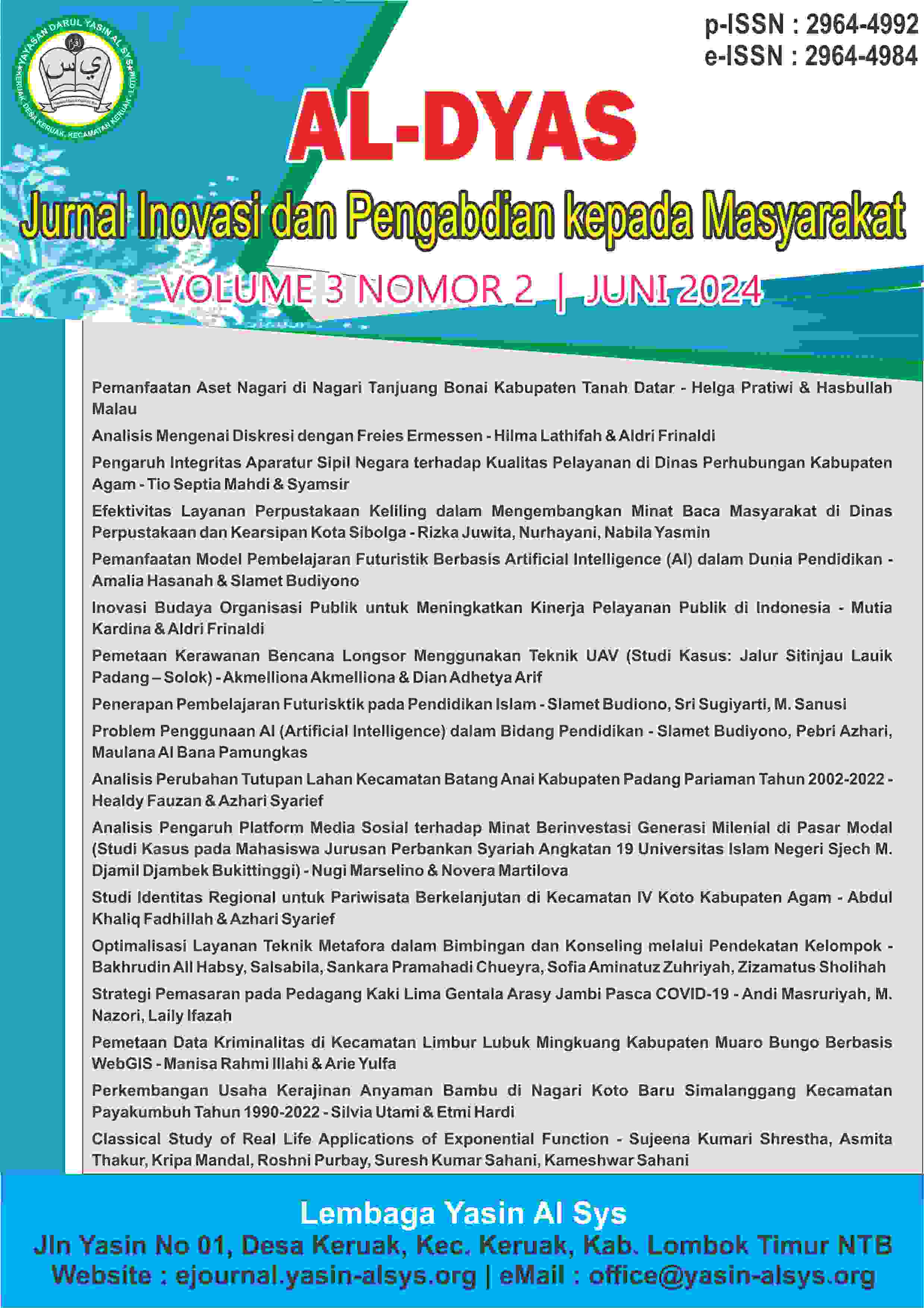
Penerapan Pembelajaran Futurisktik pada Pendidikan Islam Implementation of Futuristic Learning in Islamic Education

Main Article Content
Abstract
This This article discusses the application of futuristic learning to Islamic education. The aim is to find out the extent to which the futuristic learning model is implemented while maintaining the basic principles of Islamic education. This research uses a literature review approach from several book sources, journal articles and websites. The results of the research show that futuristic learning is applied proportionally, pays attention to all aspects of students and does not overdo the use of digital learning media, is able to bring a progressive mindset to students, is not left behind with the times, but is also not easily carried away by the current of the times and infected with addiction. digital. Of course, with strict control and supervision, both from parents and teachers. Without abandoning the basic principles and objectives of Islamic education, the most important capital for students to face the times in the future, with their behavior, whatever their various names, then Muslims have confidence, that with the principle of holding fast to the rope of Allah subhanahu wa ta'ala, in the form of the Qur'an and Sunnah, humans will not be lost forever.




Citation Metrics:




Downloads
Citation Metrics & Similar Scopus Articles
-
Ratnaningsih E. (2027)Designing a Data-Driven E-Learning Module for Teaching English to Young Learners: Integrating Needs Analysis and the ISAV Learning ModelAsean Journal of Educational Research and Technology, 6(2), 269-286
-
Unyaphatariyakool S. (2027)Science Teachers’ Learning Management Competency through Professional Learning Communities to Promote Scientific Creativity and Sustainable Development Goals (SDGs)Asean Journal of Educational Research and Technology, 6(2), 241-252
-
Trisnowati E. (2027)Science, Technology, Engineering, and Mathematics (STEM) and Research Skill Development (RSD) in Science Education in Higher Education: A Delphi-Based ModelAsean Journal of Educational Research and Technology, 6(2), 253-268
Article Details

Authors retain copyright and grant the journal right of first publication with the work simultaneously licensed under a Creative Commons Attribution-NonCommercial-ShareAlike 4.0 International License that allows others to share the work with an acknowledgement of the work's authorship and initial publication in this journal.
References
Putra, P. H. (2019). Tantangan Pendidikan Islam dalam Menghadapi Society 5.0, 19(02), 99–110. Diambil dari https://ejournal.iainkerinci.ac.id/index.php/islamika/article/view/458/328
Sa’id, A. U. (2022). Jalan Kebenaran Hanya Satu (2). Diambil dari https://muslim.or.id/25533-jalan-kebenaran-hanya-satu-2.html
Sari, R. P., Holilulloh, & Yanzi, H. (2017). Faktor-Faktor yang Mempengaruhi Pola Pikir Masyarakat Terhadap Pentingnya Pendidikan di Desa Cugung. Jurnal Kultur Demokrasi, 8, 32. Diambil dari https://www.neliti.com/publications/252784/faktor-faktor-yang-mempengaruhi-pola-pikir-masyarakat-terhadap-pentingnya-pendid
Wahyuni, D. S., Yuliana, & Ilmi, D. (2023). Pendekatan Futuristik. Jurnal Anthor, 2, 416–422.
Article Sidebar
 Page Numbers:
651-659
Page Numbers:
651-659
 Digital Object Identifier:













 Viewed: 467 times
 Downloaded: 300 times

LYAS Publisher cordially invites qualified professionals to serve as Editors or Reviewers. Your expertise will make an important contribution to maintaining and strengthening the academic quality of our publications. Interested applicants are kindly requested to complete the application form at the following link: Editors & Reviewers


Please feel free to contact us if you need any further information about the submission process or if you have any additional questions.

 Authors:
Slamet Budiono1, Sri Sugiyarti2, M. Sanusi3
 Copyright :
Authors retain copyright and grant the journal right of first publication.
Explore Our Journals
Find the journal that best fits your research. If this journal does not match your manuscript’s scope, explore our portfolio below to select a more suitable publication venue.