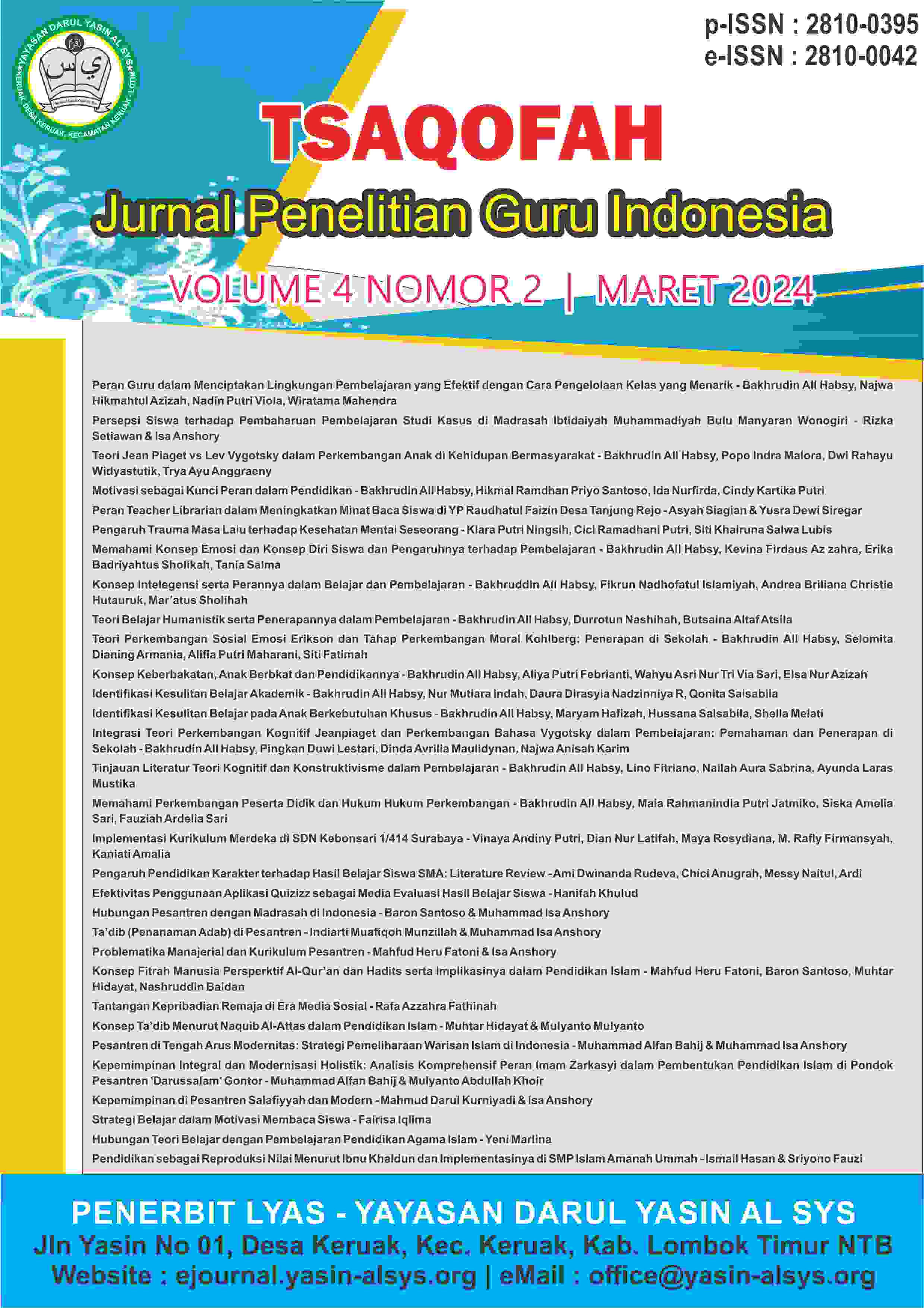
Memahami Perkembangan Peserta Didik dan Hukum Hukum Perkembangan Understanding Student Development and the Laws of Development
Main Article Content
Abstract
The students' differences lie in their thinking patterns, imagination, intelligence, and workmanship. before learning specifically about students, it is necessary to see the development of students' participation. The purpose of this study is to understand the development of students and the laws of development. Methods used are literature studies, with methods of collecting library data, reading, recording, and managing research materials. The result obtained under the definition of a Student development is a period when there is a process of change in individuals both physically and psychologically mentally that takes place continuously and will affect the formation of the personality of the individual. And in this period of development it is very important to instill the personality character of the Indonesian nation. The purpose of student development is to develop abilities, understand the nature of student growth and development starting at an early age, elementary, secondary, and adult. The development of students has three aspects: development, emotional development, and intelligence/cognitive development. The principles of law generally describe that the process of development occurs regularly, cythemically, gradually and does not occur suddenly and is influenced by certain factors. It is also explained in the principles of student development, that each individual experiences a different development from the other and occurs differentially and integrally.




Citation Metrics:



Downloads
Citation Metrics & Similar Scopus Articles
-
El Yamani Z. (2027)Mapping the literature on entrepreneurial education and students’ entrepreneurial mindset and intention: A bibliometric review using the SPAR-4-SLR protocol and the TCCM frameworkMultidisciplinary Reviews, 10(3)
-
Proverawati A. (2027)PEER INFLUENCE AND LOGO USE WITH OVERLAPPING AWARENESS AND KNOWLEDGE AMONG INDONESIAN NUTRITION STUDENTSBangladesh Journal of Multidisciplinary Scientific Research, 12(1), 118-129
-
Trisnowati E. (2027)Science, Technology, Engineering, and Mathematics (STEM) and Research Skill Development (RSD) in Science Education in Higher Education: A Delphi-Based ModelAsean Journal of Educational Research and Technology, 6(2), 253-268
Article Details

Authors retain copyright and grant the journal right of first publication with the work simultaneously licensed under a Creative Commons Attribution-NonCommercial-ShareAlike 4.0 International License that allows others to share the work with an acknowledgement of the work's authorship and initial publication in this journal.
Article Sidebar
 Page Numbers:
770-784
 Digital Object ID:













 Viewed: 3.038 times
 Downloaded: 1.644 times
LYAS Publisher cordially invites qualified professionals to serve as Editors or Reviewers. Your expertise will make an important contribution to maintaining and strengthening the academic quality of our publications. Interested applicants are kindly requested to complete the application form at the following link: Editors & Reviewers


Please feel free to contact us if you need any further information about the submission process or if you have any additional questions.

 Authors:
 Copyright :
Authors retain copyright and grant the journal right of first publication.
Explore Our Journals
Find the journal that best fits your research. If this journal does not match your manuscript’s scope, explore our portfolio below to select a more suitable publication venue.