
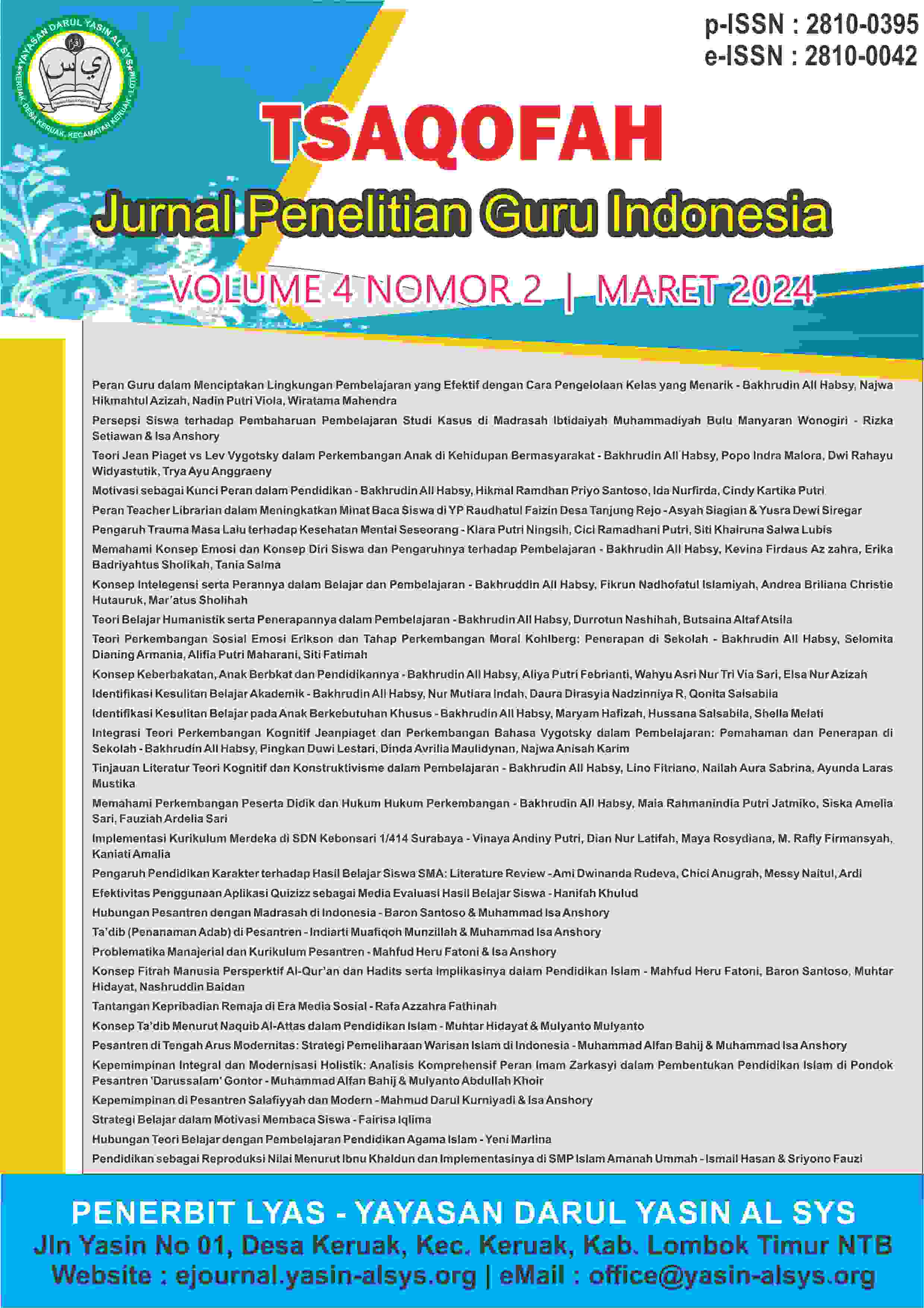
Teori Belajar Humanistik serta Penerapannya dalam Pembelajaran Humanistic Learning Theory and Its Application in Teaching and Learning
Main Article Content
Abstract
Not just a means of knowledge transformation, but the learning process of humanistic education is part of developing human values. This research uses a literature study method with a descriptive qualitative research type with library research which seeks to describe the role of humanistic learning theory and its application in learning. The theory of humanism, which was initiated by key figures such as Abraham Maslow and Carl Rogers, has the main goal of encouraging human self-development towards autonomous self-actualization. The implementation of humanistic theory in education includes forming students with noble character, motivating students to learn actively, and creating an environment that supports students' positive self-development. The main aim of education by applying humanistic learning theory is to humanize humans.




Citation Metrics:



Downloads
Citation Metrics & Similar Scopus Articles
-
Ratnaningsih E. (2027)Designing a Data-Driven E-Learning Module for Teaching English to Young Learners: Integrating Needs Analysis and the ISAV Learning ModelAsean Journal of Educational Research and Technology, 6(2), 269-286
-
Unyaphatariyakool S. (2027)Science Teachers’ Learning Management Competency through Professional Learning Communities to Promote Scientific Creativity and Sustainable Development Goals (SDGs)Asean Journal of Educational Research and Technology, 6(2), 241-252
-
Naemi Z. (2027)The Relationship between Second Language Learning Strategies, Learning Engagement, and Writing Skill in the Arabic Writing CurriculumLanguage Related Research, 17(4), 331-360
Article Details

Authors retain copyright and grant the journal right of first publication with the work simultaneously licensed under a Creative Commons Attribution-NonCommercial-ShareAlike 4.0 International License that allows others to share the work with an acknowledgement of the work's authorship and initial publication in this journal.
Article Sidebar
 Page Numbers:
658-673
Page Numbers:
658-673
 Digital Object ID:













 Viewed: 2.867 times
 Downloaded: 4.166 times
LYAS Publisher cordially invites qualified professionals to serve as Editors or Reviewers. Your expertise will make an important contribution to maintaining and strengthening the academic quality of our publications. Interested applicants are kindly requested to complete the application form at the following link: Editors & Reviewers


Please feel free to contact us if you need any further information about the submission process or if you have any additional questions.

 Authors:
 Copyright :
Authors retain copyright and grant the journal right of first publication.
Explore Our Journals
Find the journal that best fits your research. If this journal does not match your manuscript’s scope, explore our portfolio below to select a more suitable publication venue.