
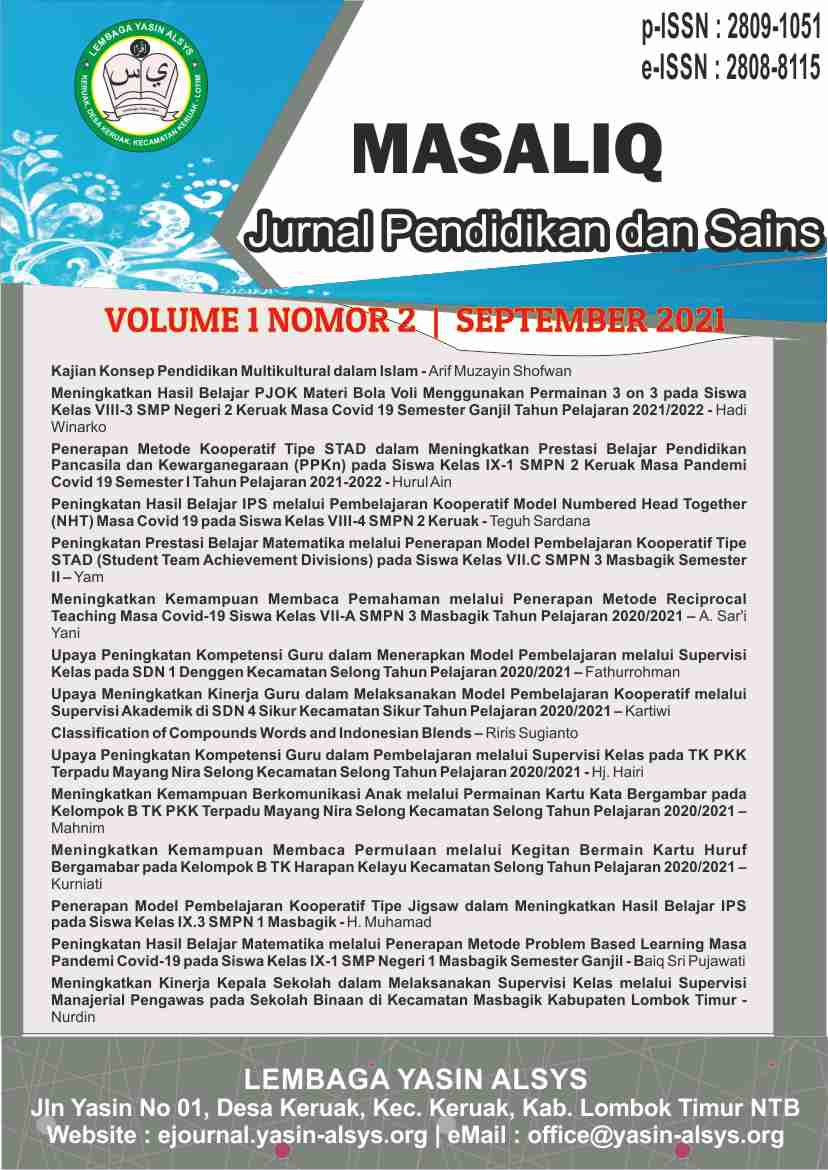
Classification of Compounds Words and Indonesian Blends
Main Article Content
Abstract
This paper is about theoretical research on classification of compound words and Indonesian Blends. Compound and blends are part of words formation in English language. The way to use two words together to yield a new meaning whether blends are one of the many ways new words are made in English. This paper attempts to make the classification of compounds, the reason of why are compounds divided into three categories; solid compound, hypenated compound, and open compound. This paper also attempts to analyze the reason why Indonesian blends inconsistent syllabically and state the implication to the language development




Citation Metrics:




Downloads
Citation Metrics & Similar Scopus Articles
-
Esmaeelpour E. (2027)The role of semantic transparency in lexical processing of head-first endocentric compounds in PersianLanguage Related Research, 17(4), 231-261
-
Mirhaji H.R. (2027)The Arabic Language from a Semantic Perspective An Inquiry into Essentialism and Nominalism in Words and StructuresLanguage Related Research, 17(4), 499-535
-
Myrzaliyeva S.K. (2028)The environmental efficiency of the combined combustion of low-grade Ekibastuz coal and plant biomassKompleksnoe Ispolzovanie Mineralnogo Syra, 347(4), 5-14
Article Details

Authors retain copyright and grant the journal right of first publication with the work simultaneously licensed under a Creative Commons Attribution-NonCommercial-ShareAlike 4.0 International License that allows others to share the work with an acknowledgement of the work's authorship and initial publication in this journal.
Article Sidebar
 Page Numbers:
115-125
Page Numbers:
115-125
 Digital Object ID:













 Viewed: 483 times
 Downloaded: 352 times

LYAS Publisher cordially invites qualified professionals to serve as Editors or Reviewers. Your expertise will make an important contribution to maintaining and strengthening the academic quality of our publications. Interested applicants are kindly requested to complete the application form at the following link: Editors & Reviewers


Please feel free to contact us if you need any further information about the submission process or if you have any additional questions.

 Authors:
 Copyright :
Authors retain copyright and grant the journal right of first publication.
Explore Our Journals
Find the journal that best fits your research. If this journal does not match your manuscript’s scope, explore our portfolio below to select a more suitable publication venue.