
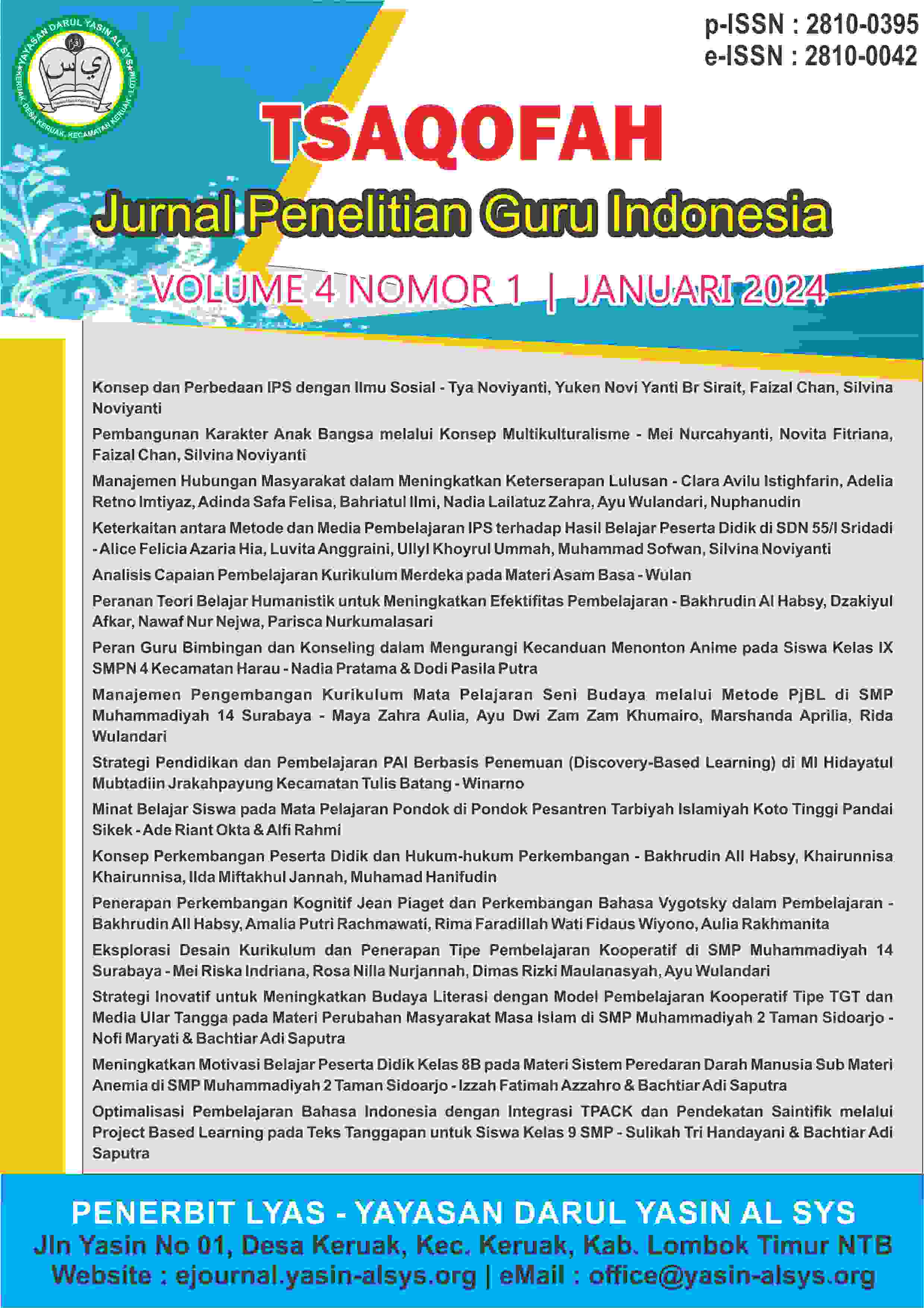
Eksplorasi Desain Kurikulum dan Penerapan Tipe Pembelajaran Kooperatif di SMP Muhammadiyah 14 Surabaya Exploration of Curriculum Design and Implementation of Cooperative Learning Types at Muhammadiyah 14 Junior High School, Surabaya

Main Article Content
Abstract
Teachers in junior high schools need to gain the knowledge, skills and support necessary to integrate cooperative learning methods into learning programs. There needs to be an update in curriculum design to accommodate these learning strategies and ensure the achievement of educational goals with efficiency. Exploring curriculum design to implement cooperative learning methods for teachers in junior high schools is a very relevant and important step in responding to the demands of current developments. This research method involves interviews with the Head of Curriculum as a resource person and uses the Project Based Learning (PJBL) learning model at SMP Muhammadiyah 14 Surabaya. The results of implementing this learning model include two aspects, namely the work or projects produced by students and the development of a sense of concern for the problems they face. Apart from that, there is a relationship between learning the Merdeka curriculum and the P5 program (Project for Strengthening the Profile of Pancasila Students). In conclusion, exploring curriculum design and implementing cooperative learning in junior high schools requires an in-depth understanding of student needs and characteristics, as well as the educational goals to be achieved. A good curriculum will include material that is developmentally appropriate for students and provides opportunities for them to be actively involved in the learning process. However, the implementation of cooperative learning in junior high schools is also faced with a number of challenges.




Citation Metrics:




Downloads
Citation Metrics & Similar Scopus Articles
-
Ratnaningsih E. (2027)Designing a Data-Driven E-Learning Module for Teaching English to Young Learners: Integrating Needs Analysis and the ISAV Learning ModelAsean Journal of Educational Research and Technology, 6(2), 269-286
-
Azhand A. (2027)Teaching Persian derivational affixes to non-Persian speakers from a Cognitive Morphology Approach: A case study of nominal suffixes (kar, gar, ban, baz, -ande)Language Related Research, 17(4), 469-497
-
Naemi Z. (2027)The Relationship between Second Language Learning Strategies, Learning Engagement, and Writing Skill in the Arabic Writing CurriculumLanguage Related Research, 17(4), 331-360
Article Details

Authors retain copyright and grant the journal right of first publication with the work simultaneously licensed under a Creative Commons Attribution-NonCommercial-ShareAlike 4.0 International License that allows others to share the work with an acknowledgement of the work's authorship and initial publication in this journal.
Article Sidebar
 Page Numbers:
159-172
Page Numbers:
159-172
 Digital Object Identifier:













 Viewed: 527 times
 Downloaded: 376 times

LYAS Publisher cordially invites qualified professionals to serve as Editors or Reviewers. Your expertise will make an important contribution to maintaining and strengthening the academic quality of our publications. Interested applicants are kindly requested to complete the application form at the following link: Editors & Reviewers


Please feel free to contact us if you need any further information about the submission process or if you have any additional questions.

 Authors:
Mei Riska Indriana1, Rosa Nilla Nurjannah2, Dimas Rizki Maulanasyah3, Ayu Wulandari4
 Copyright :
Authors retain copyright and grant the journal right of first publication.
Explore Our Journals
Find the journal that best fits your research. If this journal does not match your manuscript’s scope, explore our portfolio below to select a more suitable publication venue.