
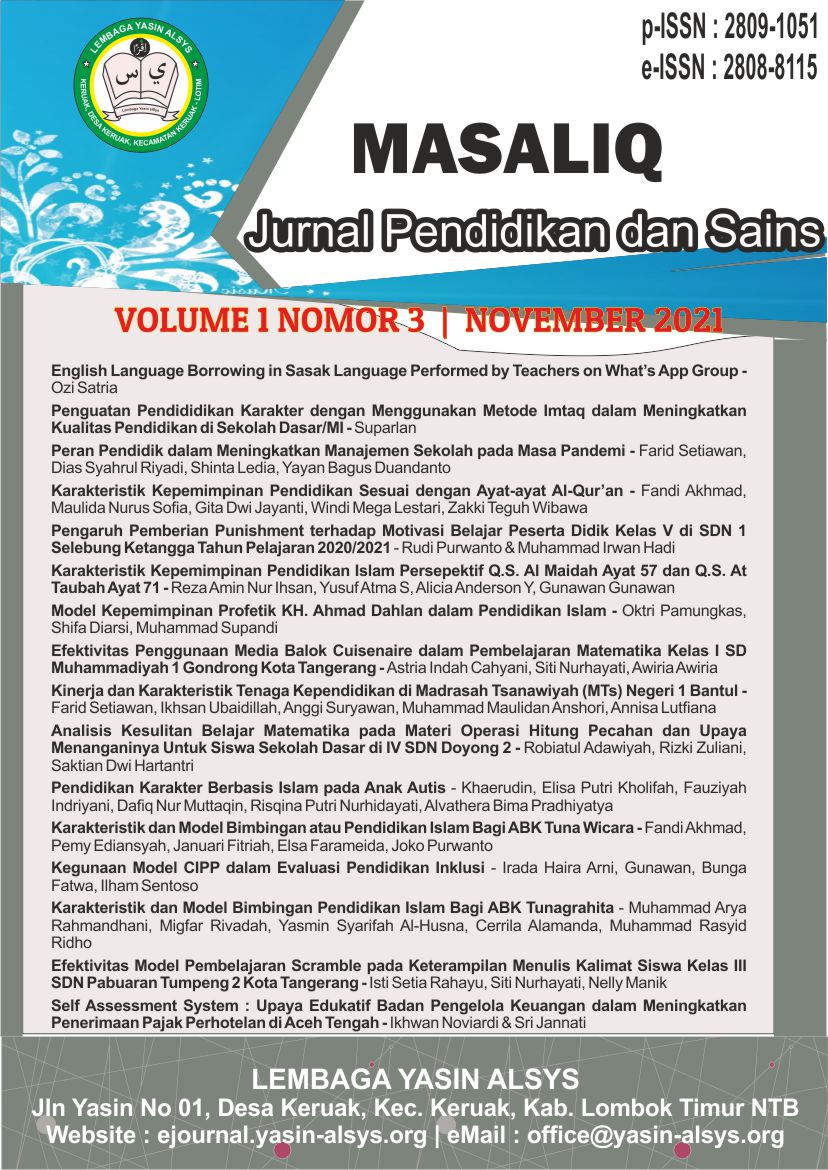
Karakteristik dan Model Bimbingan Pendidikan Islam Bagi ABK Tunagrahita

Article Sidebar
 Page Numbers:
176-190
Page Numbers:
176-190
 Digital Object Identifier:


 Viewed: 945 times
 Downloaded: 1.390 times












LYAS Publisher cordially invites qualified professionals to serve as Editors or Reviewers. Your expertise will make an important contribution to maintaining and strengthening the academic quality of our publications. Interested applicants are kindly requested to complete the application form at the following link: Editors & Reviewers


Please feel free to contact us if you need any further information about the submission process or if you have any additional questions.

 Authors:
Muhammad Arya Rahmandhani1, Migfar Rivadah2, Yasmin Syarifah Al-Husna3, Cerrila Alamanda4, Muhammad Rasyid Ridho5
 Copyright :
Authors retain copyright and grant the journal right of first publication.
Explore Our Journals
Find the journal that best fits your research. If this journal does not match your manuscript’s scope, explore our portfolio below to select a more suitable publication venue.
Main Article Content
Abstract
Research submitted on the mentally retarded crew is a person who really needs to be considered for its development because it has weaknesses in thinking and reasoning with this deficiency resulting in learning abilities and social adaptation below the average human being in general. This does not mean that they are unable to receive a proper education. There are various levels to assess the ability of mentally retarded children as seen from their characteristics, so that it can facilitate learning and educational institutions to identify learning models that will be used as in inclusive educational institutions so that they are right on target in increasing their knowledge, especially Islamic education. This study uses aresearch method library research which aims to examine the literature-based sources raised and look for a meaning from the characteristics and models that will be used in inclusive education.




Citation Metrics:




Downloads
Citation Metrics & Similar Scopus Articles
-
Bursan I.Z. (2027)The Integration of Islamic Religious Values in the Ritual Mantras of Pinisi Boat-Making as Instructional Material for Literature Learning in Islamic SchoolsAsean Journal of Educational Research and Technology, 6(1), 1-14
-
Ding S. (2027)Digital Renewal of University Education: Barriers, Opportunities, and Contributions to Sustainable Development Goals (SDGs)Asean Journal of Educational Research and Technology, 6(2), 229-240
-
Irawati R. (2027)Enhancing accounting students’ writing performance through problem-based learning: Evidence from a vocational higher education contextMultidisciplinary Science Journal, 9(1)
Article Details

Authors retain copyright and grant the journal right of first publication with the work simultaneously licensed under a Creative Commons Attribution-NonCommercial-ShareAlike 4.0 International License that allows others to share the work with an acknowledgement of the work's authorship and initial publication in this journal.