
ALSYS: Jurnal Keislaman dan Ilmu Pendidikan
Latest Issue: Vol. 6 No. 4 (July 2026). This issue presents peer-reviewed contributions that strengthen scholarship at the intersection of Islamic studies and educational sciences.
Open Access Peer Reviewed Islamic & Education Studies
Indexed
Sinta 5 Copernicus Harvard University Boston University Dimensions Scilit Crossref Garuda Google Scholar BASE
To date, ALSYS has published articles by authors affiliated with institutions in four (4) countries: Indonesia, Nigeria, Iraq, and Malaysia.





ALSYS: Jurnal Keislaman dan Ilmu Pendidikan is published by Lembaga Yasin Al Sys and is issued six times per year (January, March, May, July, September, and November). All submissions undergo an initial editorial assessment followed by peer review to ensure originality, methodological rigor, ethical compliance, and clarity of scholarly contribution.
Aims
ALSYS: Jurnal Keislaman dan Ilmu Pendidikan aims to publish rigorous, peer-reviewed scholarship in two complementary domains—Islamic studies (keislaman) and educational sciences (ilmu pendidikan)—while also welcoming integrative studies that connect Islamic scholarship with educational theory and practice. The journal prioritizes manuscripts that demonstrate conceptual clarity, methodological transparency, and a clear scholarly contribution.
• Keislaman: strengthen scholarly inquiry in Qur’an and Hadith studies, theology (‘aqidah), ethics (akhlaq), jurisprudence (fiqh), Islamic thought, and the history of Islamic civilization.
• Ilmu Pendidikan: advance research on curriculum, pedagogy, learning and assessment, educational psychology, teacher education, educational leadership, and technology-enhanced learning.
• Integrative Scholarship: encourage work on Islamic education, values and character education, and the integration of religious knowledge with contemporary educational practice and research.
• Methodological Diversity: support quantitative, qualitative, mixed-methods, conceptual, and review-based studies with ethical compliance and transparent reporting.
Submissions should state a clear research question or argument, report methods or analyses transparently, and articulate a well-defined contribution grounded in relevant scholarship.
Scope
ALSYS accepts manuscripts within two primary streams—Islamic studies and educational sciences—as well as studies bridging both streams. Topics may address formal education (schools, madrasah, higher education), non-formal education (pesantren, community learning), and broader social institutions, with local to global relevance.
• Islamic Studies topics: Qur’anic and Hadith studies, ‘aqidah, akhlaq, fiqh, Islamic law and society, Islamic thought, and Islamic civilization and intellectual history.
• Educational Sciences topics: curriculum and instruction, pedagogy, assessment and evaluation, educational psychology, inclusive education, teacher professional development, educational leadership, and educational policy.
• Islamic Education intersections: Islamic curriculum and learning resources, character or values education, pesantren and madrasah studies, educational practice in Muslim communities, and integration of religious knowledge with contemporary learning.
• Formats: empirical articles (quantitative, qualitative, or mixed-methods), conceptual papers, critical perspectives, and systematic or scoping reviews with clear procedures and ethical compliance.
Priority is given to manuscripts with strong theoretical framing, transparent methods or argumentation, and implications that are logically derived from the evidence or analysis.
Current Issue
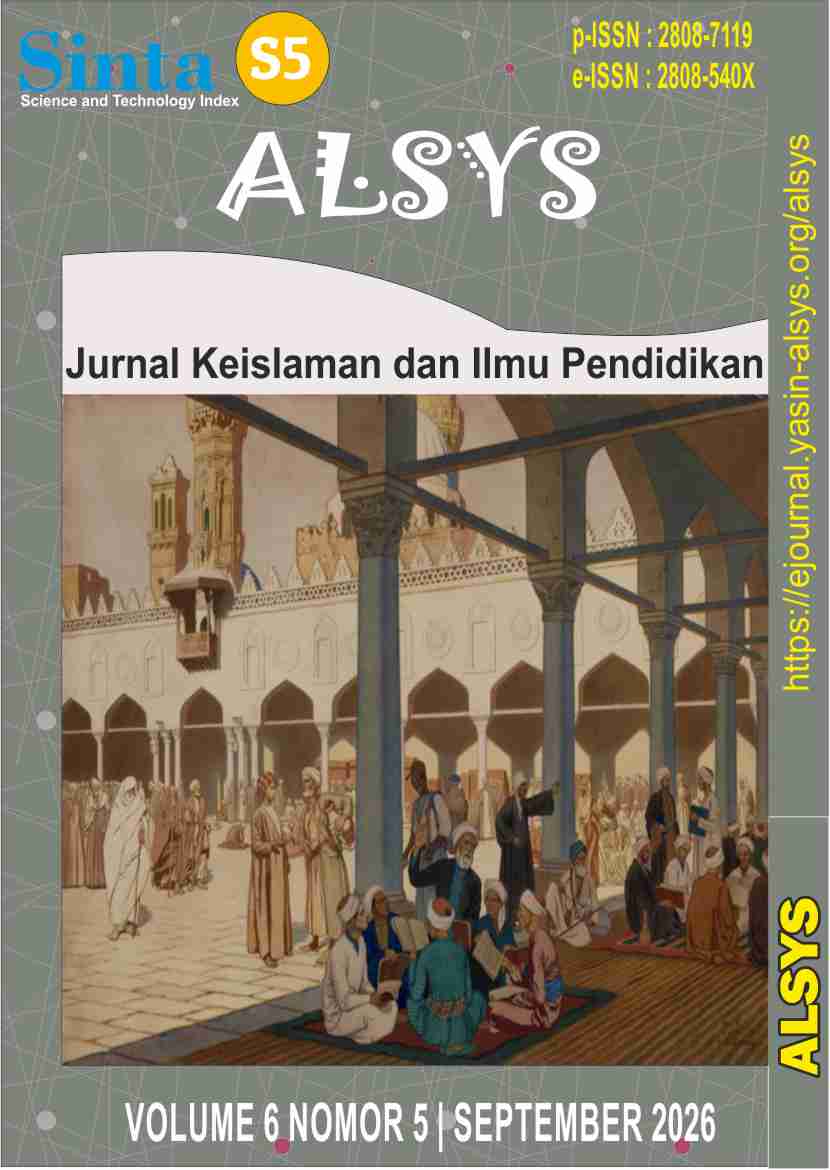
Vol 6 No 5 (2026): ALSYS: Jurnal Keislaman dan Ilmu Pendidikan
- Total Articles: -
- Unique Authors: 47
- Unique Affiliations: 17
- Unique Countries: 1
ID
Published: 2026-09-30
Articles
Media Sosial dan Minat Belajar Pendidikan Agama Islam Pelajar di Era Digital Social Media and Students’ Interest in Learning Islamic Religious Education in the Digital Era
 Yusran Fajar Asikin
-
Yusran Fajar Asikin
-  STAI DDI Pangkep
Damar Saputra
- STAI DDI Pangkep
STAI DDI Pangkep
Damar Saputra
- STAI DDI Pangkep
 2743-2759

 Viewed: 62,
 Downloaded: 52
Riba in Maqāṣid-Based Exegesis: Evaluating the Viability of Cryptocurrency as an Islamic Financial Instrument
Satriawan
- STAI Darul Kamal NW Kembang Kerang, Indonesia
Siti Asiah
- STAI Darul Kamal NW Kembang Kerang, Indonesia
Muhyidin Azmi
- STAI Darul Kamal NW Kembang Kerang, Indonesia
2760-2780
Penerapan Model STAD untuk Meningkatkan Hasil Belajar PAI Siswa Kelas VIII SMPN 3 Batang Anai Implementation of the STAD Model to Improve PAI Learning Outcomes Among Eighth-Grade Students at SMPN 3 Batang Anai
Witmas Hasan
- Universitas Negeri Padang
Ahmad Rivauzi
- Universitas Negeri Padang
2781-2793
Problematika Dakwah Dikalangan Masyarakat Transmigran (Studi di Nagari Taratak Tinggi Kecamatan Timpeh Kabupaten Dharmasraya) Problems of Da’wah among Transmigrant Communities (Study in Nagari Taratak Tinggi Timpeh District Dharmasraya Regency)
Rika Julia
- UIN Sjech M. Djamil Djambek Bukittinggi
Yusuf Afandi
- UIN Sjech M. Djamil Djambek Bukittinggi
2794--2820
Qur’anic Perspectives on Child Grooming: An Analytical Study of Ibn ‘Ashur’s Tafsir al-Tahrir wa al-Tanwir
Maolida Ana Rizki
- STAI Darul Kamal NW Kembang Kerang, Indonesia
Muhammad Said
- STAI Darul Kamal NW Kembang Kerang, Indonesia
Muhyidin Azmi
- STAI Darul Kamal NW Kembang Kerang, Indonesia
2821-2837