
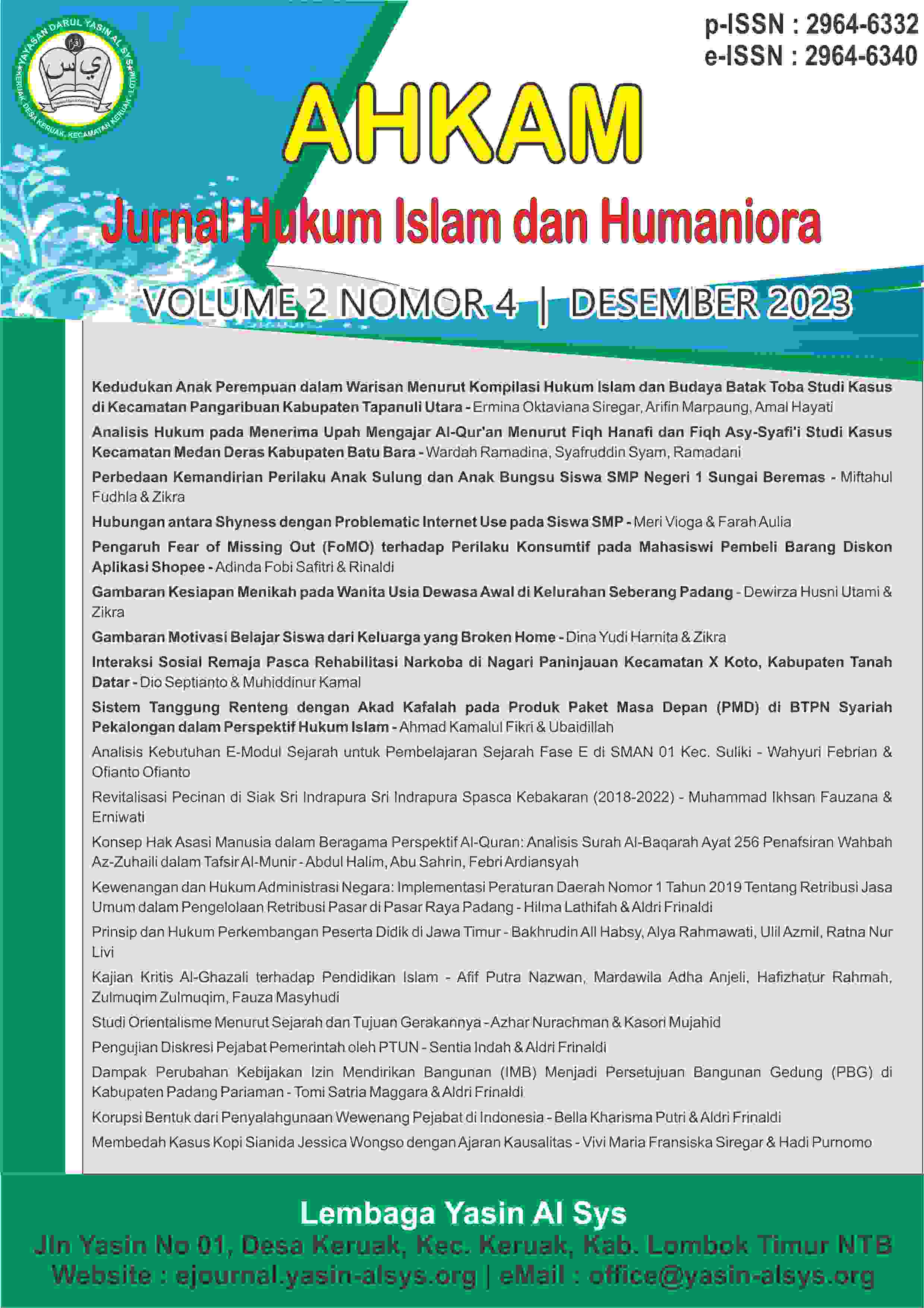
Prinsip dan Hukum Perkembangan Peserta Didik di Jawa Timur

Article Sidebar
 Page Numbers:
841-857
Page Numbers:
841-857
 Digital Object Identifier:


 Viewed: 1.656 times
 Downloaded: 1.275 times












LYAS Publisher cordially invites qualified professionals to serve as Editors or Reviewers. Your expertise will make an important contribution to maintaining and strengthening the academic quality of our publications. Interested applicants are kindly requested to complete the application form at the following link: Editors & Reviewers


Please feel free to contact us if you need any further information about the submission process or if you have any additional questions.

 Authors:
Bakhrudin All Habsy1, Alya Rahmawati2, Ulil Azmil3, Ratna Nur Livi4
 Copyright :
Authors retain copyright and grant the journal right of first publication.
Main Article Content
Abstract
Development is a process of change in an individual over time, influenced by maturity and interaction with the surrounding environment. This developmental process can be understood through certain laws and principles. These laws and principles regulate all aspects of an individual's development and are always present in the developmental process. Therefore, these laws and principles should be understood by all stakeholders in education, especially educators or teachers. Because these principles are crucial in improving the effectiveness and efficiency of achieving educational goals, developing the curriculum, and even creating learning programs according to the needs of students. Students often have different learning styles. Teachers also have the responsibility to guide and mentor students to develop in a gradual, organized, and non-deviating manner.




Citation Metrics:




Downloads
Citation Metrics & Similar Scopus Articles
-
Khasanah A.N. (2027)Self-Health Literacy Among Students in Islamic School Science Education: A Comparative Analysis Across Gender, Grade Level, and School ContextAsean Journal of Educational Research and Technology, 6(1), 93-106
-
Boonpratham P. (2027)Scientific Creativity in Materials Science Education among High School Students through Inquiry-Based Learning and Metacognitive StrategiesAsean Journal for Science and Engineering in Materials, 6(1), 79-90
-
Irawati R. (2027)Enhancing accounting students’ writing performance through problem-based learning: Evidence from a vocational higher education contextMultidisciplinary Science Journal, 9(1)
Article Details

Authors retain copyright and grant the journal right of first publication with the work simultaneously licensed under a Creative Commons Attribution-NonCommercial-ShareAlike 4.0 International License that allows others to share the work with an acknowledgement of the work's authorship and initial publication in this journal.
References
Abrams, M., & Reber, A. S. (1988). Implicit learning: Robustness in the face of psychiatric disorders. Journal of Psycholinguistic Research, 17, 425-439.
Aidil Fitrito Yara dan Muhammad Erwan Syah. (2022). Jangan Salah, Ini Perbedaan Pertumbuhan dan Perkembangan!Details
Aisyah, Siti. (2015). Perkembangan peserta didik dan bimbingan belajar. Deepublish.
Arifudin, Opan. (2022). PERKEMBANGAN PESERTA DIDIK (TINJAUAN TEORI-TEORI DAN PRAKTIS). Edited by Ulfah, Ulfah, CV WIDINA MEDIA UTAMA,.https://repository.penerbitwidina.com/publications/557922/perkembangan-peserta-didik-tinjauan-teori-teori-dan-praktis
Bloom, Benjamin S. dkk. (1956). Taxonomy of Education Objectives The, Classification of Educational Gools Handbook I: Cognitive Domain. New ~ York: Longma.n.Jnc. Crowl, Thomas K., Sal[y Kaminsky, & David M. Podell. 1997. http://elearning.iainkediri.ac.id/pluginfile.php/319821/mod_resource/content/1/7325Taksonomi%20Bloom.pdf
Budiman, J. (2019). Perkembangan peserta didik. Pustaka Rumah Aloy.
Desmita. (2010). Psikologi Perkembangan Peserta Didik; Panduan Bagi Orang
Hani Hanifah, Susi Susanti, Aris Setiawan Adji. (2020) "PERILAKU DAN KARATERISTIK PESERTA DIDIK BERDASARKAN TUJUAN PEMBELAJARAN". Universitas Muhammadiyah Tangerang
Hasanah, Ika. (2014). "Hukum Perkembangan Peserta Didik." http://hasanahika.blogspot.com/2014/09/normal-0-false-false-false-en-us-x-none_7.html?m=1
Hidayati, Anisa, Nabilah. (2016). Aspek Perkembangan Peserta Didik
Hotimah. (2021). "Perkembangan Peserta Didik. Universitas Negeri Makassar"
Irwansyah, R., Darmayani, S., Mastikawati, M., Saputro, A. N. C., Wihartanti, L. V., Fauzi, A., ... & Hartono, R. (2021). Perkembangan Peserta Didik. PERKEMBANGAN PESERTA DIDIK - cv widina media utama https://repository.penerbitwidina.com/publications/339459/perkembangan-peserta-didik Didik, A. Perkembangan Peserta. "BAB 4 ASPEK PERKEMBANGAN PESERTA DIDIK." PSIKOLOGI PENDIDIKAN (2023): 50.
Khasanah, I., Prasetyo, A., & Rakhmawati, E. (2011). Permainan tradisional sebagai media stimulasi aspek perkembangan anak usia dini. PAUDIA: Jurnal Penelitian dalam Bidang Pendidikan Anak Usia Dini
Kogoya, Willius. (2018). BUKU AJAR PERKEMBANGAN PESERTA DIDIK. Edited by Rismawati, N. CV WIDINA MEDIA UTAMA. https://repository.penerbitwidina.com/publications/558645/buku-ajar-perkembangan-peserta-didik
Latifa, U. (2017). Aspek Perkembangan pada Anak Sekolah Dasar : Masalah dan Perkembangannya. Journal of Multidisciplinary Studies
M. Makbul. Nurqadriani. (2019) "PRINSIP-PRINSIP UMUM PERKEMBANGAN & FUNGSI KEMATANGAN DALAM PERKEMBANGAN." UNIVERSITAS ISLAM NEGERI (UIN) ALAUDDIN MAKASSAR
Monks, dkk. (2001). Psikologi Perkembangan. Yogyakarta: Universitas Gajah Mada.
Mu'Min, Sitti A. (2013). Teori Perkembangan Kognitif Jean Piaget." Al-Ta'dib, vol. 6, no. 1, Jul., pp. 89-99.
Nadirah, Sitti. (2013). ANAK DIDIK PERSPEKTIF NATIVISME, EMPIRISME, DAN KONVERGENSI. Sekolah Tinggi Agama Islam Negeri (STAIN) https://www.neliti.com/publications/145705/anak-didik-perspektif-nativisme-empirisme-dan-konvergensi
Novitasari, Y. (2018). Analisis permasalahan" Perkembangan kognitif anak usia dini”. PAUD Lectura: Jurnal Pendidikan Anak Usia Dini, 2(01), 82-90.
Rahmat, Pupu Saeful. (2021). Perkembangan peserta didik. Bumi Aksara.
Santrock, John W.; Tri Wibowo. (2007). Psikologi pendidikan / John W. Santrock ; terjemahan, Tri Wibowo. Jakarta :: Kencana,.
Sinolungan, A. E. (1997). Psikologi perkembangan peserta didik. Jakarta: Wira Sari.
Soetjiningsih. (1995). Tumbuh Kembang Anak. Jakarta: EGC.
Sunarto, Haji. Hartono, Agung, B., Ny. (2013). Perkembangan Peserta Didik. Rineka Cipta
Syamsu Yusuf. (2001). Psikologi Perkembangan Anak dan Remaja. Bandung: Remaja Rosdakarya