
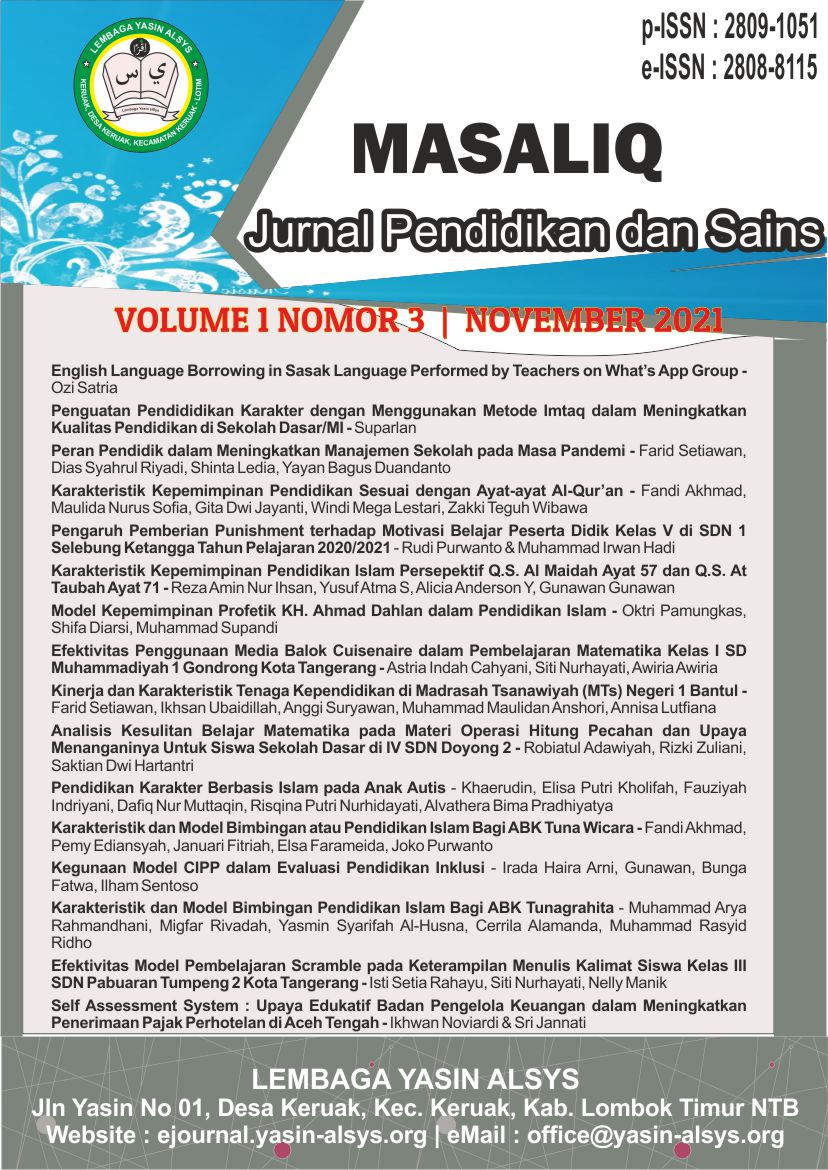
Efektivitas Model Pembelajaran Scramble pada Keterampilan Menulis Kalimat Siswa Kelas III SDN Pabuaran Tumpeng 2 Kota Tangerang
Main Article Content
Abstract
Learning Indonesian Language and Literature in schools is to develop language skills both orally and in writing. Most students find it difficult to develop aspects of writing. Especially in stringing words to be arranged into a sentence. This difficulty may be caused by teachers who in their delivery are less precise and almost never use appropriate media. The problems mentioned above require alternative solutions in the form of learning models that can improve students' writing skills. A model that can provide a lot of information to students in order to inspire students and improve writing skills, through the Scramble Learning Model, students can find information about various vocabularies. In this study, researchers used quantitative methods and the variety of methods used in this study was experimental research with a pre-experimental design type of experiment. The research design used was a one-group pre-test-post test. Then the data collection technique used in this research is to use test questions (pre test and post test), observation, interviews and documentation. The research analysis uses the arithmetic mean. Based on the results of the post-test hypothesis, the t-test with the results of the T-value > with the T-table value, so that Ha which means 'Effectiveness of the Scramble Learning Model on Sentence Writing Skills for Class III Students at SDN Pabuaran Tumpeng 2 Tangerang City is accepted, and Ho which means "No Effectiveness". The Scramble learning model on Sentence Writing Skills for Class III Students at SDN Pabuaran Tumpeng 2 Tangerang City was rejected.




Citation Metrics:




Downloads
Citation Metrics & Similar Scopus Articles
-
Ratnaningsih E. (2027)Designing a Data-Driven E-Learning Module for Teaching English to Young Learners: Integrating Needs Analysis and the ISAV Learning ModelAsean Journal of Educational Research and Technology, 6(2), 269-286
-
Unyaphatariyakool S. (2027)Science Teachers’ Learning Management Competency through Professional Learning Communities to Promote Scientific Creativity and Sustainable Development Goals (SDGs)Asean Journal of Educational Research and Technology, 6(2), 241-252
-
Azhand A. (2027)Teaching Persian derivational affixes to non-Persian speakers from a Cognitive Morphology Approach: A case study of nominal suffixes (kar, gar, ban, baz, -ande)Language Related Research, 17(4), 469-497
Article Details

Authors retain copyright and grant the journal right of first publication with the work simultaneously licensed under a Creative Commons Attribution-NonCommercial-ShareAlike 4.0 International License that allows others to share the work with an acknowledgement of the work's authorship and initial publication in this journal.
Article Sidebar
 Page Numbers:
191-202
Page Numbers:
191-202
 Digital Object ID:













 Viewed: 1.410 times
 Downloaded: 1.411 times

LYAS Publisher cordially invites qualified professionals to serve as Editors or Reviewers. Your expertise will make an important contribution to maintaining and strengthening the academic quality of our publications. Interested applicants are kindly requested to complete the application form at the following link: Editors & Reviewers


Please feel free to contact us if you need any further information about the submission process or if you have any additional questions.

 Authors:
 Copyright :
Authors retain copyright and grant the journal right of first publication.
Explore Our Journals
Find the journal that best fits your research. If this journal does not match your manuscript’s scope, explore our portfolio below to select a more suitable publication venue.