
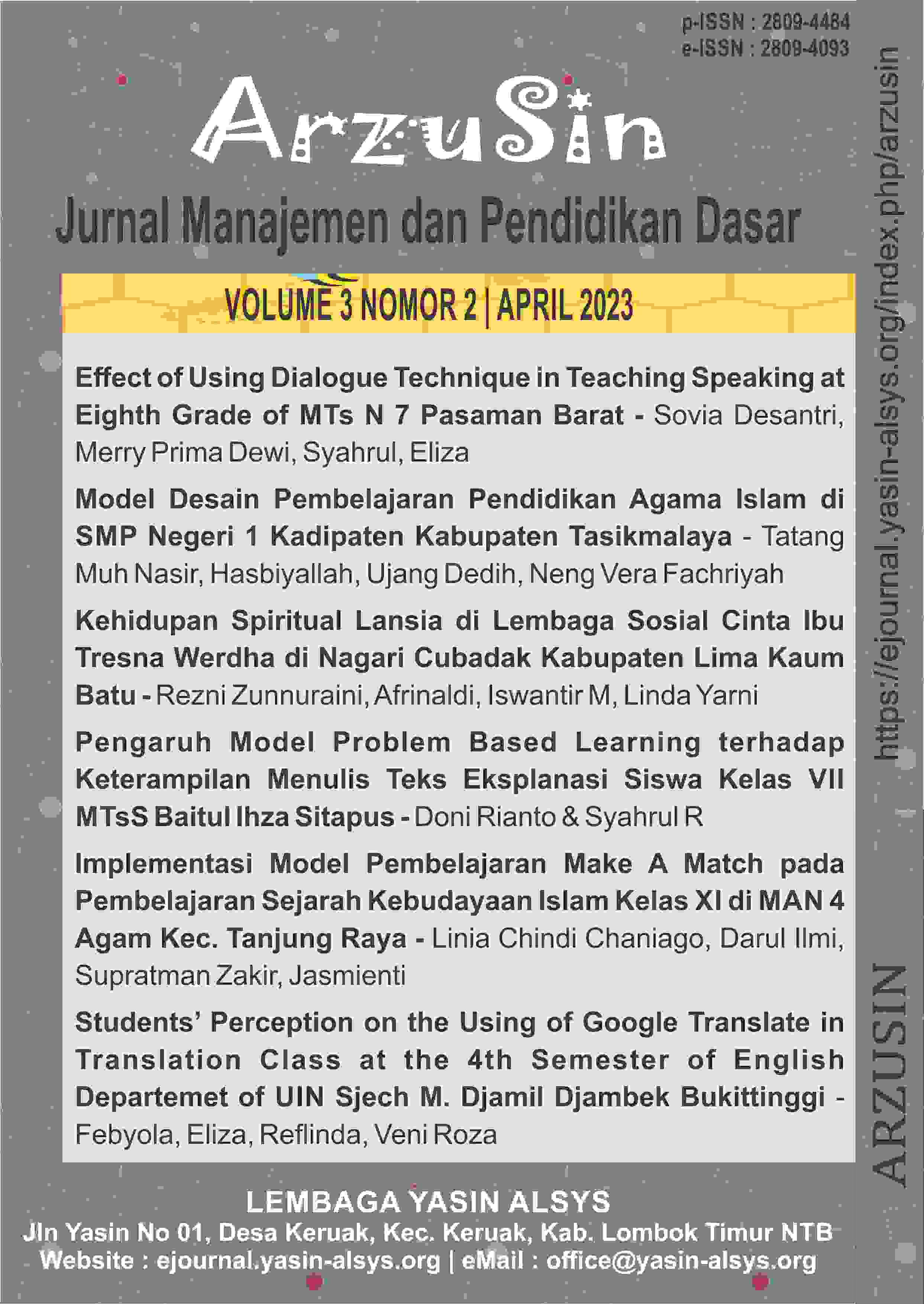
Model Desain Pembelajaran Pendidikan Agama Islam di SMP Negeri 1 Kadipaten Kabupaten Tasikmalaya

Article Sidebar
 Page Numbers:
117-123
Page Numbers:
117-123
 Digital Object Identifier:


 Viewed: 785 times
 Downloaded: 614 times












LYAS Publisher cordially invites qualified professionals to serve as Editors or Reviewers. Your expertise will make an important contribution to maintaining and strengthening the academic quality of our publications. Interested applicants are kindly requested to complete the application form at the following link: Editors & Reviewers


Please feel free to contact us if you need any further information about the submission process or if you have any additional questions.

 Authors:
Tatang Muh Nasir1, Hasbiyallah Hasbiyallah2, Ujang Dedih3, Neng Vera Fachriyah4
 Copyright :
Authors retain copyright and grant the journal right of first publication.
Explore Our Journals
Find the journal that best fits your research. If this journal does not match your manuscript’s scope, explore our portfolio below to select a more suitable publication venue.
Main Article Content
Abstract
This study aims to find an overview of the PAI learning design model in SMPN 1 Kadipaten Tasikmalaya Regency. This research uses a qualitative approach and the data sources are PAI teachers, class teachers and principals. This study used observation and interview techniques to collect data related to the research objectives. After the data is collected, the next stage is to analyze the data, in this case the researcher uses the approach of Miles et al, namely, data selection and data mapping, data presentation and perification and conclusions. This study found the following conclusions: the learning model applied by PAI teachers is the first active and cooperative learning model, which is a learning model that brings students to be active and creative, not only listening, but also carrying out activities such as processing, finding, and utilizing information. Second, the contextual learning model, this model helps educators relate the material taught to the real-world situation of students, thus allowing learners to find a connection between the knowledge they have and its application in their lives as family and community members.




Citation Metrics:




Downloads
Citation Metrics & Similar Scopus Articles
-
Ratnaningsih E. (2027)Designing a Data-Driven E-Learning Module for Teaching English to Young Learners: Integrating Needs Analysis and the ISAV Learning ModelAsean Journal of Educational Research and Technology, 6(2), 269-286
-
Unyaphatariyakool S. (2027)Science Teachers’ Learning Management Competency through Professional Learning Communities to Promote Scientific Creativity and Sustainable Development Goals (SDGs)Asean Journal of Educational Research and Technology, 6(2), 241-252
-
Trisnowati E. (2027)Science, Technology, Engineering, and Mathematics (STEM) and Research Skill Development (RSD) in Science Education in Higher Education: A Delphi-Based ModelAsean Journal of Educational Research and Technology, 6(2), 253-268
Article Details

Authors retain copyright and grant the journal right of first publication with the work simultaneously licensed under a Creative Commons Attribution-NonCommercial-ShareAlike 4.0 International License that allows others to share the work with an acknowledgement of the work's authorship and initial publication in this journal.