
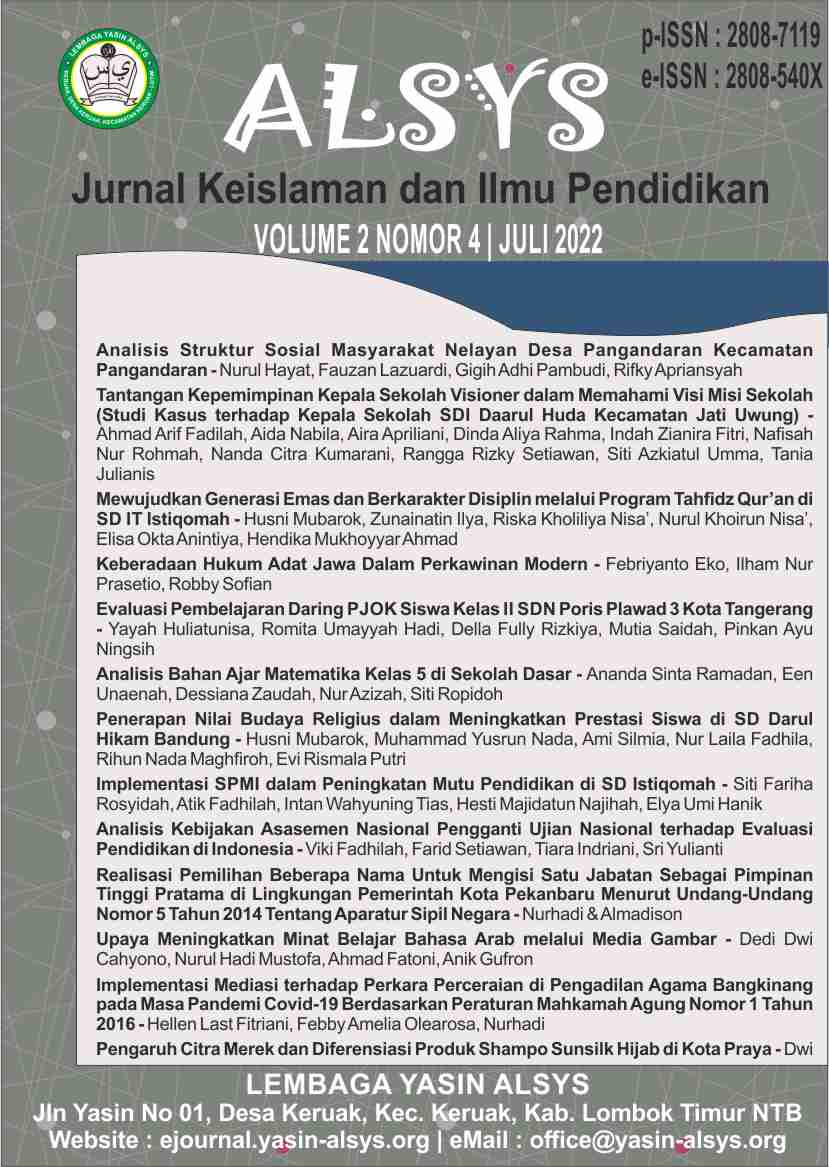
Evaluasi Pembelajaran Daring PJOK Siswa Kelas II SDN Poris Plawad 3 Kota Tangerang
Main Article Content
Abstract
Physical education learning focuses on maintaining and improving physical fitness and movement skills in students during the learning process, also helping students to improve critical thinking patterns, maintaining students' emotional stability, and fostering good values contained in sports such as respect and sportsmanship. This study aims to determine the process of evaluating online learning PJOK for grade II students at SDN Poris Palawad 3 Tangerang City, using a qualitative descriptive method. Sources of information in this study were PJOK teachers. Data collection techniques through observation, interviews, and documentation studies. Based on the results of the study, it shows that PJOK online learning uses applications such as whatApp (to collect assignments), zoom or Google meet for the learning process. The teacher presents the material and videos in the application using print media and audiovisual media. Constraints encountered in the online learning process in general are in the form of networks, gadgets/mobile phones, worksheets, and assessments.




Citation Metrics:




Downloads
Citation Metrics & Similar Scopus Articles
-
Lukpanov R.E. (2027)Evaluation of the Effect of Additives on the Workability of Concrete Mix as Part of a Study of a Modified Wall BlockKompleksnoe Ispolzovanie Mineralnogo Syra, 342(3), 100-110
-
Naemi Z. (2027)The Relationship between Second Language Learning Strategies, Learning Engagement, and Writing Skill in the Arabic Writing CurriculumLanguage Related Research, 17(4), 331-360
-
Azhand A. (2027)Teaching Persian derivational affixes to non-Persian speakers from a Cognitive Morphology Approach: A case study of nominal suffixes (kar, gar, ban, baz, -ande)Language Related Research, 17(4), 469-497
Article Details

Authors retain copyright and grant the journal right of first publication with the work simultaneously licensed under a Creative Commons Attribution-NonCommercial-ShareAlike 4.0 International License that allows others to share the work with an acknowledgement of the work's authorship and initial publication in this journal.
Article Sidebar
 Page Numbers:
473-482
Page Numbers:
473-482
 Digital Object ID:













 Viewed: 404 times
 Downloaded: 434 times

LYAS Publisher cordially invites qualified professionals to serve as Editors or Reviewers. Your expertise will make an important contribution to maintaining and strengthening the academic quality of our publications. Interested applicants are kindly requested to complete the application form at the following link: Editors & Reviewers


Please feel free to contact us if you need any further information about the submission process or if you have any additional questions.

 Authors:
 Copyright :
Authors retain copyright and grant the journal right of first publication.
Explore Our Journals
Find the journal that best fits your research. If this journal does not match your manuscript’s scope, explore our portfolio below to select a more suitable publication venue.