
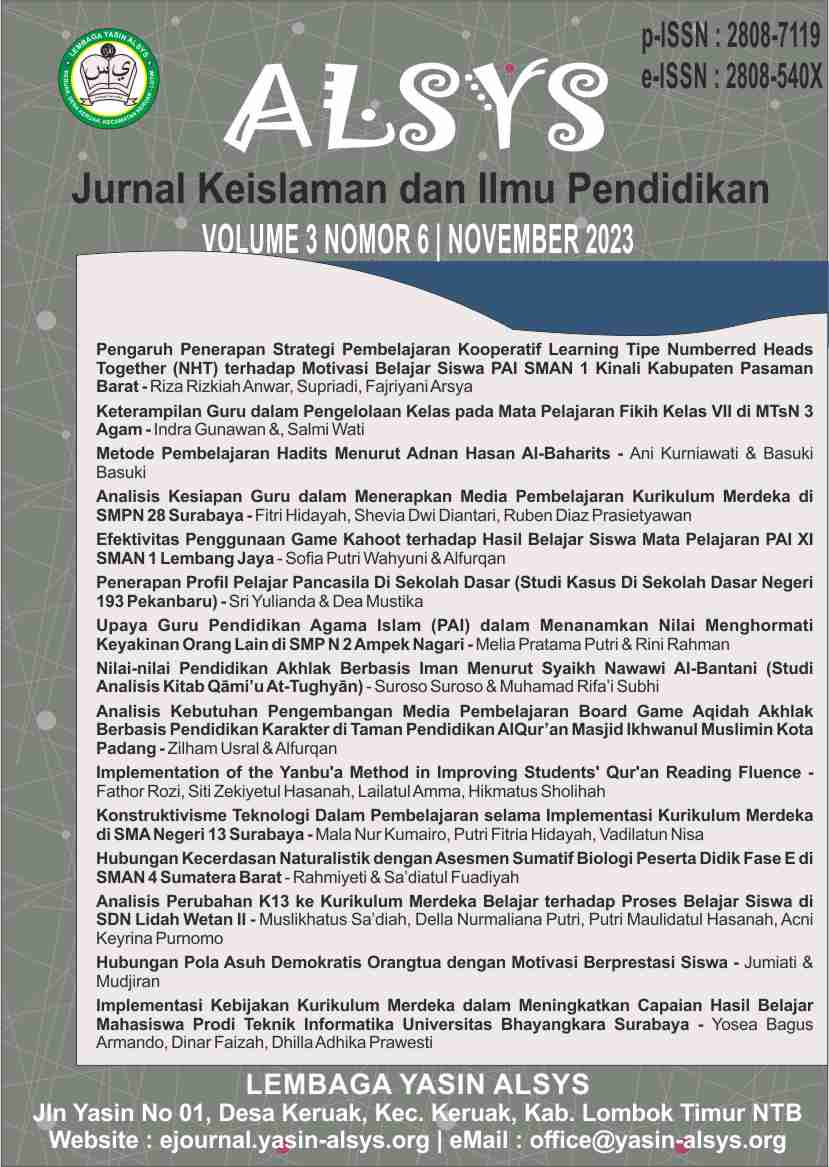
Konstruktivisme Teknologi Dalam Pembelajaran selama Implementasi Kurikulum Merdeka di SMA Negeri 13 Surabaya

Article Sidebar
 Page Numbers:
679-687
Page Numbers:
679-687
 Digital Object Identifier:


 Viewed: 393 times
 Downloaded: 485 times












LYAS Publisher cordially invites qualified professionals to serve as Editors or Reviewers. Your expertise will make an important contribution to maintaining and strengthening the academic quality of our publications. Interested applicants are kindly requested to complete the application form at the following link: Editors & Reviewers


Please feel free to contact us if you need any further information about the submission process or if you have any additional questions.

 Authors:
Mala Nur Kumairo1, Putri Fitria Hidayah2, Vadilatun Nisa3
 Copyright :
Authors retain copyright and grant the journal right of first publication.
Main Article Content
Abstract
Education has the responsibility to integrate new values in students caused by advances in technology and science. Appropriate learning methods are needed because the education system evolves with the changing times. One branch of the philosophy of knowledge known as constructivism emphasizes the idea that the knowledge we have is the result of our own construction. The issue addressed in this research is how SMAN 13 Surabaya implements technological developments in its teaching. The aim of this research is to analyze the extent of active student participation in the learning process, particularly through the constructivist approach, and how technology can be optimized to facilitate learning activities. The research method used in this study is descriptive qualitative. The results indicate that the utilization of technology in learning at SMAN 13 Surabaya is not yet running optimally, due to constraints such as the lack of teacher skills in using technology, inadequate facilities, and financial constraints.




Citation Metrics:




Downloads
Citation Metrics & Similar Scopus Articles
-
Ratnaningsih E. (2027)Designing a Data-Driven E-Learning Module for Teaching English to Young Learners: Integrating Needs Analysis and the ISAV Learning ModelAsean Journal of Educational Research and Technology, 6(2), 269-286
-
Azhand A. (2027)Teaching Persian derivational affixes to non-Persian speakers from a Cognitive Morphology Approach: A case study of nominal suffixes (kar, gar, ban, baz, -ande)Language Related Research, 17(4), 469-497
-
Unyaphatariyakool S. (2027)Science Teachers’ Learning Management Competency through Professional Learning Communities to Promote Scientific Creativity and Sustainable Development Goals (SDGs)Asean Journal of Educational Research and Technology, 6(2), 241-252
Article Details

Authors retain copyright and grant the journal right of first publication with the work simultaneously licensed under a Creative Commons Attribution-NonCommercial-ShareAlike 4.0 International License that allows others to share the work with an acknowledgement of the work's authorship and initial publication in this journal.