
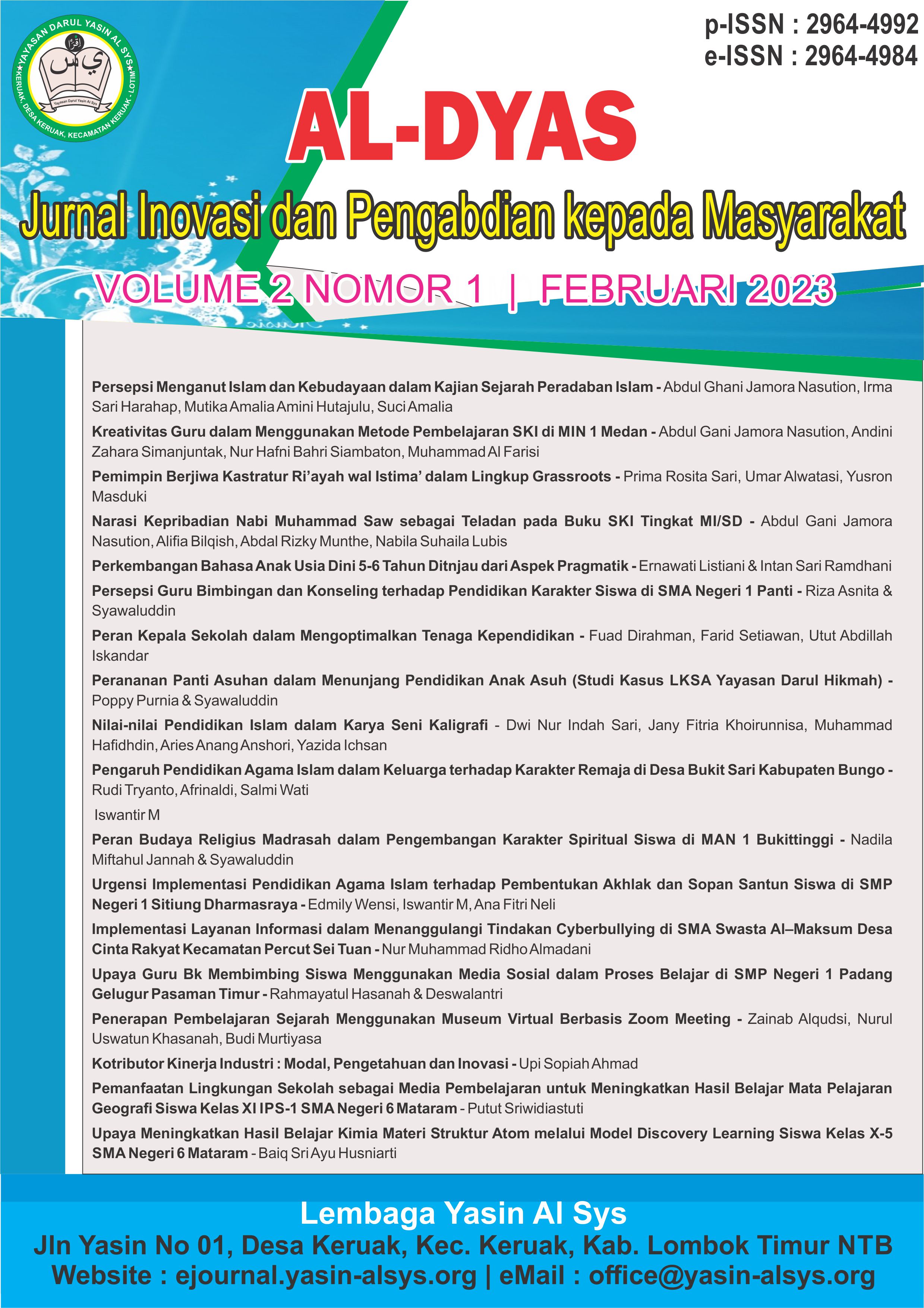
Pemimpin Berjiwa Kastratur Ri’ayah wal Istima’ dalam Lingkup Grassroots

Article Sidebar
 Page Numbers:
20-29
Page Numbers:
20-29
 Digital Object Identifier:


 Viewed: 392 times
 Downloaded: 430 times












LYAS Publisher cordially invites qualified professionals to serve as Editors or Reviewers. Your expertise will make an important contribution to maintaining and strengthening the academic quality of our publications. Interested applicants are kindly requested to complete the application form at the following link: Editors & Reviewers


Please feel free to contact us if you need any further information about the submission process or if you have any additional questions.

 Authors:
Prima Rosita Sari1, Umar Alwatasi2, Yusron Masduki3
 Copyright :
Authors retain copyright and grant the journal right of first publication.
Explore Our Journals
Find the journal that best fits your research. If this journal does not match your manuscript’s scope, explore our portfolio below to select a more suitable publication venue.
Main Article Content
Abstract
Grassroots or commonly referred to as grassroots appear as an alternative to solving problems that exist in society, especially in rural communities. This has something to do with the soul of a leader, where to be a leader must be able to play an important role, namely being able to provide innovation, motivation, form a shared vision and mission, and also form broader network relations. Leadership is the main thing in human life. By looking at various literature and literature reviews trying to examine Islamic leadership based on the Qur'an and Hadith in the scope of grassroots. As a leader and also leadership has such a close relationship that these two elements cannot be separated. This style of leader is a reflection of leader behavior, in which these two things are the main key in the successful management of an organizational system. Being a leader must have a spirit of ri'ayah wal istima' and also implement the four obligatory characteristics of Allah SWT, namely sidiq, amanah, tabligh, and fathonah. As well as making better leadership will also produce good output from something he leads. The credibility of being a leader also shows an expertise or expert power, accompanied by the positive habits of a leader. This becomes the main point in the soul of a leader to form a vision and mission, in order to run the wheels of the organization he is leading to achieve the goals that have been set.




Citation Metrics:




Downloads
Citation Metrics & Similar Scopus Articles
-
Faqih A. (2026)It takes two: digital fatherhood and the ‘Ayah ASI’ community in urban IndonesiaJournal of Family Studies
-
Chakraborty S.S. (2026)Colonial Caregivers: Ayahs and the Gendered History of Race and Caste in British IndiaColonial Caregivers Ayahs and the Gendered History of Race and Caste in British India, 1-302
-
Saldanha T.S. (2026)Stories in service: The figure of the ayah storyteller in Anglo Indian literatureJournal of Postcolonial Writing, 62(3), 334-349
Article Details

Authors retain copyright and grant the journal right of first publication with the work simultaneously licensed under a Creative Commons Attribution-NonCommercial-ShareAlike 4.0 International License that allows others to share the work with an acknowledgement of the work's authorship and initial publication in this journal.