
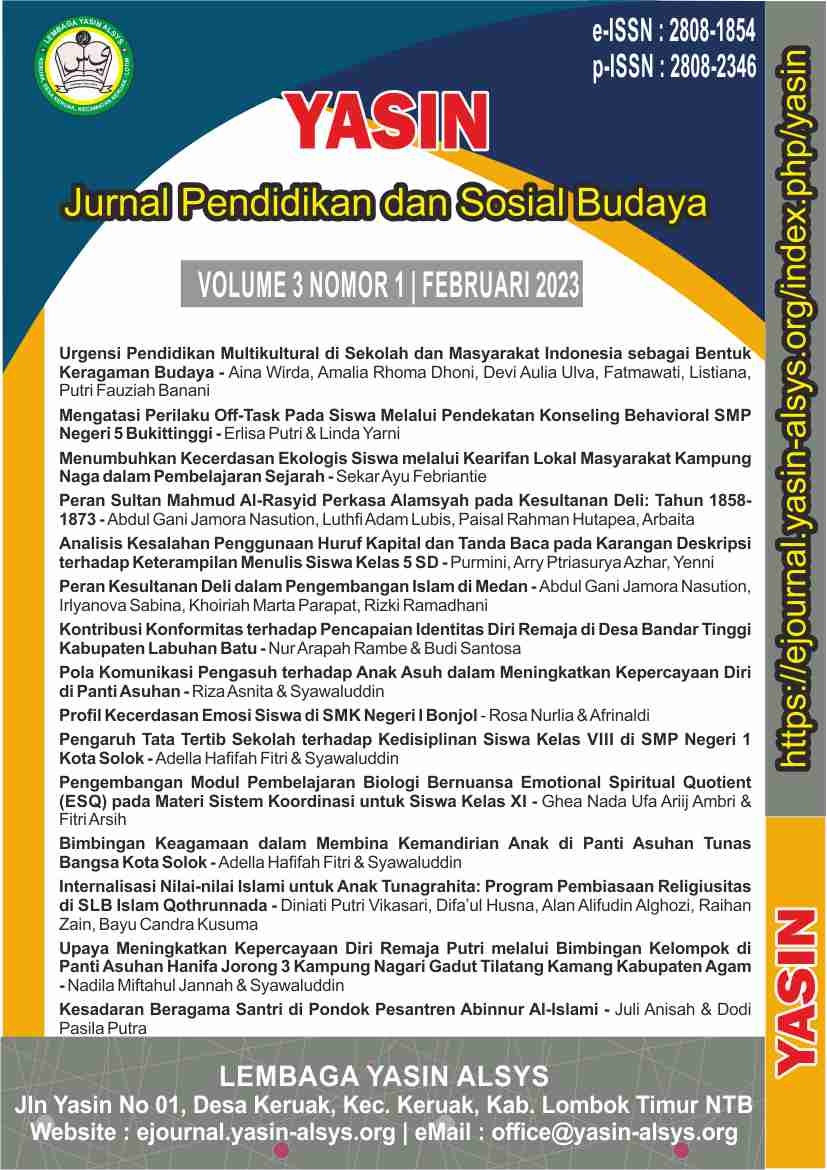
Bimbingan Keagamaan dalam Membina Kemandirian Anak di Panti Asuhan Tunas Bangsa Kota Solok
Main Article Content
Abstract
Religious guidance is a process of providing appropriate assistance by mentors so that children can increase their piety through religious approaches. The religious approach is a container for fostering independence with good directions in accordance with the commands of Allah SWT so that children understand independence for a better future. The background of this research is considering the number of children who are less independent so that it becomes an obstacle in every action. Because nowadays educating children to be independent, it is necessary to use a religious approach so that children are independent in all things and teach children to always be guided by religious teachings. The use of this religious approach must be applied to children from an early age because religious development takes quite a long time so that the goals can be achieved properly. In this study using descriptive qualitative research. In this study it was revealed that the religious approach is very influential on the independence of children today. In this sophisticated era, children must be equipped with religious knowledge to guide children in the future. An independent child who is equipped with religious knowledge will be different from a child who is independent but is not equipped with religious knowledge. From the results of religious guidance carried out at the Tunas Bangsa Orphanage, it was able to show quality personality changes that were in accordance with religious rules.




Citation Metrics:




Downloads
Citation Metrics & Similar Scopus Articles
-
Gom-os D.F.K. (2026)An empirical study on the use of a facial emotion recognition system in guidance counseling utilizing the technology acceptance model and the general comfort questionnaireApplied Computing and Informatics, 22(1-2), 158-172
-
Aflahah S. (2026)AI, ETHICS, AND ISLAMIC HIGHER EDUCATION: NAVIGATING THE TENSIONS BETWEEN PRACTICAL RISK MITIGATION AND RELIGIOUS NORMATIVITYJurnal Ilmiah Islam Futura, 26(1), 1-24
-
Dewi K.H. (2026)Aisyiyah muballighats digital da’wah on YouTube: Expanding pious agency, identifying challenges, and mapping emerging trendsIndonesian Journal of Islam and Muslim Societies, 16(1), 177-204
Article Details

Authors retain copyright and grant the journal right of first publication with the work simultaneously licensed under a Creative Commons Attribution-NonCommercial-ShareAlike 4.0 International License that allows others to share the work with an acknowledgement of the work's authorship and initial publication in this journal.
Article Sidebar
 Page Numbers:
116-123
Page Numbers:
116-123
 Digital Object ID:













 Viewed: 429 times
 Downloaded: 593 times

LYAS Publisher cordially invites qualified professionals to serve as Editors or Reviewers. Your expertise will make an important contribution to maintaining and strengthening the academic quality of our publications. Interested applicants are kindly requested to complete the application form at the following link: Editors & Reviewers


Please feel free to contact us if you need any further information about the submission process or if you have any additional questions.

 Authors:
 Copyright :
Authors retain copyright and grant the journal right of first publication.
Explore Our Journals
Find the journal that best fits your research. If this journal does not match your manuscript’s scope, explore our portfolio below to select a more suitable publication venue.