
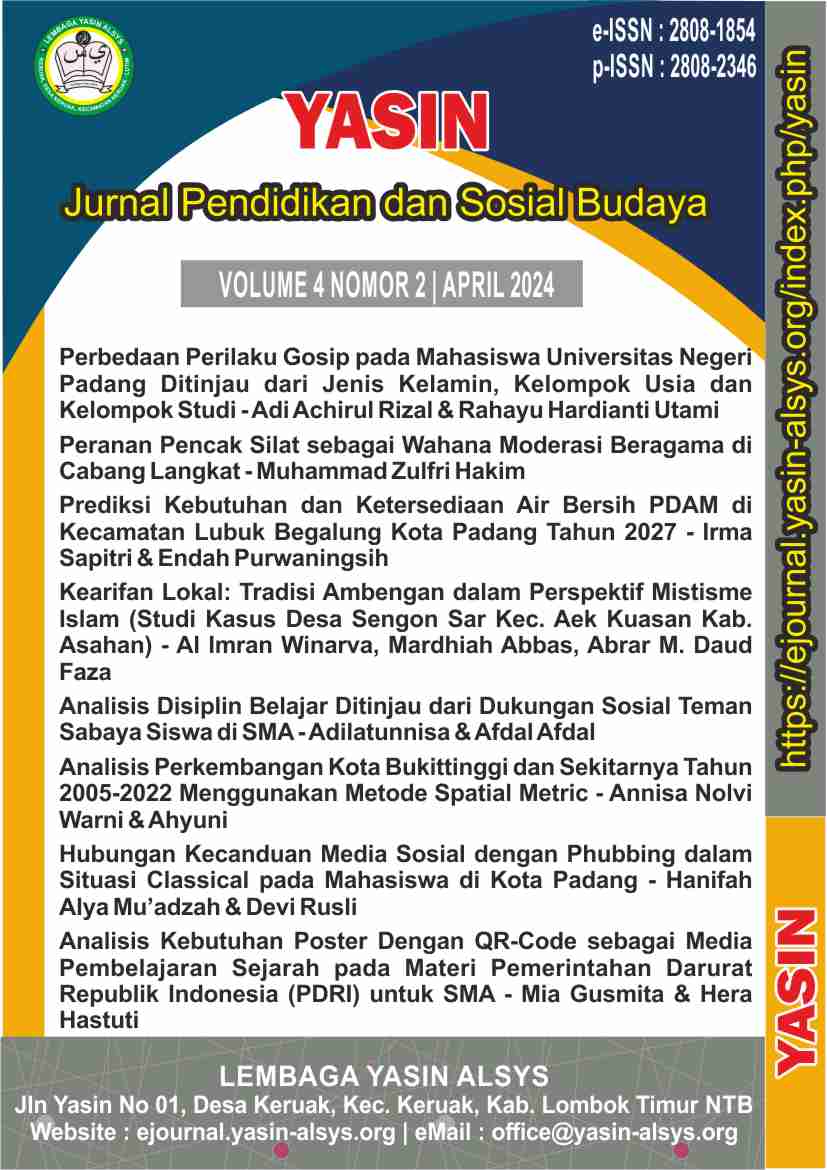
Perbedaan Perilaku Gosip pada Mahasiswa Universitas Negeri Padang Ditinjau dari Jenis Kelamin, Kelompok Usia dan Kelompok Studi Differences in Gossip Behavior Among Students of Universitas Negeri Padang Based on Gender, Age Group, and Study Group
Main Article Content
Abstract
Nowadays social phenomena are influenced by the exchange of information in it. The exchange of information where people gather and talk about building an interaction with others is a collective culture called gossiping behavior (Sulistyowati, 2016). This study aims to look at differences in gossip behavior between men and women, late adolescents and early adults, as well as social and scientific study groups in State University students. The sample collection technique used proportional random sampling technique using the Gossip Functions Questionare (GFQ) scale. The results of the measuring instrument reliability test were 0.865 and data analysis using two-way anova and mann witney. The results showed that there were no differences in gossiping behavior based on gender indicated by a p value = 0.90 (p> 0.05). There is no difference in gossiping behavior based on age group with a p value = 0.602 (P> 0.05) and there is no difference in gossiping behavior based on study group because the p value = 0.321 (p> 0.05).




Citation Metrics:




Downloads
Citation Metrics & Similar Scopus Articles
-
Irawati R. (2027)Enhancing accounting students’ writing performance through problem-based learning: Evidence from a vocational higher education contextMultidisciplinary Science Journal, 9(1)
-
Trisnowati E. (2027)Science, Technology, Engineering, and Mathematics (STEM) and Research Skill Development (RSD) in Science Education in Higher Education: A Delphi-Based ModelAsean Journal of Educational Research and Technology, 6(2), 253-268
-
Wangtaphan W. (2027)From Individual Reasoning to Collaborative Engagement: Continuity of Student Problematic in Grade 1 Mathematical Problem SolvingAsean Journal of Educational Research and Technology, 6(2), 287-300
Article Details

Authors retain copyright and grant the journal right of first publication with the work simultaneously licensed under a Creative Commons Attribution-NonCommercial-ShareAlike 4.0 International License that allows others to share the work with an acknowledgement of the work's authorship and initial publication in this journal.
Article Sidebar
 Page Numbers:
96-107
Page Numbers:
96-107
 Digital Object ID:













 Viewed: 457 times
 Downloaded: 537 times

LYAS Publisher cordially invites qualified professionals to serve as Editors or Reviewers. Your expertise will make an important contribution to maintaining and strengthening the academic quality of our publications. Interested applicants are kindly requested to complete the application form at the following link: Editors & Reviewers


Please feel free to contact us if you need any further information about the submission process or if you have any additional questions.

 Authors:
 Copyright :
Authors retain copyright and grant the journal right of first publication.
Explore Our Journals
Find the journal that best fits your research. If this journal does not match your manuscript’s scope, explore our portfolio below to select a more suitable publication venue.