
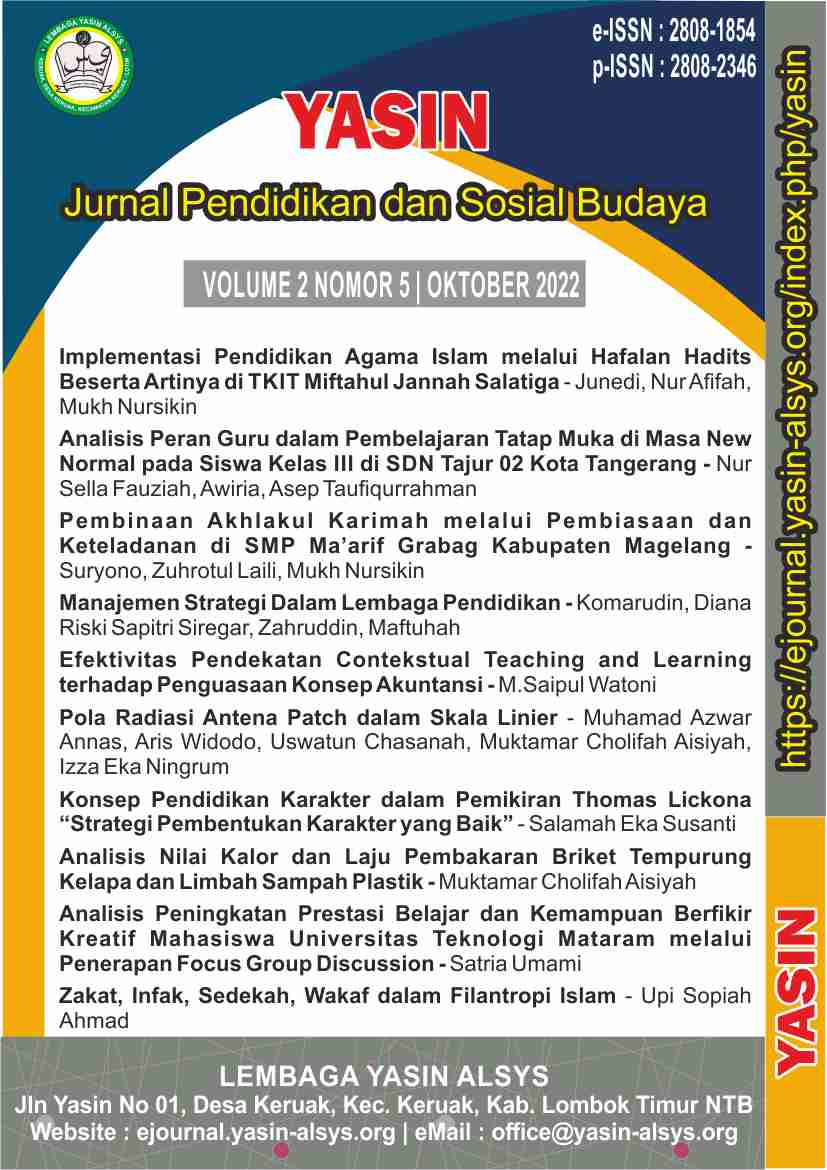
Zakat, Infak, Sedekah, Wakaf dalam Filantropi Islam

Article Sidebar
 Page Numbers:
749-761
Page Numbers:
749-761
 Digital Object Identifier:


 Viewed: 2.616 times
 Downloaded: 4.997 times












LYAS Publisher cordially invites qualified professionals to serve as Editors or Reviewers. Your expertise will make an important contribution to maintaining and strengthening the academic quality of our publications. Interested applicants are kindly requested to complete the application form at the following link: Editors & Reviewers


Please feel free to contact us if you need any further information about the submission process or if you have any additional questions.

 Authors:
Abdiansyah Linge1, Upi Sopiah Ahmad2
 Copyright :
Authors retain copyright and grant the journal right of first publication.
Explore Our Journals
Find the journal that best fits your research. If this journal does not match your manuscript’s scope, explore our portfolio below to select a more suitable publication venue.
Main Article Content
Abstract
One way to use wealth is to implement the concept of philanthropy, this is contained in the Qur'an and then clarified by Allah with the actualization of the Prophet Muhammad SAW, Philanthropy is a concept that already exists in Islam, which aims for goodness (al-birr), seeing the condition of the level of different social and economic aspects of society, the idea or concept of philanthropy is an alternative for a group of people to reduce social inequality between communities. The approach used in this paper is an empirical approach, namely a search based on existing findings. In this context, studies of the concept of Islamic Philanthropy become one way to empower the community in economic activities. This study focuses on the role of ZISWAF as a part of Philanthropy in Islam. The data collection technique used a literature review in the form of collecting books, written materials and references relevant to the theme of philanthropy as an instrument. Furthermore, an analysis of Islamic Philanthropy theories that have an impact on the economic activities of the community is carried out, which is expected to eventually build the concept of Islamic Philanthropy as an effort to reduce social inequality. Referring to the Qur'an and Hadith, philanthropy in Islam is an act of kindness based on faith which is charity. Philanthropy, as a charity, is a very fundamental ethical teaching in Islam. In general, the form of philanthropy in Islam is stated in the concept of zakat and shadaqah. The aim of building togetherness and reducing social inequality is inseparable from the distribution system. In Islam, there are two main distribution systems, namely commercial distribution and following the market mechanism and a distribution system that is based on aspects of community social justice.




Citation Metrics:




Downloads
Citation Metrics & Similar Scopus Articles
-
Susiyanto (2026)Zakat Behavior in Urban Communities: A Sharia-Oriented Phenomenological StudyAl Istinbath Jurnal Hukum Islam, 11(1), 220-214
-
Muqoyyidin A.W. (2026)Inclusive multicultural Islamic education and educational reform in Nurcholish Madjid’s thought a bibliometric and systematic reviewDiscover Global Society, 4(1)
-
Ferdinan (2026)Examining the enactment of digital literacy in Islamic education across two school contexts in Indonesia and ThailandDiscover Education, 5(1)
Article Details

Authors retain copyright and grant the journal right of first publication with the work simultaneously licensed under a Creative Commons Attribution-NonCommercial-ShareAlike 4.0 International License that allows others to share the work with an acknowledgement of the work's authorship and initial publication in this journal.