
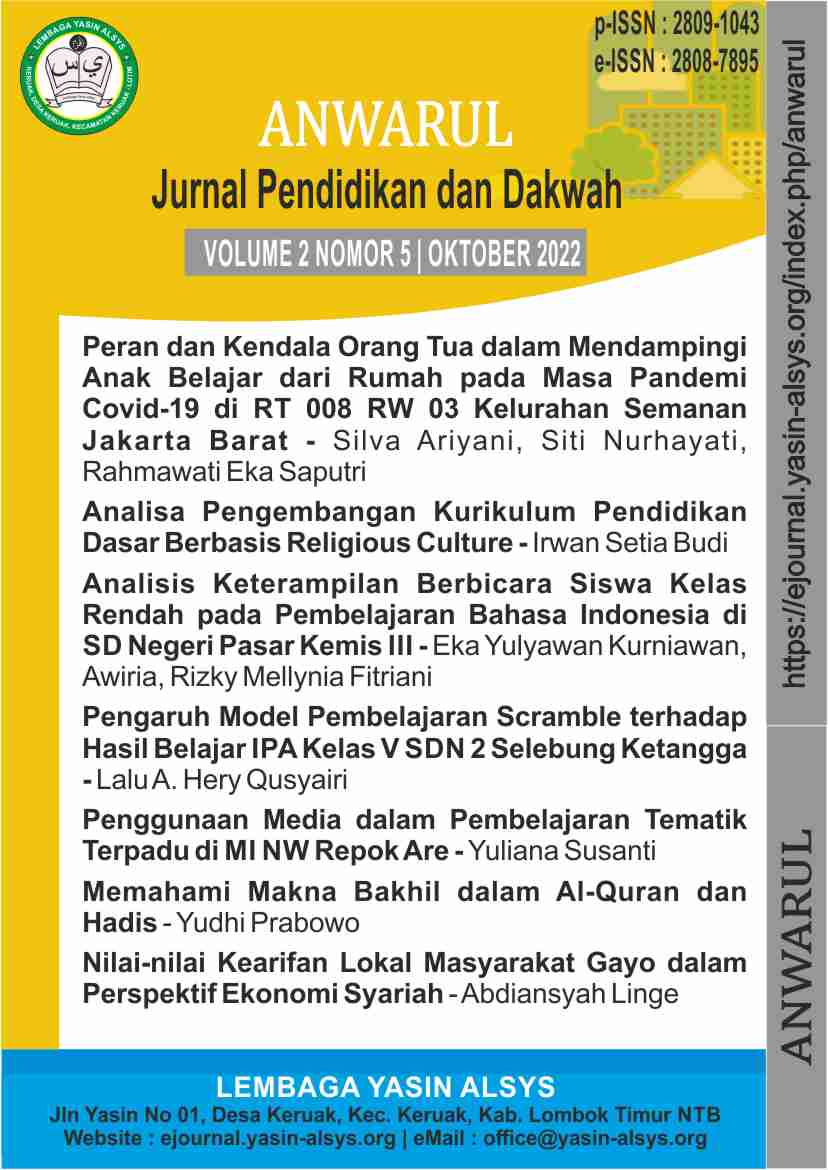
Nilai-nilai Kearifan Lokal Masyarakat Gayo dalam Perspektif Ekonomi Syariah
Main Article Content
Abstract
Entrepreneurship concepts or values based on local wisdom of the Gayo people are the foundation of the behavior of the Gayo community in economic activities, so that sharia entrepreneurial values can be built that originate from the smallest community behavior patterns, namely culture, and can be a driving force for community interest in carrying out economic activities of production and distribution with the value of entrepreneurship. This study uses a micro-ethnographic approach by developing indigenous Gayo linguistics as a concept of sharia entrepreneurship. The integration of spiritual values, planning, sustainability of economic and moral resources is the concept of sharia entrepreneurship in Gayo customary local wisdom.




Citation Metrics:




Downloads
Citation Metrics & Similar Scopus Articles
-
Michou V. (2027)Breathing in harm: current insights into the effects of air pollution on cardiorespiratory healthMedical Gas Research, 17(1)
-
Fazeli F. (2027)The representation of the properties of the social actors in the two poetries of“Aghadar”and “Fokhos”written by Sheevan Foumani in accordance with the socio-semantic model and semio-semantic analysisLanguage Related Research, 17(4), 397-431
-
Arianpour M. (2027)Assessment of Pragmatic Disorders in PersianSpeaking Adults with Acquired Brain InjuryLanguage Related Research, 17(4), 35-70
Article Details

Authors retain copyright and grant the journal right of first publication with the work simultaneously licensed under a Creative Commons Attribution-NonCommercial-ShareAlike 4.0 International License that allows others to share the work with an acknowledgement of the work's authorship and initial publication in this journal.
Article Sidebar
 Page Numbers:
457-466
Page Numbers:
457-466
 Digital Object ID:













 Viewed: 351 times
 Downloaded: 319 times

LYAS Publisher cordially invites qualified professionals to serve as Editors or Reviewers. Your expertise will make an important contribution to maintaining and strengthening the academic quality of our publications. Interested applicants are kindly requested to complete the application form at the following link: Editors & Reviewers


Please feel free to contact us if you need any further information about the submission process or if you have any additional questions.

 Authors:
 Copyright :
Authors retain copyright and grant the journal right of first publication.
Explore Our Journals
Find the journal that best fits your research. If this journal does not match your manuscript’s scope, explore our portfolio below to select a more suitable publication venue.