
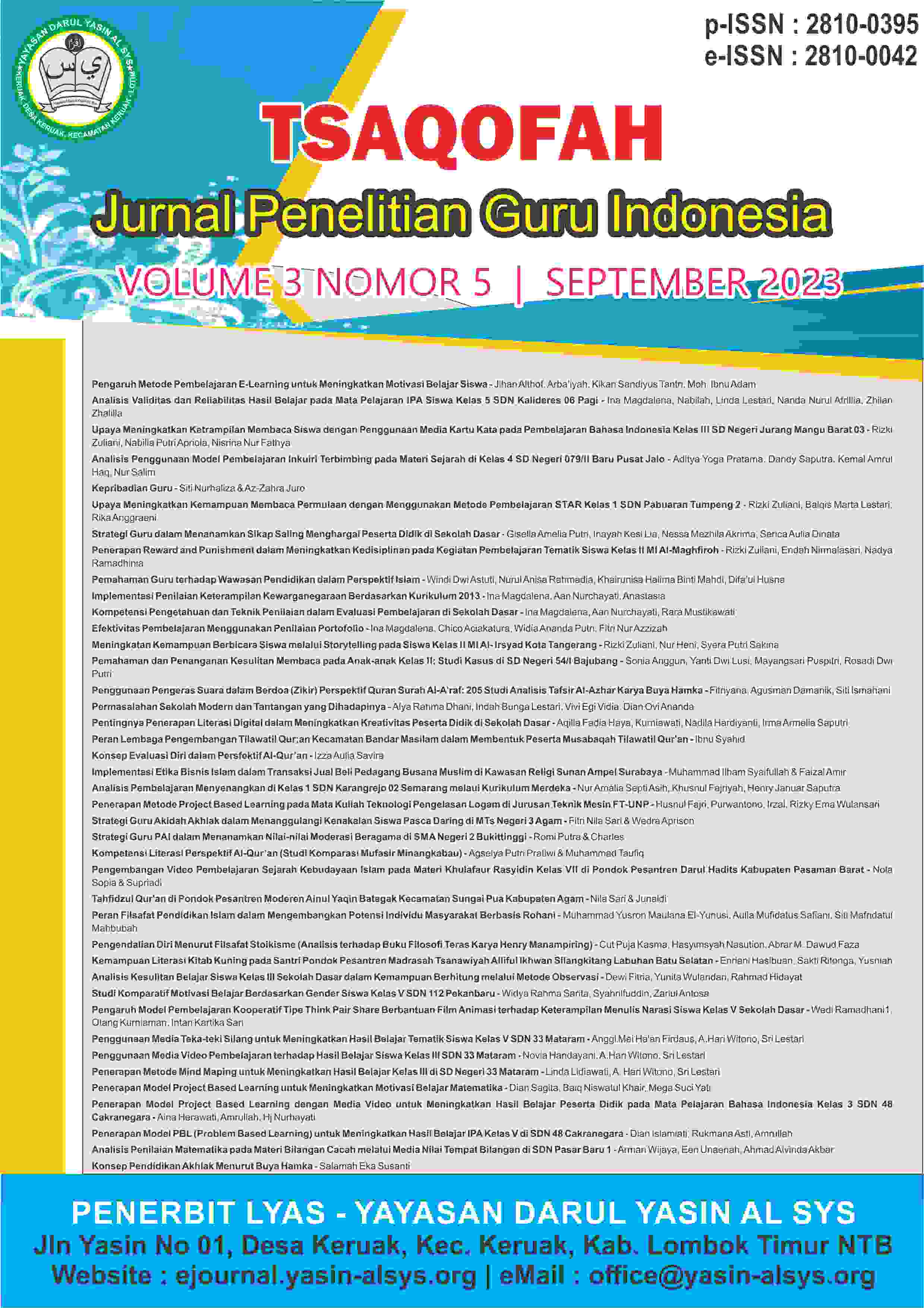
Konsep Pendidikan Akhlak Menurut Buya Hamka The Concept of Moral Education According to Buya Hamka
Main Article Content
Abstract
This research aims to explore moral education from Buya Hamka's perspective and understand the methods used in character development. The method employed is qualitative, specifically library research. The findings suggest that education, according to Buya Hamka, involves inner behavior that can change; thus, when based on religious principles, it leads to good behavior, and vice versa. In the process of character development, parents and educators can utilize methods such as understanding, habituation (ta'widiyah), exemplification (uswatun hasanah), advice (mau’izhah al-hasanah), and storytelling (qishah).




Citation Metrics:



Downloads
Citation Metrics & Similar Scopus Articles
-
Ding S. (2027)Digital Renewal of University Education: Barriers, Opportunities, and Contributions to Sustainable Development Goals (SDGs)Asean Journal of Educational Research and Technology, 6(2), 229-240
-
Irawati R. (2027)Enhancing accounting students’ writing performance through problem-based learning: Evidence from a vocational higher education contextMultidisciplinary Science Journal, 9(1)
-
Sternberg T. (2027)Pastoral Belonging and Educational Opportunity for Mongolian Herder WomenHuman Ecology, 55(2)
Article Details

Authors retain copyright and grant the journal right of first publication with the work simultaneously licensed under a Creative Commons Attribution-NonCommercial-ShareAlike 4.0 International License that allows others to share the work with an acknowledgement of the work's authorship and initial publication in this journal.
References
Azra, Azyumardi. (2012). Pendidikan Karakter Generasi Muda: Peran Sekolah dan Keluarga. Jakarta: Al-Azhar Institute.
Abduddin Nata. (2012). Akhlak Tasawuf. Jakarta: PT Raja Grafindo Persada.
Abdhillah Shafrianto. (2021). Pendidikan Akhlak Dalam Perspektif Buya Hamka, Raudhah Proud To Be Profesional Journal Tarbiyah Islamiyah, Volume 6 Edisi 1 Juni
Nasir Tamara. (1984). Hamka di Mata Hati Umat. Jakarta: Sinar Harapan
Husnul Qodim. (2022). Pendidikan Akhlak Sufi Buya Hamka: Solusi Pembangunan Karakter bagi Generasi Z, Edukasi Islami: Jurnal Pendidikan Islam, Volume : 11/No : 01 Februari
Hamka. (2019). Falsafah Hidup. Jakarta: Republika Penerbit.
Hamka. (2016). Lembaga Budi. Jakarta: Republik
Hamka. (1992). Akhlakul Karimah, Jakarta: Pustaka Panjimas
Abdullah Sani Ritonga Dkk. (2018). Pendidikan Akhlak Dalam Perspektif Hamka (Studi Q.S. Luqman dalam Tafsir Al-Azhar), Edu Riligia: Vol. 2 No.4 Oktober- Desember.
Syamsul Kurniawan dan Erwin Mahrus. (2011). Jejak Pemikiran Tokoh Pendidikan Islam. Yogyakarta : Ar-Ruzz Media
Abdullah Sani Ritonga Dkk. (2018). Pendidikan Akhlak Dalam Perspektif Hamka (Studi Q.S. Luqman dalam Tafsir Al-Azhar), Edu Riligia: Vol. 2 No.4 Oktober- Desember
Zahruddin, Hasanuddin Sinaga. (2004). Pengantar Studi Akhlak, (Jakarta: PT Raja Grafindo Persada
Achmad Mubarok, Akhlak Mulia. (2009). Jakarta: GMPAM-YPC-WAP
Husnul Qodim. (2022). Pendidikan Akhlak Sufi Buya Hamka: Solusi Pembangunan Karakter bagi Generasi Z, Edukasi Islami: Jurnal Pendidikan Islam, Vol : 11/NO: 01 Februari
Samsul Nizar. (2008). Memperbincangkan Dinamika Intelektual Dan Pemikiran Hamka Tentang Dinamika Islam, Jakarta: Kencana.
Sarwan. (2001). Sejarah Dan Perjuangan Buya Hamka Diatas Api Di Bawah Api. Padang: The Minangkabau Foundation.
Article Sidebar
 Page Numbers:
1120-1130
Page Numbers:
1120-1130
 Digital Object ID:













 Viewed: 556 times
 Downloaded: 334 times
LYAS Publisher cordially invites qualified professionals to serve as Editors or Reviewers. Your expertise will make an important contribution to maintaining and strengthening the academic quality of our publications. Interested applicants are kindly requested to complete the application form at the following link: Editors & Reviewers


Please feel free to contact us if you need any further information about the submission process or if you have any additional questions.

 Authors:
 Copyright :
Authors retain copyright and grant the journal right of first publication.
Explore Our Journals
Find the journal that best fits your research. If this journal does not match your manuscript’s scope, explore our portfolio below to select a more suitable publication venue.