
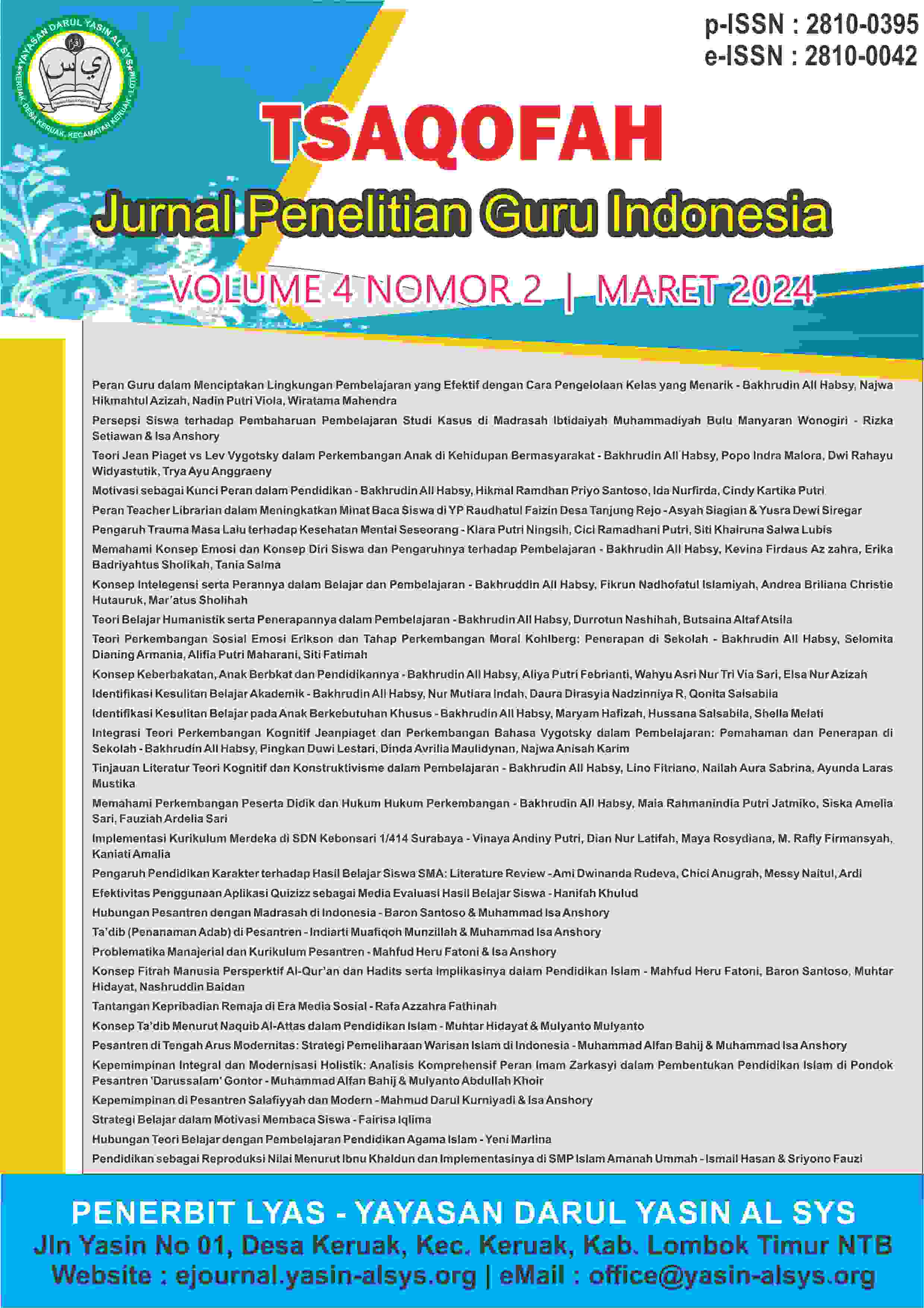
Konsep Fitrah Manusia Persperktif Al-Qur’an dan Hadits serta Implikasinya dalam Pendidikan Islam The Concept of Human Fitrah in the Perspective of the Qur'an and Hadith and Its Implications in Islamic Education

Article Sidebar
 Page Numbers:
845-856
Page Numbers:
845-856
 Digital Object Identifier:


 Viewed: 1.276 times
 Downloaded: 1.156 times












LYAS Publisher cordially invites qualified professionals to serve as Editors or Reviewers. Your expertise will make an important contribution to maintaining and strengthening the academic quality of our publications. Interested applicants are kindly requested to complete the application form at the following link: Editors & Reviewers


Please feel free to contact us if you need any further information about the submission process or if you have any additional questions.

 Authors:
Mahfud Heru Fatoni1, Baron Santoso2, Muhtar Hidayat3, Nashruddin Baidan4
 Copyright :
Authors retain copyright and grant the journal right of first publication.
Main Article Content
Abstract
The concept of fitrah developed by experts today refers more to the purity of a person's soul when born, meaning that it has not been impacted by the ideologies that develop in this life. However, this concept is apparently not in line with the Islamic education concept that fitrah is actually a universal concept of divinity within a person, namely recognizing the monotheism of Allah SWT. Even since the baby was in the womb, every individual has testified to this Unity, regardless of Muslim or non-Muslim families. The concept of fitrah based on the Qur'an was later developed in Islamic education. This research aims to describe the concept of human nature from the perspective of the Al-Qur'an and Hadith and its implications for Islamic education. The research method used is library research. The research results obtained are that the definition of fitrah according to the Qur'an illustrates that humans were actually created by Allah with religious instincts, namely the religion of monotheism. Therefore, humans who do not have monotheistic religion are a form of deviation from their nature. The implication of nature in Islamic education means educating people to deepen their understanding of the Islamic religion, to know Allah, and to know themselves. Thus, fitrah in Islamic education can be interpreted as the command to study the Islamic religion, the command to know Allah, and the command to know oneself, which humans undertake through the process of Islamic education.




Citation Metrics:




Downloads
Citation Metrics & Similar Scopus Articles
-
Fadzli A.I.M. (2026)THE CONSTITUTION OF MEDINA AND THE ORIGINS OF CITIZENSHIP CONCEPT: A CONTEMPORARY REAPPRAISALIium Law Journal, 34(1), 559-604
-
Norihsan N.S. (2026)Feasibility of Post-Quantum Cryptography in Digital Signature Systems: From Theory to Proof of ConceptAsia Pacific Journal of Information Technology and Multimedia, 15(1), 84-98
-
Ran A. (2026)Feminist Body Horror and Abjection in Black Christmas (2019)Gema Online Journal of Language Studies, 26(2), 470-481
Article Details

Authors retain copyright and grant the journal right of first publication with the work simultaneously licensed under a Creative Commons Attribution-NonCommercial-ShareAlike 4.0 International License that allows others to share the work with an acknowledgement of the work's authorship and initial publication in this journal.