
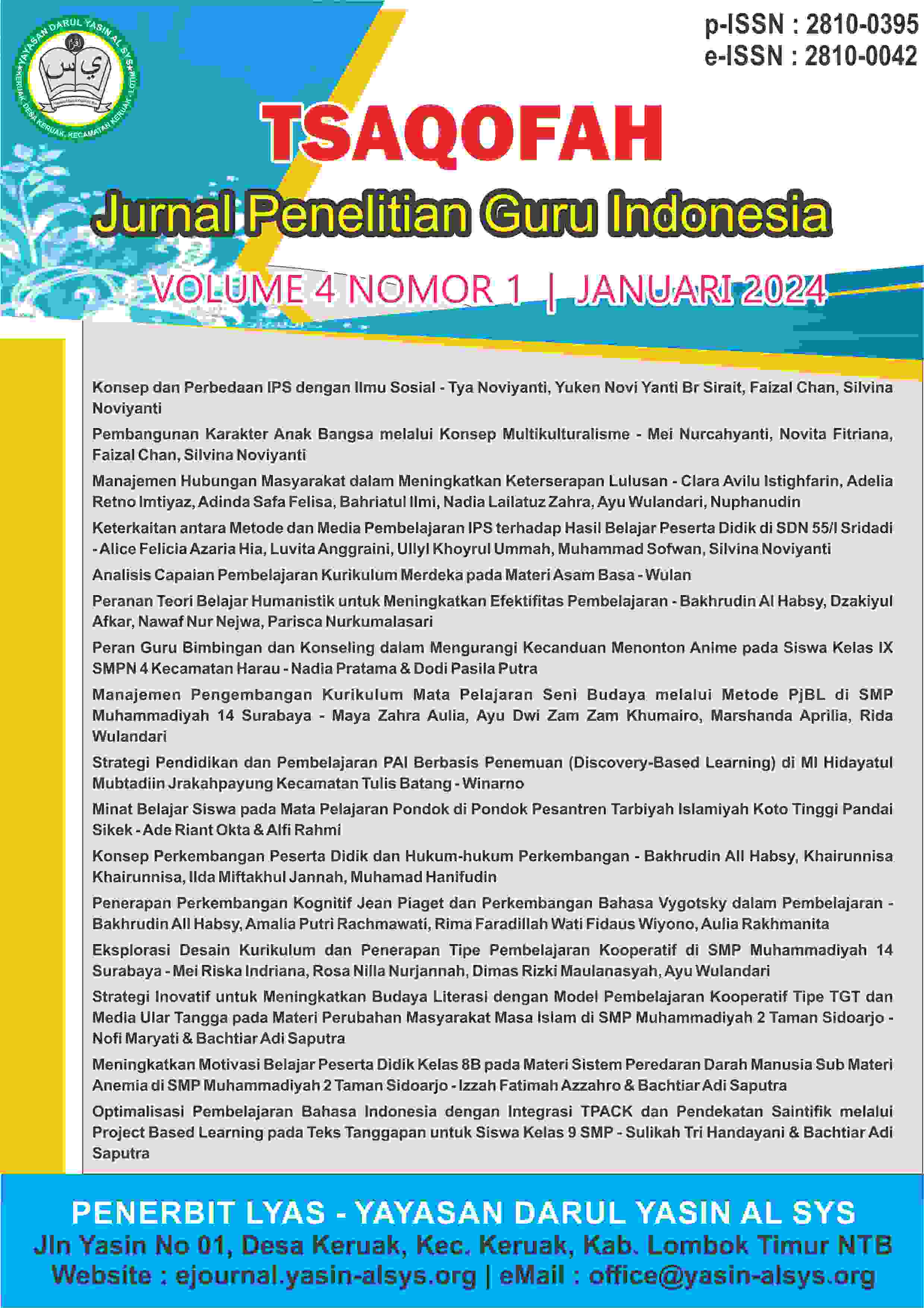
Peranan Teori Belajar Humanistik untuk Meningkatkan Efektifitas Pembelajaran The Role of Humanistic Learning Theory in Enhancing the Effectiveness of Learning

Article Sidebar
 Page Numbers:
66-78
Page Numbers:
66-78
 Digital Object Identifier:


 Viewed: 1.172 times
 Downloaded: 976 times












LYAS Publisher cordially invites qualified professionals to serve as Editors or Reviewers. Your expertise will make an important contribution to maintaining and strengthening the academic quality of our publications. Interested applicants are kindly requested to complete the application form at the following link: Editors & Reviewers


Please feel free to contact us if you need any further information about the submission process or if you have any additional questions.

 Authors:
Bakhrudin Al Habsy1, Dzakiyul Afkar2, Nawaf Nur Nejwa3, Parisca Nurkumalasari4
 Copyright :
Authors retain copyright and grant the journal right of first publication.
Main Article Content
Abstract
In this research, researchers want to examine how to understand humanistic learning theory to increase learning effectiveness. Humanistic education aims to make humans whole so that individuals can understand changes in the environment and themselves by paying attention to human values. In this case, the education model places much hope on the pragmatic value of science and technology, and cannot kill interests and humanity. Therefore, humanities education can help students develop in a better direction and improve their abilities to face life's challenges in the future. In today's digital era, a humanistic approach to education remains relevant and important to implement. In his research, the research method used by the researcher was a quantitative method through library research. The research object of this research is to study humanistic learning theory to increase learning effectiveness. The benefit of this research is to change an individual's attitude or behavior, from what was initially bad because they didn't know it to good. Getting individuals used to acting democratically, participatively, and humanely. The results of this research can be said that by understanding students' learning styles and types of intelligence, teachers can use learning methods, strategies, and models that suit students' learning styles and types of intelligence. Thus, the existence of humanistic learning theory will make learning that takes place in the school environment more interesting and meaningful for students, because students learn using learning styles and intelligence.




Citation Metrics:




Downloads
Citation Metrics & Similar Scopus Articles
-
Ratnaningsih E. (2027)Designing a Data-Driven E-Learning Module for Teaching English to Young Learners: Integrating Needs Analysis and the ISAV Learning ModelAsean Journal of Educational Research and Technology, 6(2), 269-286
-
Unyaphatariyakool S. (2027)Science Teachers’ Learning Management Competency through Professional Learning Communities to Promote Scientific Creativity and Sustainable Development Goals (SDGs)Asean Journal of Educational Research and Technology, 6(2), 241-252
-
Azhand A. (2027)Teaching Persian derivational affixes to non-Persian speakers from a Cognitive Morphology Approach: A case study of nominal suffixes (kar, gar, ban, baz, -ande)Language Related Research, 17(4), 469-497
Article Details

Authors retain copyright and grant the journal right of first publication with the work simultaneously licensed under a Creative Commons Attribution-NonCommercial-ShareAlike 4.0 International License that allows others to share the work with an acknowledgement of the work's authorship and initial publication in this journal.